Syrian souqs: how they are laid out and how to navigate one
The lanes are divided by trade, khan courtyards open off them, the roof is closed and your phone map fails under the vault. The logic of not getting lost.
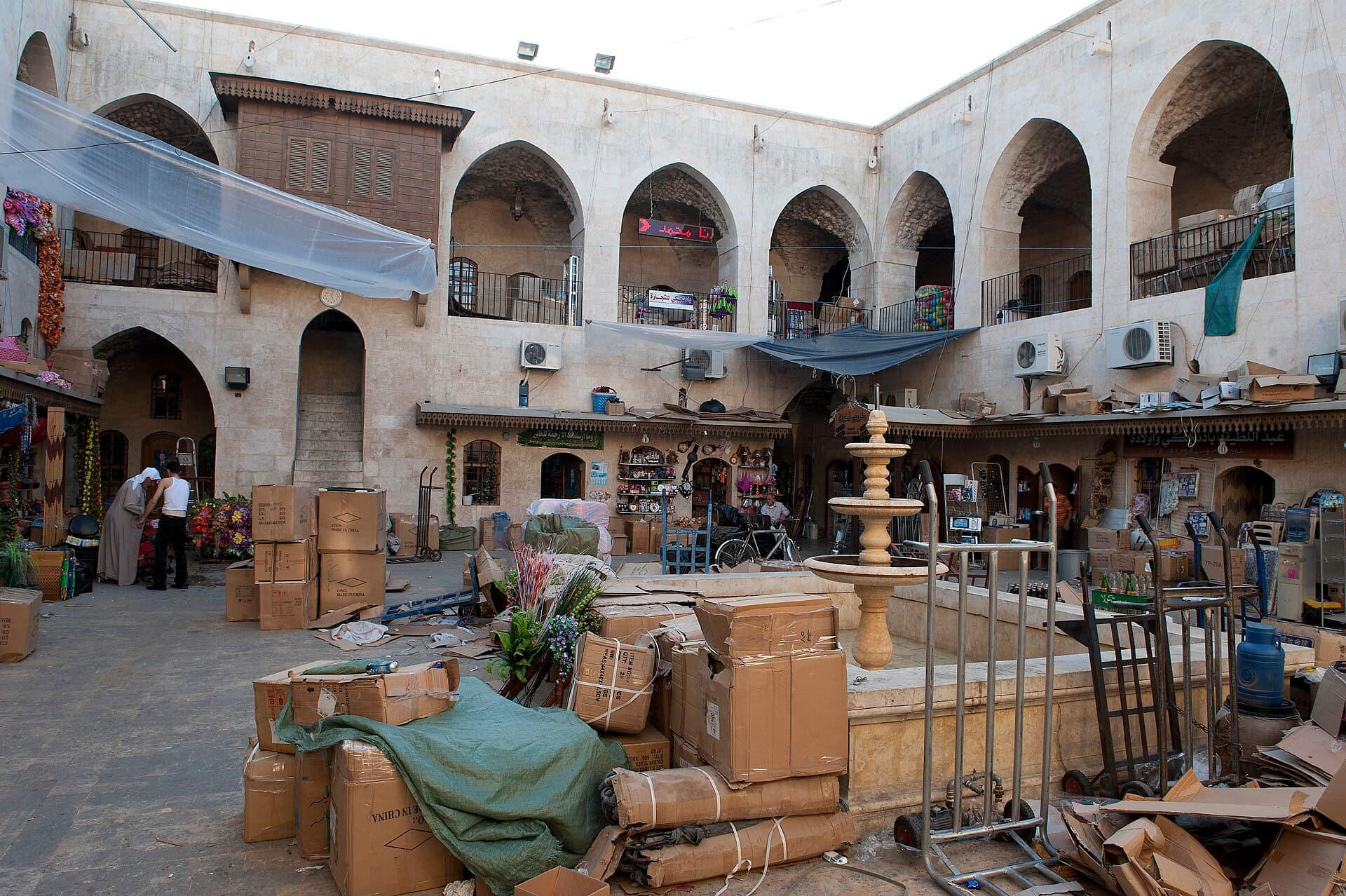
A Syrian souq is an arrangement rather than a shopping street. The lanes are divided by trade, khan courtyards open off them, the whole thing is roofed, and your sense of direction goes within ten minutes. This page covers how a souq is laid out and how to find your way inside one. What to buy and what not to buy is on this section’s shopping page; haggling is on the tipping page.
The lanes are divided by guild
There is one main artery, lanes running off it, and each lane belongs to a trade: coppersmiths, soap makers, spice and herb dealers, cloth merchants, tailors, goldsmiths. The division is not decoration, it is how the place works. Noisy and smelly trades are kept together, fire and hammering are moved away from the mosque, and people doing the same work keep an eye on each other’s quality.
For a visitor the consequence is this: if ten shops in one lane sell the same thing, you are not in the wrong place, you are in exactly the right one. Comparing prices is easy for the same reason — ask three shops and decide at the fourth.
In Damascus the spice and herb lane is Bzuriyya, and the run of cloth and abayas is in Souq Midhat Pasha. In Aleppo the soap makers and the coppersmiths hold separate lanes inside Souq al-Madina.
What a khan is
A khan is a courtyard building set into the souq. Storage and stabling below, merchants’ rooms and lodging above, a well or a fountain in the middle. The gate is single and large: once it shuts at night the khan becomes a box that locks itself. It takes its name either from the goods traded inside or from whoever had it built.
Most khans are now wholesalers’ stores and workshops. Many visitors walk the main artery and never see one, and yet the real architecture of a souq is in those courtyards — two storeys of arcade, a well in the middle, open sky above. Khan As’ad Pasha in Damascus and Khan al-Harir in Aleppo have their own records on this site.
Why it is roofed
The roof is climate rather than aesthetics: shade, insulation and cover from rain. In Aleppo the cover is a stone vault; in the Hamidiyah in Damascus it is arched sheet metal. Either way the light comes in from above as points or shafts, and the level below stays noticeably cooler than the street in summer.
There is also the qaysariyya: a smaller enclosure inside the souq that can be shut separately, used for valuable goods. In most cities the goldsmiths and the silk sellers sit inside a shell like that.
Hours, Friday and Ramadan
The general pattern is opening around 09:00 and closing between 19:00 and 21:00. Many shops pull the shutter down for half an hour at midday prayer; this is normal and short.
On Friday morning most of the souq is shut and things start moving in the afternoon. Giving that morning to a museum or an archaeological site pays better. In the Christian quarter the closed day for some shops is Sunday instead. In Ramadan the pattern shifts: quiet in daylight, and open late into the night once the fast is broken.
Finding your way
Souqs did not sprawl at random; they are strung between two ends. In Aleppo, Souq al-Madina runs from the citadel to the Great Mosque; in Damascus the Hamidiyah comes out at the west gate of the Umayyad Mosque. That one fact solves half the problem — whichever gate you enter by, walking the main artery in one direction brings you out at an end.
- Keep going one way. Doubling back into the same lane is the easiest way to lose yourself.
- Do not trust the phone map. Under the vault the location signal drops and the map places you a lane or two off.
- Ask a shopkeeper, not someone pulling customers in at a door. The man behind the counter knows where things are and is not going anywhere.
- Directions come in shops, not metres: “past the coppersmiths, right at the second arch”. Write it down or have it repeated.
- Pick a landmark. A gate, a dome, a clock tower. Look for it on the way out.
- Lanes can be closed. Repair work continues in Aleppo and sections reopen in turn; do not hesitate to ask.
Walking in the crowd
Motorbikes, handcarts and porters use the main artery, so walking at the side is both safer and easier. Carry your bag in front and keep the phone out of an open pocket. The crush peaks in the late afternoon; for a calmer walk go in the morning as the shutters go up.
Carry cash and small notes, cards are not taken. Do not go through the goods on a stall yourself — cloth and soap are handed to you. If tea is offered, accepting it puts you under no obligation.
Not every souq does the same job
The four souqs of Damascus do four different things, and knowing which is which makes the day easier to plan. The Hamidiyah is the main artery and the busiest. Midhat Pasha is more local: cloth, abayas, thread and buttons. Bzuriyya is spices and herbs. Jazmatiyya, in the Midan quarter, is a food street working for the city rather than for visitors, and the sweet shops are concentrated there.
In Aleppo the distinction is simpler: Souq al-Madina is one large network and the lanes inside it divide by trade. Walking it end to end without stopping takes half an hour, and nobody does it in half an hour.
Tips
- Walk the main artery one way; doubling back is the shortcut to being lost
- Phone maps fail under the vault — ask a shopkeeper instead
- Step into the khan courtyards off the side lanes; that is the real architecture
- Most shops are shut on Friday morning and open in the afternoon
- Walk at the side: motorbikes and handcarts use the middle
Transparency
- How this was chosen
- This page carries the fastest-ageing information on the site: visa rules, exchange rates, border crossings and SIM prices change several times a year. The verification date above says when the facts were last put through their sources; for anything later, check your own foreign ministry travel advice and a Syrian consulate. No figure that is not known for certain is written here.
- Facts checked
- August 2026
- Last updated
- September 15, 2026