Shopping and souvenirs: what to buy, what not to
Laurel oil in the soap, the reverse side of the brocade, a fingernail on the inlay. Antiquities are the hard line: buying or exporting one is a crime.
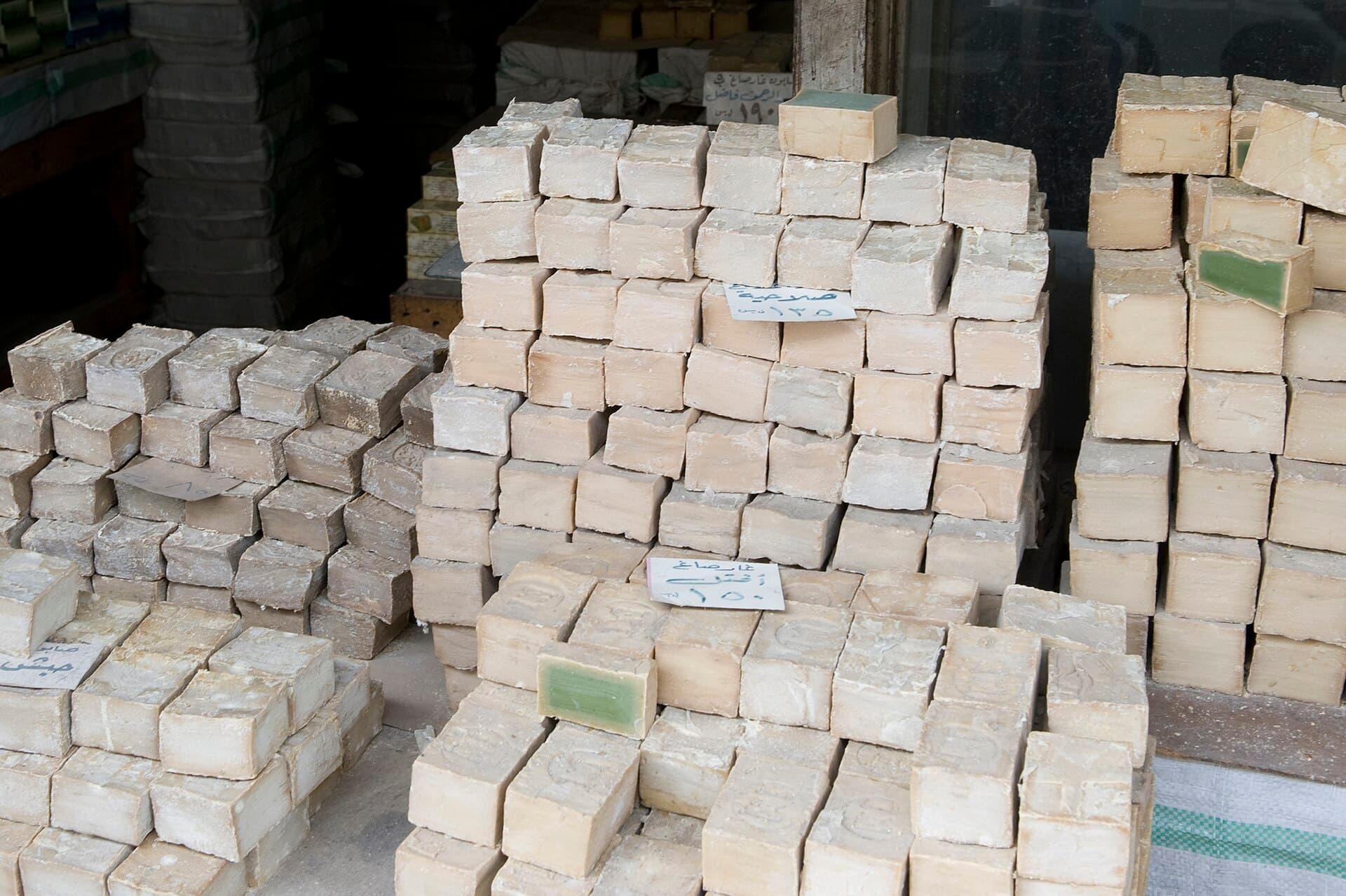
Buying a souvenir in Syria is easy. Two things are not: telling what was actually made there, and knowing what may not leave the country. The second one is serious — an antiquity is not a keepsake question but a criminal one.
Aleppo soap
A soap built from olive oil, laurel berry oil and ash. What separates one bar from another is the share of laurel oil: it usually runs between 2 and 20 per cent, and anything above 16 per cent counts as high grade. As the share rises the colour darkens, the smell sharpens and the price multiplies.
How to check: look at the cut face of the bar. The outside should be pale gold and the inside green, which shows the bar was aged for at least 6 months. If the seller cannot tell you the percentage, or quotes the same price for every bar, the share is low. It is a heavy gift, so plan your luggage around it.
UNESCO added the craft of Aleppo ghar soap to its intangible cultural heritage list in 2024. Some of the workshops that stopped during the war are running again.
Brocade and silk
Damascene brocade is woven on silk with gold- or silver-wrapped thread, and a metre of it takes days on a hand loom. That is why the real thing is expensive; the cheap version is machine-woven and often polyester. The practical test is the reverse side: on hand weaving the pattern reads from the back too, and the thread ends sit unevenly.
Tablecloths and cushion covers travel well, and you can buy the cloth by the metre. In Damascus the Al-Hamidiyah Souq and the khans around it are the centre of the trade.
Mother-of-pearl inlay
Shell, bone and ebony are set into walnut or rosewood. On a good piece the inlay sits flush with the surface: run a fingernail across it and you feel nothing. On a poor one the shell is glued on and the edges catch. Boxes, chess boards and mirror frames are the most portable forms.
Wood moves when the climate changes. A box carried from a humid city to a dry house may develop a stiff lid. That is not a fault. It is the wood.
Copper and brass
Tinned copper trays, coffee pots and bowls are still beaten by hand in the markets and still used in kitchens. If you mean to cook with one, check that the tinning is sound; untinned copper and food do not get on. For display it makes no difference.
Weight decides things here too. A large tray will not go in hand luggage and crushes everything else in a case.
Spices, olive oil and sweets
Aleppo pepper, zaatar, sumac, black seed and rose water are cheap, light and genuinely used in cooking. Olive oil comes from Idlib and the coast and is sold in tins; it cannot go in the cabin and has to be wrapped so it cannot leak in a case.
Pistachio pastries and paper-thin halva travel, but they suffer in heat, so buy them on the day you fly. In Damascus the Al-Bzouriyah Souq is the centre for spices; in Aleppo the repaired sections of the Al-Madina Souq are trading.
Antiquities: the hard line
Do not buy an antiquity and do not take one out of the country. Coins, pieces of mosaic, inscribed stone, fragments of sculpture, oil lamps, seals — anything that came out of the ground is covered. Syria is a party to the 1970 UNESCO convention. The United States placed import restrictions on Syrian archaeological and ethnological material in 2016, and comparable restrictions are in force elsewhere.
The exposure is not one-sided either: Syrian customs on the way out, your own customs on the way in. A fake will not save you — if the officer believes the piece is genuine the same investigation opens, and you are the one carrying it.
The measure is this: buy what was newly made, from a seller you can name, with a receipt you can be given. Do not buy the piece that comes with the story about a grandfather.
Bargaining
Bargaining belongs in the markets, not in a fixed-price shop. The rule is simple: hear the price, answer with one of your own, meet in the middle, and do not back out once you agree. If you cannot agree, thank the seller and walk — being called after is part of the process.
The glass of tea belongs to hospitality, not to the bargaining. Drinking it puts you under no obligation to buy.
Do not buy the first time you see something. The same goods are usually three doors down as well, and hearing a second price is the most useful move you have. If you came with a guide, price may include the guide’s share.
Price, payment and carrying it home
Payment is cash. Cards are not taken, there is no paying online, and small notes make everything easier. Two zeros came off the pound at the start of 2026, so do not read old online prices as today’s.
Settle the terms before you hand anything over: which currency, what the total is, whether packing is included. No record on this site carries a fixed price, and this is why — in a moving currency a written price turns into wrong information within months.
Carry the fragile things yourself. Inlaid boxes and glass go in your hand; soap, trays and olive oil go in the case.
Tips
- Check the cut face of the soap: gold outside, green inside
- Laurel oil runs 2 to 20 per cent; above that mark is high grade
- Judge brocade from the reverse; test inlay with a fingernail
- Buy no antiquities and export none — coins and mosaic included
- Payment is cash; agree currency and total before you buy
Transparency
- How this was chosen
- This page carries the fastest-ageing information on the site: visa rules, exchange rates, border crossings and SIM prices change several times a year. The verification date above says when the facts were last put through their sources; for anything later, check your own foreign ministry travel advice and a Syrian consulate. No figure that is not known for certain is written here.
- Facts checked
- August 2026
- Last updated
- September 15, 2026