Coffee, tea and the Syrian coffeehouse
Bitter murra against Damascene coffee, how the tea is brewed, water-pipe etiquette and what a coffeehouse is for. A small shake of the cup means enough.
A Syrian coffeehouse sells the right to sit rather than something to drink. One tea holds a table for hours and nobody waits for you to leave. This page covers what to say when you sit down, how each thing is drunk and how the water pipe works.
Two different coffees
One word covers two drinks, and mixing them up is common.
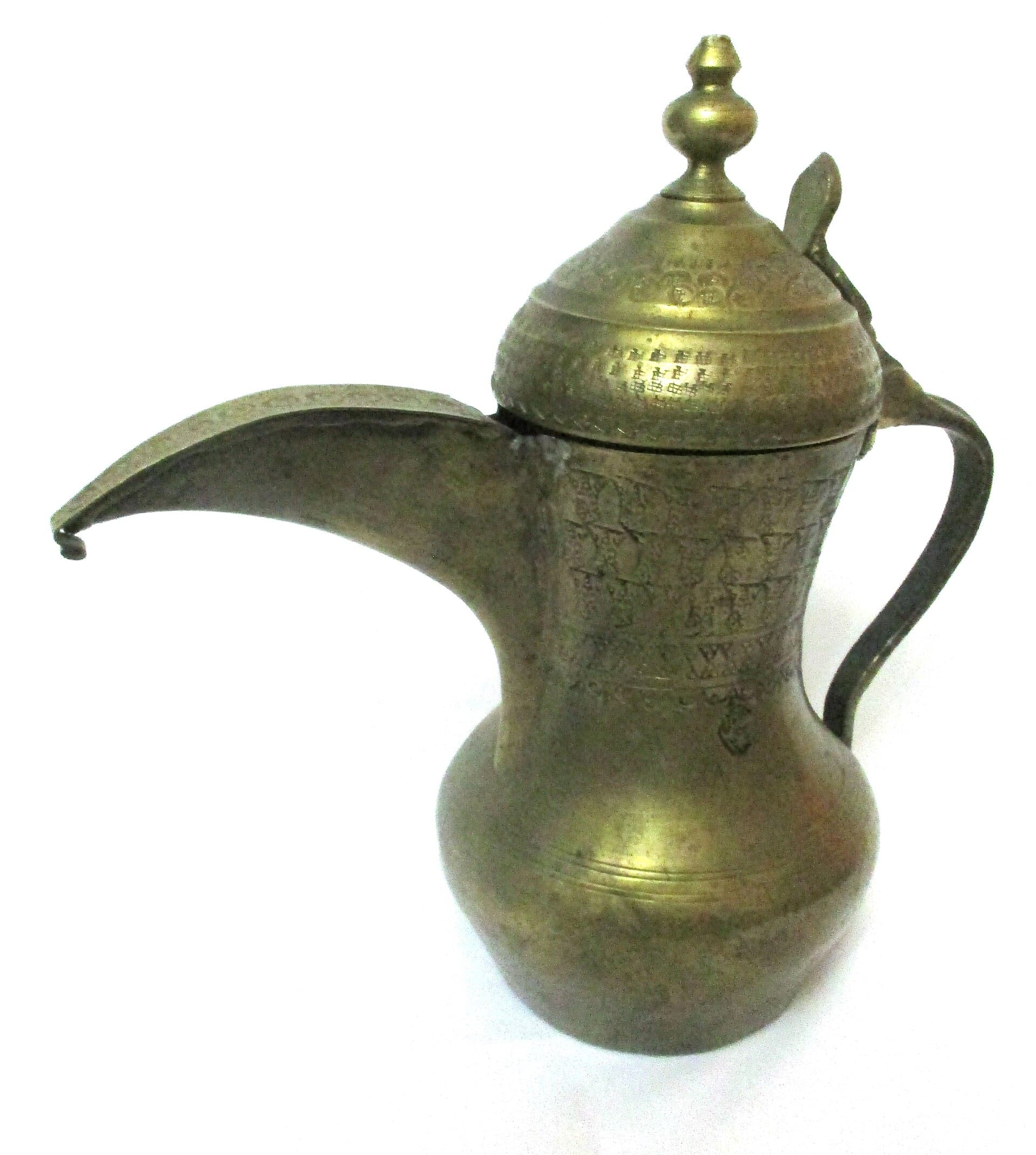
Murra — the name means bitter. It comes from Bedouin practice: heavy on cardamom, pale gold, no sugar. It is poured from a long-spouted pot, the dallah, into a small handleless cup, and the cup is never filled — a mouthful goes in and is topped up as long as you keep holding it out. It is known as the coffee of hospitality and of condolence, and you will meet it in a home or a guest room more often than in a coffeehouse. After two or three cups, a small shake of the cup from the wrist means enough, thank you. You do not have to refuse in words.
Damascene coffee — grounds left in, cooked in a small pot, close to what is called Turkish coffee. The sugar is settled when you order: sada unsweetened, wasat medium, hilweh sweet. Cardamom goes into this one too, in smaller measure. In a coffeehouse this is usually what arrives.
How the tea comes
Tea comes in a small waisted glass, dark and sweet. In the coffeehouses of Damascus the method is plain: long-brewed and rested — the name for it is shay hamir. You can ask for mint (shay bi-na’na), which is common on summer evenings.
Settle the sugar at the start. The default is sweet and it arrives with the sugar already in; if you want less, say so when you order, because it cannot be fixed afterwards. Along the coast people also drink mate, and there a mate set may come to the table instead of tea.
Water-pipe etiquette
The pipe is set in the middle of the table and an attendant looks after the coals. A few signals cover everything.
- Ask for a disposable plastic tip; say so if one is not offered. That is what it is for on a shared hose.
- The hose is not handed person to person. It is put down and the next person picks it up.
- When the coal fades, call the attendant. Do not handle the charcoal yourself.
- Cigarettes are not lit from the pipe. Nobody says it out loud, and nobody does it either.
- You will be asked which tobacco: the two-apple blend is the default, mint and lemon are common too.
Indoors the smoke sits heavy, and in many places the outside or open section is more comfortable.
What a coffeehouse is for
Historically it was the quarter’s noticeboard and hiring hall: a master looking for an apprentice, someone needing a van, a piece of news working its way from table to table. Backgammon and chess are part of that arrangement — the game is the excuse, the reason is staying at the table.
The function has not disappeared. It is still the place people meet without arranging it, and the prices are kept low enough to be open to everyone. This site covers three Damascus coffeehouses separately: Nawfara below the Umayyad Mosque, Rawda on Abed Street and Kamal on Mutanabbi Street. All three serve tea, coffee and the water pipe only; no food is expected.
The storyteller: the hakawati
The oldest performance in a coffeehouse was a man climbing onto a high chair and reading from a book. The reader is a hakawati and the repertoire is fixed: the epics of Baybars, of Antar ibn Shaddad and of the Bani Hilal. A reading runs half an hour a night and stops at the worst possible moment, picking up there the next evening. A single epic therefore takes months.
The audience is not silent. When the hero is cornered, people call out; when the villain arrives, the room grumbles. The reader expects this and paces himself to it.
The tradition all but died out with the spread of television in 1960; epics read in dozens of Damascus coffeehouses lost to the screen within a few years. Today the places where a hakawati can be heard regularly can be counted on one hand. For where and at what hour, see the Nawfara record — that detail is kept current there, not here.
Women in coffeehouses
The traditional popular coffeehouse is largely a male room and still is. In the big central places and in modern cafés women customers are ordinary; in a small neighbourhood coffeehouse down a narrow lane there are almost none.
For a foreign woman the practical position is this: going is fine, being noticed is certain. The reception is usually the treatment given to a guest, not discomfort. What helps: taking a table outside or in the open section, going in daylight, and starting somewhere busy rather than trying a small place alone first. This section’s page for women travellers goes into it further.
Practicalities
You pay at the end; a tally is kept at the table or the glasses are counted. Ask the price before you sit, especially for the pipe, which can be several times the price of a tea. Carry cash, cards are not taken. Tips are small and optional.
Hours are wide: most places open early and close late. Friday morning is quiet, late afternoon and evening are the busiest. In Ramadan the pattern inverts and the crowd comes after the fast is broken.
Tips
- With murra, a small shake of the cup means enough, thank you
- Settle the sugar when ordering: sada, wasat, hilweh — it cannot be fixed later
- Ask for a disposable tip; the hose is put down, not handed over
- Ask the price of the water pipe before sitting; it can be several teas
- No food in a coffeehouse — tea, coffee and the water pipe
Transparency
- How this was chosen
- This page carries the fastest-ageing information on the site: visa rules, exchange rates, border crossings and SIM prices change several times a year. The verification date above says when the facts were last put through their sources; for anything later, check your own foreign ministry travel advice and a Syrian consulate. No figure that is not known for certain is written here.
- Facts checked
- August 2026
- Last updated
- September 15, 2026