Day trips from Homs
Krak des Chevaliers and Lake Qattinah, the villages of Wadi al-Nasara, Qatna and Kadesh, the Orontes to Hama. How long each takes, finding a car, and when not to go.
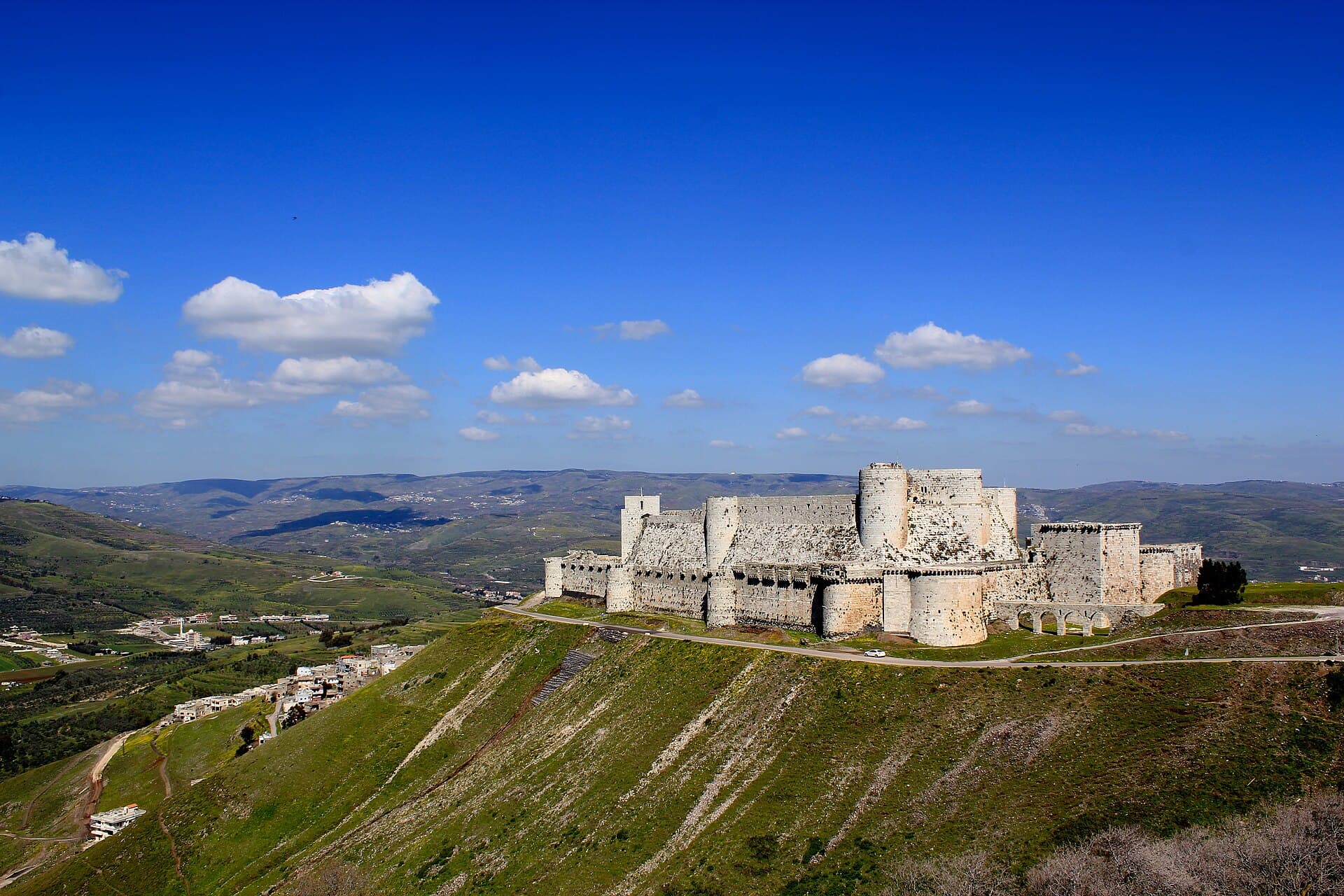
On this site Homs mostly appears as a base: it is the nearest large city to Krak des Chevaliers and the Valley of the Christians. The city itself takes half a day; the real days are outside it. To the west, the castle guarding the gap and the villages of the valley; to the northeast and southwest, two Bronze Age cities; to the north, the Orontes valley to Hama. This page collects distance, time and transport for each trip, and every place on it has a record on this site.
How to find a car
Homs has two intercity garages, the South Garage and the North Garage. But most of the stops on this page are villages or open sites, and public transport between the valley villages is sparse. In practice there are two ways: a car with a driver hired by the day, or the domestic tour offices that the tourism directorate licenses for trips in and around Homs. In July 2026 the Homs director of tourism said the province had 51 places to stay and 237 restaurants and roadside facilities, and that the number of foreign and Arab guests in 2026 was up on the year before.
This page gives no fares. On 13 September 2026 diesel went up from 125 to 175 new pounds, and minibus and bus fares are being recalculated. Agree the daily rate, the hours and the waiting time with the driver before you get in.
West, half a day: Krak des Chevaliers and Lake Qattinah
The shortest trip and the one most people make. Krak des Chevaliers stands 60 to 65 kilometres west of Homs, in the Valley of the Christians, on a 650-metre hill; an hour by car. Lake Qattinah is on the same road, and a tea stop on the shore takes half an hour. The route Homs to Krak des Chevaliers in half a day starts at the Khalid ibn al-Walid Mosque and covers 80 kilometres in three stops; you leave in the morning and are back in Homs for dinner. The castle is open 09:00–17:00 and its inner courtyard falls into shade in the afternoon, so leaving the castle until last pays off.
West, a full day: the Valley of the Christians
For anyone who wants to see Krak without cutting it off from its surroundings. The valley with its 32 villages, Saint George’s Monastery and, at the end of the day, the castle: a day in the Valley of the Christians covers 110 kilometres in all. Drive through the villages rather than along the main road. Reach the monastery before noon, because the courtyard fills up in the afternoon. Public transport between the villages is sparse, so this day needs a car with a driver. Marmarita sits at 850 metres, 55-60 kilometres from Homs; a more detailed day in the villages is on the route from Marmarita to Mizyeneh.
Northeast and southwest: Qatna and Kadesh
Two Bronze Age capitals lie on opposite sides of the city: Qatna 18 kilometres to the northeast, and Tell Nebi Mend, the mound of Kadesh, 24 kilometres to the southwest on the bank of the Orontes. There is no direct road between them. The day loops back through Homs, covers 127 kilometres and ends at the Homs Museum, where most finds from both sites are kept; the plan is on the route Qatna and Kadesh. Neither mound has shade or signposts.
The Kadesh direction is sensitive to rain. According to a report dated 27 April 2026, the Orontes flooded in heavy rain and some roads in the al-Qusayr countryside were closed. After a wet week, check that the southwest road is open.
North: the Orontes valley to Hama
Hama is 45 kilometres away on the M5, but the value of this trip lies on the way. The route starts at the mound of Homs citadel, goes to Lake Qattinah, then through al-Rastan to Shayzar, and reaches the norias of Hama in the late afternoon: 140 kilometres and one way only, with the night spent in Hama. To return to Homs instead, spend half a day in Hama and drive back on the M5 in 45 minutes.
East: Palmyra is not a day trip
There is a direct minibus to Palmyra from the Homs South Garage, and the ride takes two and a half hours each way (December 2025). The journey there and back plus the site do not fit comfortably into one day, and the desert road has rules of its own. The details are on the page how to get to Palmyra.
When not to go
Crowded days. The villages of the valley fill up for the feasts on 6 May and 14 September, and on 14 August the Marmarita carnival is the busiest day of the year. On these dates, arrange your room and your car in advance.
Security incidents. On the evening of 1 October 2025 there was an armed attack outside the mukhtar’s office in the village of Anaz in the valley; according to the Homs internal security commander, three young men were killed. Roads were closed in the villages and a general strike was held, and calm returned the next day. English-language sources that compile the events say the Syrian Observatory for Human Rights reported two people killed in the valley on 23 December 2025. A compilation by 7al.net says 8 people were killed in Homs province in the first two weeks of May 2026; one was a bus driver on the Talkalakh–Tartus line, killed at his home in the western countryside.
None of these incidents means a road has closed for good, but they are reason enough to ask your hotel owner or guide about that week’s situation. Nobody sets out on intercity roads at night, and the return from the valley is planned for before dark.
Tips
- Leave Krak until last; the inner courtyard is in shade in the afternoon
- Hire a car with a driver for the valley villages; public transport is sparse
- On 6 May, 14 August and 14 September, book your place in the valley ahead
- After a wet week, check that the road to Kadesh is open
- Agree the fare before you get in; fares changed in September 2026
Transparency
- How this was chosen
- This page carries the fastest-ageing information on the site: visa rules, exchange rates, border crossings and SIM prices change several times a year. The verification date above says when the facts were last put through their sources; for anything later, check your own foreign ministry travel advice and a Syrian consulate. No figure that is not known for certain is written here.
- Facts checked
- September 2026
- Last updated
- September 15, 2026