Syrian desert truffle (kamaa)
A wild truffle that swells under the desert floor after winter rain. It reaches the markets of Palmyra, Homs and Deir ez-Zor between February and April.
- Where to eat it
- Sold by weight at the markets of Palmyra, Homs, Hama, Raqqa and Deir ez-Zor between February and April; out of season it is not available.
- Price
- Variable — sold by weight, and the price swings from year to year with the winter rain; ask at the market
- When it is eaten
- February to April, in the first weeks after a wet winter
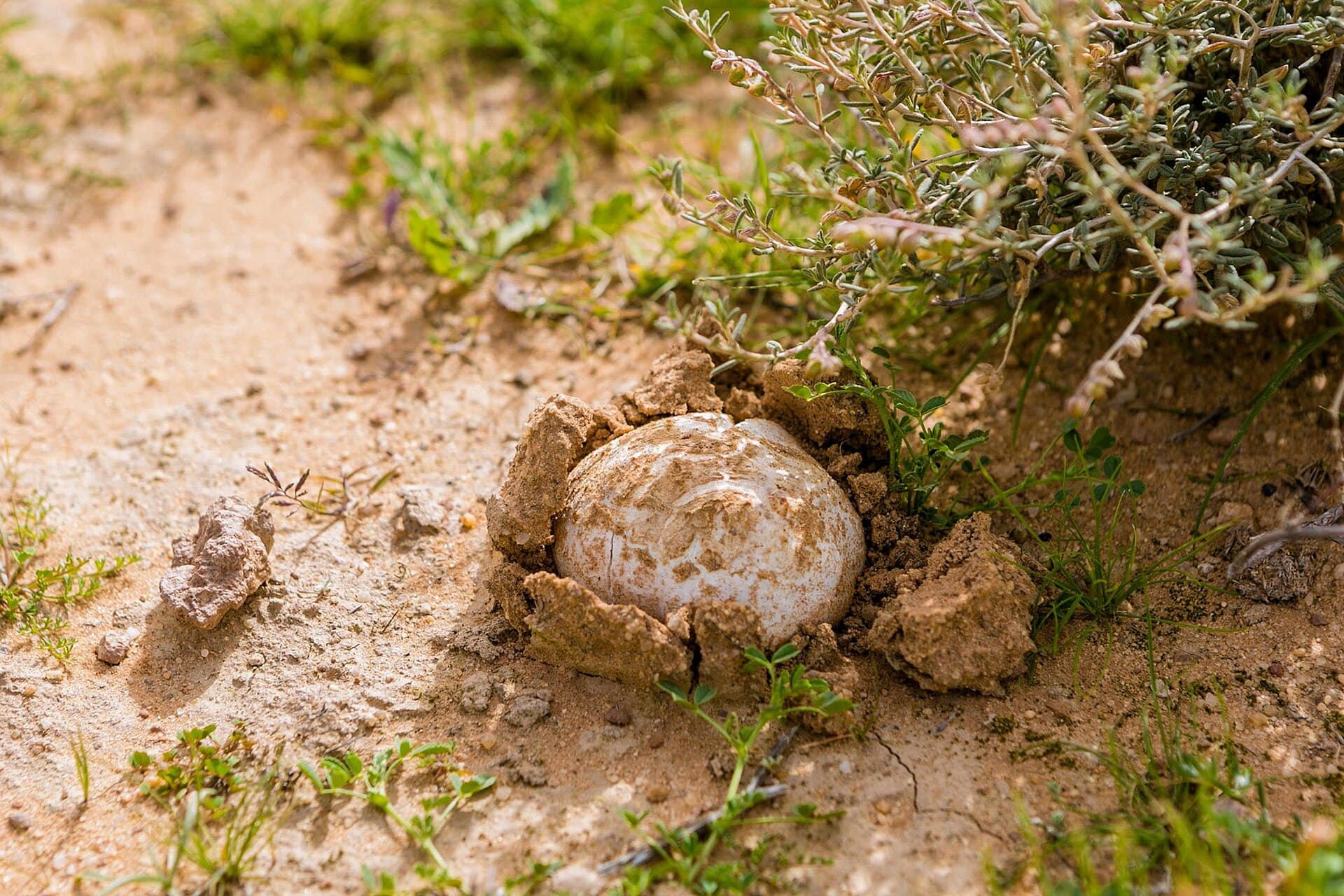
Kamaa is a wild truffle that ripens underground in the desert after the winter rain. The soil above it cracks and lifts, and the gatherer reads that crack and digs. The truffle sits between 5 and 15 centimetres down and weighs anything from 30 grams to 300 — some the size of a hazelnut, some of an orange. In Syria the season is early spring, and outside those few weeks it simply is not there.
How it is found
You do not see the truffle. You see what it does to the ground. Growing underneath, it pushes the surface up and leaves a thin crack or a small dome in the drying soil. Gatherers know that mark and dig by hand. A dry winter means a thin season and a higher price on the stall, so a good year depends directly on how much rain fell.
The varieties
They are sold by name. Zubaidi runs pale and is the largest; hallasi is red and smaller, and in some districts is rated above zubaidi in both flavour and price. Jibi is a very small red so dark it reads as black. Hobar is black outside and white within; it surfaces before the true kamaa and is taken as its signal, and it is also the lowest grade. Whichever name the seller uses sets the price.
Where and when it is sold
It is gathered in the Badiya and comes down to the markets of Palmyra, Homs, Hama, Raqqa and Deir ez-Zor. It is sold by weight, laid out on the stall with the soil still on it, and buyers pick by size and type. The season is a narrow window between February and April. For anyone in Palmyra in those months it is a real sight in the market; for the rest of the year there is nothing to see.
The gathering grounds are not safe
This part is better stated plainly. The gathering grounds lie inside the Badiya, and that ground is both mined and insecure. In 2023 an attack on gatherers in the desert near al-Sukhnah killed 61 civilians, and in the same year 36 gatherers were killed in the desert of Hama. The practical meaning is simple: the truffle you see in the market is safe, the place it came from is not. Do not go out into the countryside to look for it, and read the security and where-to-go guides on this site before planning anything of the kind.
Tips
- The window is short; before February and after April there is no point looking
- Ask which type it is — zubaidi, hallasi, jibi and hobar are priced apart
- It is sold with the soil on; some of the weight is earth, so ask for it cleaned
- Do not go gathering yourself: the grounds are mined and insecure
Transparency
- How this was chosen
- Two kinds of record live here: the dish itself, and the place that serves it. Both are chosen and written by hand; ranking is not for sale and there are no sponsored entries. If a price range is not known for certain, it says so. Venues that serve alcohol are not listed on this site at all.
- Facts checked
- September 2026
- Last updated
- September 15, 2026