Havana Café
On Port Said Street since 1945: the poets’ coffeehouse, backgammon tables, a Damascene breakfast. Expropriation saved it from becoming shops in the 1980s.
- What to order
- Arabic coffee beside French and Italian style brews; a Damascene breakfast in the morning — hummus, fatteh, ful
- Price
- Cheap; people sit for hours over one glass of tea — ask the price at the door
- Opening hours
- Variable — said to run from breakfast until late, confirm at the door
- Duration
- 60 minutes
- Best time
- Quiet at breakfast time; full from late afternoon on
A two-storey coffeehouse stands where Port Said Street meets Argentine Street, on the stretch between Yusuf al-Azma Square and the Hijaz railway station. It opened in 1945. For half a century the writing, arguing side of Damascus sat in this hall, and the photographs on the walls still show those regulars. Backgammon and chess on the tables; tea, coffee and nargileh on the trays.
Getting there
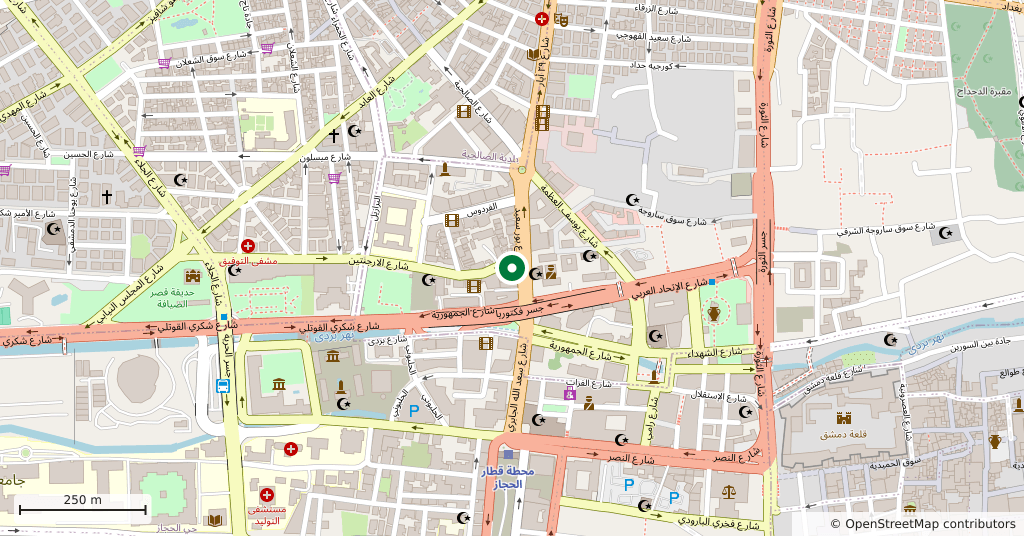
Central, on the line between the Hijaz station and Yusuf al-Azma Square. The address comes in two versions: maps give the Sarouja quarter and Argentine Street, Arabic sources say Port Said Street. They are the same junction. If you cannot find the door, ask for maqha al-Havana and anyone nearby will point.
What to drink and eat
Tea, coffee and nargileh. The coffee list is the distinctive part: Arabic coffee in a small cup sits on the same menu as French and Italian style brews. In the morning they serve a Damascene breakfast — hummus, fatteh, ful. The ground floor is the main hall, the upper floor is set aside as the family floor.
Whose café it was
Through the 1940s and 1950s the Havana was where the Arab literary world met in Damascus. From Damascus came Muhammad al-Maghut, Adonis, Zaki al-Arsuzi and Sidqi Ismail; from outside Syria, Badr Shakir al-Sayyab, Abd al-Wahhab al-Bayati, Muhammad Mahdi al-Jawahiri, Muzaffar al-Nawwab and the Egyptian Ahmed Abdel Muti Hijazi. Egyptian regulars compared it to El Fishawi in Cairo. In those years the place was called Mukha al-Rashid, and in 1947 the founding congress of a political party was held in this hall.
How it escaped becoming a shop
In the mid-1980s a contractor bought the building and wanted to turn it into shops. The Ministry of Tourism expropriated it, Cham Hotels took on the restoration, and the coffeehouse stayed a coffeehouse. Some of the furniture you sit on predates that work.
When to go
At breakfast time the hall is quiet and the light is good. From late afternoon into the night the tables fill and the dice get louder. One of the waiters has worked the same hall for 20 years. Sitting for hours over a single glass of tea is normal here; nobody waits for you to free the table.
Tips
- Look for the corner of Port Said and Argentine Street; the address is written both ways
- The coffee list runs from Arabic to French and Italian style, so say which you want
- Go at breakfast time for a table away from the crowd
- Do not mix it up with the other historic cafés of Damascus: Al-Nawfara is known for its storyteller, Al-Rawda for political argument, Kamal for its game tables
Transparency
- How this was chosen
- Two kinds of record live here: the dish itself, and the place that serves it. Both are chosen and written by hand; ranking is not for sale and there are no sponsored entries. If a price range is not known for certain, it says so. Venues that serve alcohol are not listed on this site at all.
- Facts checked
- September 2026
- Last updated
- September 15, 2026