Kleicha, the feast cookie of the Jazira
Filled with date paste, walnut or coconut, and scented with cardamom and nigella. In the Jazira the same tray is baked for Easter and for Eid al-Fitr alike.
- Where to eat it
- In home kitchens across the Jazira before Eid and Easter; on the sweet-shop counters of Hasakah, Qamishli and Deir ez-Zor.
- Price
- Variable — sold by weight; ask the price at the counter
- When it is eaten
- The week of Eid al-Fitr and the week of Easter
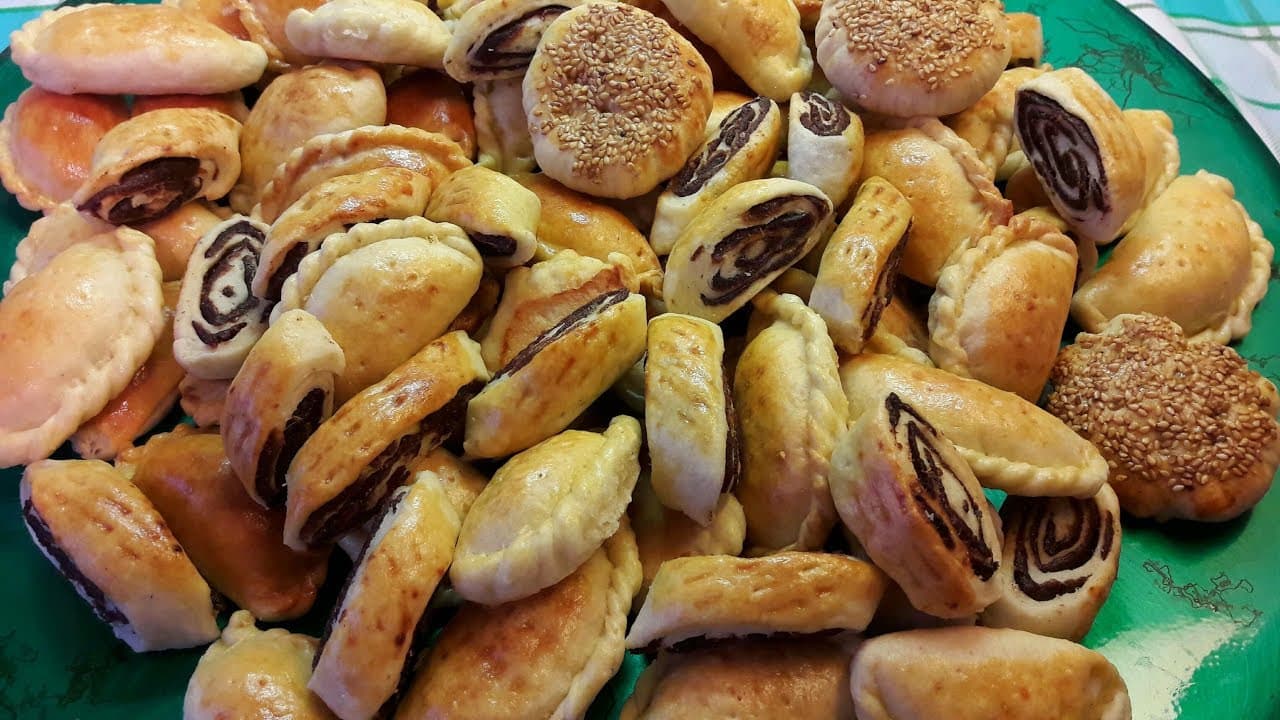
Kleicha is the feast cookie of the Jazira, the northeast of Syria. Flour dough is rolled thin, date paste or walnut goes inside, and cardamom and nigella go into the dough itself. It has two classic shapes: a wheel cut from a filled roll, and a sealed half-moon. Hasakah and Deir ez-Zor each keep a more heavily spiced version, and the tray leaves the house on the morning of the feast.
What goes inside
Three fillings are common: crushed dates, pounded walnut, grated coconut. With dates the dough is rolled up and sliced, which is why the cut face shows a spiral. Walnut and coconut are closed into half-moons instead. The scent comes from the dough, not the filling. Cardamom, nigella and in some houses fennel are worked straight into it.
Three names, one tray
The same cookie carries three names in the region. Kleicha in Arabic, kleča in Syriac, kade in Kurdish. In the Jazira all three are heard on one street. Usually they describe one tray. The name changes; the dough and the cardamom do not.
How it differs from maamoul
It gets confused with the maamoul on this site, but they are two different cookies. Maamoul is made from semolina dough and shaped by pressing it into a carved wooden mould. Kleicha is made from flour dough and rolled or folded by hand. The real difference is in the smell: maamoul carries no cardamom or nigella, and in kleicha those are part of the definition.
Which feast it belongs to
To two calendars at once. In the Syriac and Assyrian households of the Jazira it is an Easter and Christmas cookie; in Muslim households it is the cookie of Eid al-Fitr. In both cases the tray does not stay at home, it goes to the neighbours. One cookie doing the rounds twice a year, through two different doors, is the ordinary state of the region.
Tips
- Ask for the date one; walnut and coconut sit on separate trays
- Look for cardamom and nigella in the smell; without them you are probably holding maamoul
- Counters are full in feast week; the rest of the year you may have to order ahead
- Hasakah and Deir ez-Zor versions are more heavily spiced, so ask whose version it is
Transparency
- How this was chosen
- Two kinds of record live here: the dish itself, and the place that serves it. Both are chosen and written by hand; ranking is not for sale and there are no sponsored entries. If a price range is not known for certain, it says so. Venues that serve alcohol are not listed on this site at all.
- Facts checked
- September 2026
- Last updated
- September 15, 2026