Potato Kibbeh (Kibbet Batata)
The meatless branch of the kibbeh family: boiled potato, fine bulgur, onion and dried mint. A fixture of the Lenten table in Homs and the Valley of the Christians.
- Where to eat it
- At home tables in Homs and the Valley of the Christians, during the weeks of Great Lent. Rare on restaurant menus; outside the fasting season you have to ask.
- Price
- Variable — a home dish; if a restaurant has it, ask the price of a plate
- When it is eaten
- The weeks of Great Lent, before Easter
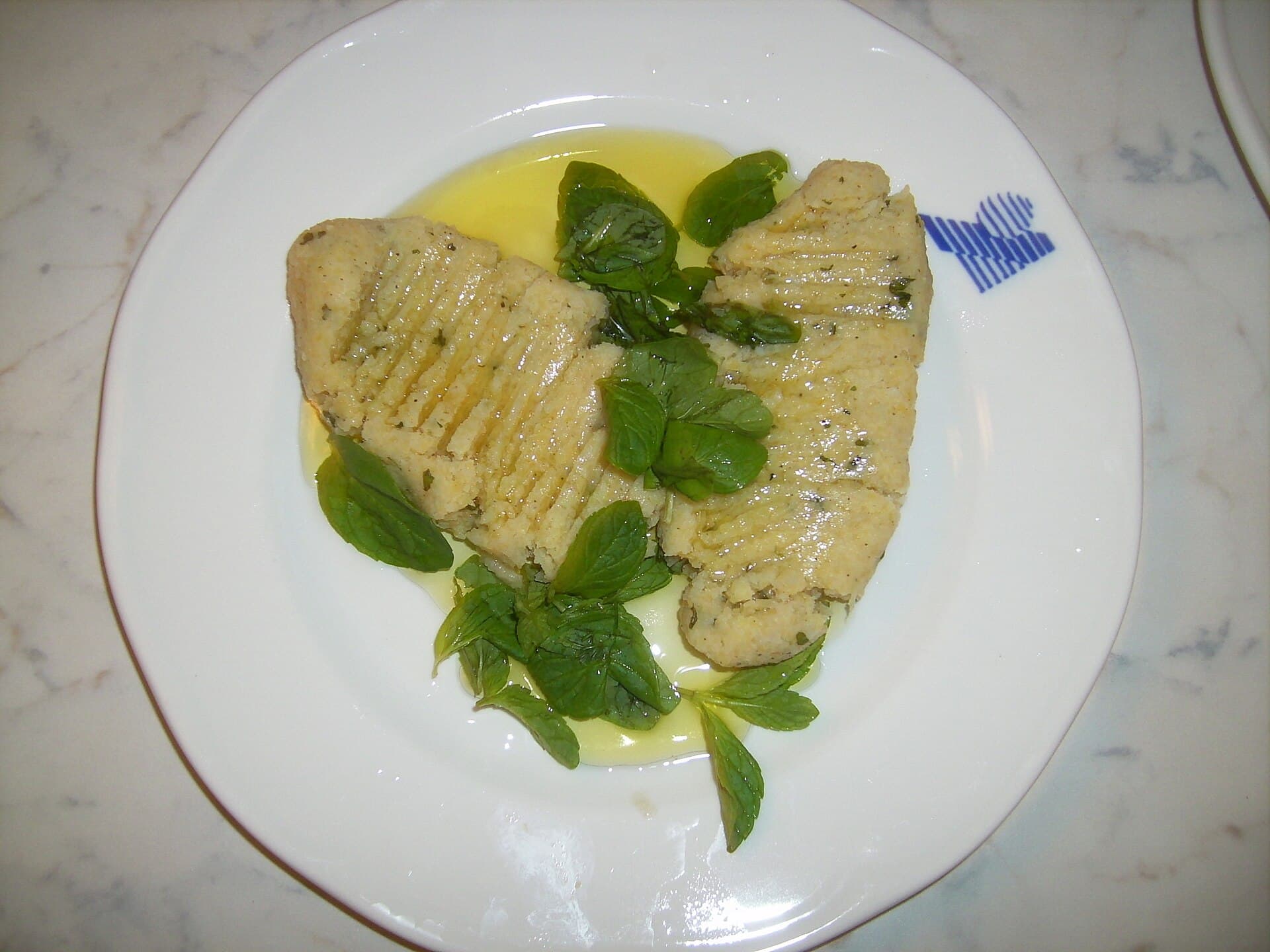
This is the kibbeh made without meat. Boiled potato is mashed and worked into fine bulgur with grated onion, dried mint, coriander and spice. Once the mixture holds together in the palm it is either spread across a tray or shaped, filled and fried. The bulgur has to be the fine grade; coarse bulgur will not take up the moisture and the paste breaks apart.
It comes in two forms
The first is the spread version: the mixture is pressed into a tray, ridged with the back of a fork, dressed with olive oil and eaten cold. Lettuce leaves, radish and olives come alongside, and you lift it with a leaf rather than a spoon. The second is the stuffed version: the potato mixture becomes the shell, minced meat fried with onion and pine nuts goes inside, and the parcels are fried or baked in a tray. On a fasting table that second form is made without the meat, with onion and walnut in place of the filling.
Where and when it is eaten
This is a home dish. Homs, the Valley of the Christians and the villages around them put it out during the weeks of Great Lent, on the days when meat leaves the table; the same dish comes back in Ramadan as a meatless-day plate. Rather than looking for it on a menu, ask at monastery and village tables if your visit falls in the fasting season.
How it differs from kibbeh nayyeh
They look the same: spread on a tray, ridged with a fork, glossy with olive oil. What is inside is not. Kibbeh nayyeh holds raw lamb pounded that morning, and freshness is the rule of the plate; the potato version has no meat at all, so a hot day or a quiet restaurant is no argument against it. Their place at the table differs too. Kibbeh nayyeh is what you serve a guest; the potato one is what you eat when you are fasting.
Tips
- Ask whether the bulgur is the fine grade; made with coarse bulgur it falls apart
- Lift the spread version with a lettuce leaf — no one uses a spoon
- Ask for the fried one hot; the shell softens as it cools
- Do not expect raw meat because it looks like kibbeh nayyeh; there is no meat here
Transparency
- How this was chosen
- Two kinds of record live here: the dish itself, and the place that serves it. Both are chosen and written by hand; ranking is not for sale and there are no sponsored entries. If a price range is not known for certain, it says so. Venues that serve alcohol are not listed on this site at all.
- Facts checked
- September 2026
- Last updated
- September 15, 2026