Qishta, Arab Clotted Cream
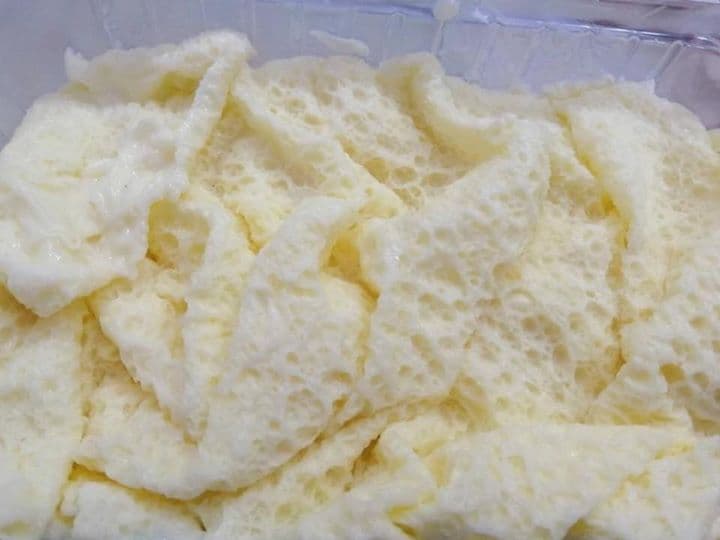
The layer that gathers on the surface of milk: held for hours at about 60 degrees in wide trays, it sets in sheets. No culture, and it keeps only days.
- Where to eat it
- On the sweet shop counter, plain with honey and crushed pistachio, and as the filling in knafeh, qatayef and halawet el-jibn. The sweet shops of Hama are known for it.
- Price
- Variable — ask the price per kilo or per bowl at the counter
- When it is eaten
- The day it is made, straight out of the chilled case
Qishta comes out of the milk’s own fat. Fresh milk goes into wide, shallow trays and stays there for hours at about 60 degrees; the layer of fat and protein that gathers on top is lifted off with a spoon. No culture, no rennet. In Syria the source is given as Hama, and the everyday name for it is Hama cream.
How it is made
The milk never comes to a boil. It is held at about 60 degrees, and if the heat climbs you get foam instead of cream. Each layer is lifted, then the tray waits again; the wider and shallower the tray, the more it yields. What comes off is not a pouring cream. It is a porous, spongy sheet that holds its shape on the spoon. Yoghurt needs a culture and cheese needs rennet; qishta takes neither, and nothing ferments. Anatolian kaymak and Indian khoa work by the same heat, and the difference is in the texture.
How old it is
Kanz al-fawa’id, a cookbook compiled in medieval Egypt, describes heating milk, letting it cool and skimming what gathers on top. A dictionary printed by Socrates Spiro in 1895 gives qishta in a single word: cream. From Hama it travelled to Egypt, Iraq, Palestine and Anatolia, and Egyptians call their version baladi cream.
Where to eat it
Two kinds sit on a sweet shop counter. The plain one is spooned into a bowl under honey and crushed pistachio, and it is also what goes between the layers of a fruit cocktail. The second is thickened with starch or flour, cooked qishta in Arabic. Most shops use that one as a filling, because it holds its shape on the tray and lasts longer. Which of the two is inside the pastry you are buying is a question for the counter.
What to check before you buy
Qishta spoils fast. Even refrigerated it lasts a few days, so a tray standing on an open counter through a hot afternoon is a risk you do not need. Take what is kept in a chilled case, and leave anything that smells sour. It is dairy — skip it if lactose is a problem.
Tips
- Two kinds sit on the counter — ask whether yours is plain or thickened with starch
- Do not buy from a tray left out on an open counter on a hot day
- Send back anything that smells sour; it keeps only a few days
- It is dairy — skip it if lactose is a problem
Transparency
- How this was chosen
- Two kinds of record live here: the dish itself, and the place that serves it. Both are chosen and written by hand; ranking is not for sale and there are no sponsored entries. If a price range is not known for certain, it says so. Venues that serve alcohol are not listed on this site at all.
- Facts checked
- September 2026
- Last updated
- September 15, 2026