The breads of Syria: which bread from which oven
The saj, the taboon, the tannour and the neighbourhood oven each turn out a different bread. Which comes from where, what it is for, and when it is hot.
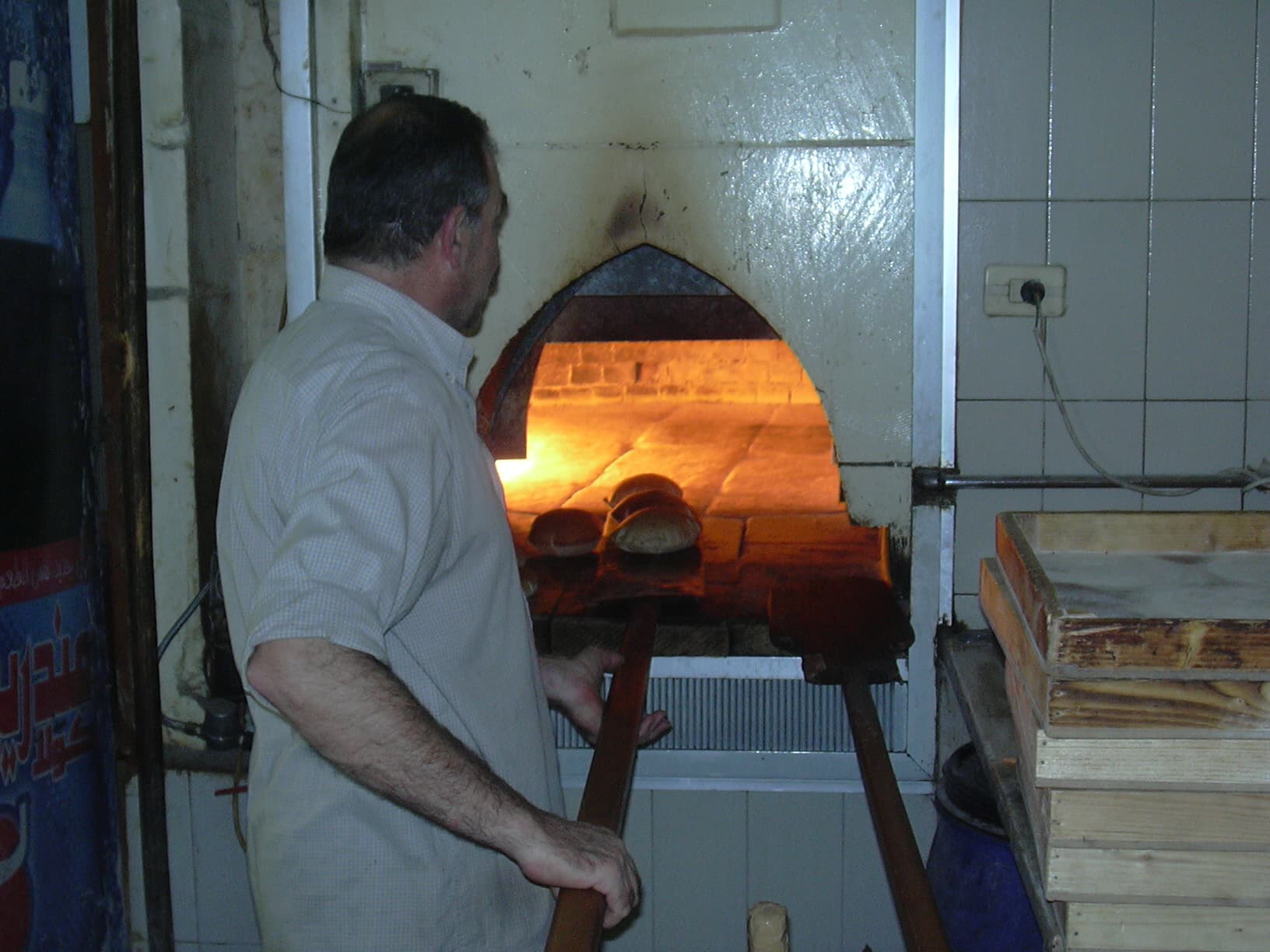
In Syria it is the oven, not the dough, that decides the bread. There are four of them and each gives its own loaf: the saj, the taboon, the tannour and the neighbourhood oven. This page is the list of breads — where each one comes from, what it is used for, and when it is hot. The oven itself, the tray custom and the morning of a holiday are covered on a separate page.
Four ovens, four breads
The saj is a convex metal dome: markook dough is stretched over a round cushion until it is almost transparent, bakes in seconds and is folded off. Thin, unleavened, made for wrapping. It is the real bread of the countryside and of nomadic households. The taboon is a domed clay oven with hot pebbles across its floor; the dimples on the underside of the loaf are the print of those stones, and taboon bread is recognised by them. That is the bread of the Hauran villages. The tannour is a vertical clay well: the dough is slapped onto the inner wall and comes off thick and dark, made from wholewheat flour, and in the countryside it is still the daily loaf. The neighbourhood oven, the furn, is the city’s oven, and it bakes both the tray and the flat loaf.
Daily bread in the city
Khubz arabi is the everyday bread: leavened, two-layered, with a pocket in the middle. It puffs and falls within seconds in the oven, it works as a fork at the table, and stale ones are not thrown out — they go into fatteh. Samoun is another thing entirely. A diamond-shaped loaf with a hard crust, leavened with yoghurt, it is the bread of the shawarma and falafel sandwich. The kimaj of Homs is thick and round, its surface pressed full of holes with the fingertips, topped with coarse salt, nigella and red pepper. Kaak you meet on the street rather than in the bakery: a sesame ring carried on a pole or a handcart, with a paper cone of za’atar on the side.
The savoury tray
The same oven turns out trays alongside bread. Manakish is morning work. A hollow is pressed into the dough with the fingers, then za’atar, cheese or minced meat goes over it. Fatayer is the closed one — raw spinach, sumac and pomegranate molasses inside thin dough, sealed on three sides. Aleppo’s sfiha is open: minced meat with pomegranate molasses and pine nuts on a thin base. In Deir ez-Zor, mashahmiyeh goes into the tannour with coarsely chopped lamb and tail fat worked into the dough. In Aleppo’s Armenian bakeries, su boreg is baked; the sheets are boiled in water before they go in, and the name comes from that.
The bread of a feast and of a liturgy
Some breads belong to particular days. Maarouk is the bread of Ramadan: milk, butter, the scent of mahlab, a date paste filling, and it goes out on trays hours before iftar. Mursham is the holiday bread of Suwayda and Daraa, stamped in a carved wooden mould and scented with anise and mahlab. Communion bread is baked in the bakeries of Bab Touma in Damascus: flour, water and a little salt, no fat and no sugar, with a wooden seal pressed on top. Aleppo’s braided choreg comes from the Armenian bakeries and sits on the Easter breakfast table. In the Jazira one tray serves both Easter and the Eid: klicheh.
When it comes out hot
Bread keeps hours. Khubz arabi is bought in a bundle in the morning and finished during the day. Manakish and fatayer come off the tray from early morning to midday, and what is left in the afternoon has been reheated. Markook is there as long as the saj is lit. Kaak has two hours of its own: morning and late afternoon. On Friday the souq stops for an hour or two around the noon prayer and bakeries may close in that gap; everything opens again afterwards.
What to ask for at the counter
Bread is sold by the piece and the trays are counted separately. If you want it hot, just ask for what has come out of the oven; the pile on the counter may be the morning’s leftover. Eating manakish standing up is normal, and many bakeries have two tables out front with tea brought from next door. Nobody throws stale bread away: it is broken into fatteh or dried and stored.
Tips
- Ask for hot; the pile on the counter may be the morning's leftover
- Manakish and fatayer are morning work; the trays run out after midday
- Markook for a wrap, samoun for a sandwich, khubz arabi for the table
- There is an hour or two of pause at Friday noon; buy your bread before it
- Stale bread is not thrown away; it goes into fatteh, and so should yours
Transparency
- How this was chosen
- This page carries the fastest-ageing information on the site: visa rules, exchange rates, border crossings and SIM prices change several times a year. The verification date above says when the facts were last put through their sources; for anything later, check your own foreign ministry travel advice and a Syrian consulate. No figure that is not known for certain is written here.
- Facts checked
- September 2026
- Last updated
- September 15, 2026