Do trains run in Syria? The state of the railway today
Trains move on these tracks, but none of them carry passengers. Which lines work, which are shut, where the Hejaz line stands, and what you can board.
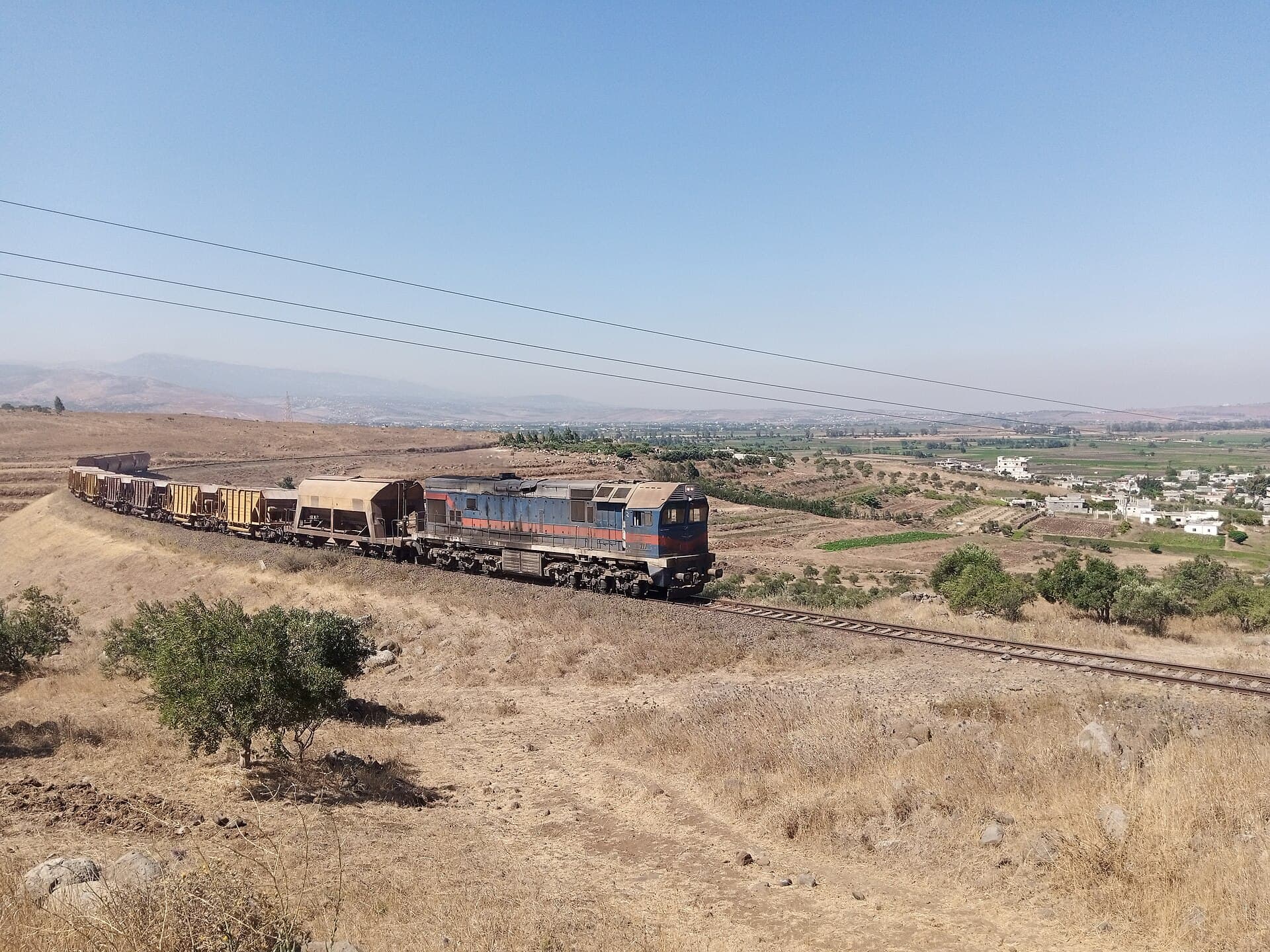
The subject of trains in Syria splits into two questions, and mixing them produces the wrong answer. The first is historical: when were these tracks laid and by whom. Our page on railway heritage answers that. The second is the question here: what moves on the rails today, and can a traveller board any of it. The short answer is that trains run and passenger trains do not.
How much of the network stands
The national network measures 2750 km, and as of late 2025 some 1052 km of it was in working order. Roughly a third, in other words. The rest is either damaged or physically gone; on the coastal mountain section even the trace of the line has vanished, and trains detour to the south. Aleppo carries the heaviest loss in this picture: four of the city’s five lines are unusable, and the one remaining link runs to Homs and the coast.
What the working lines carry
What moves on the lines that work is fuel, not people. The freight train taking fuel oil from the Baniyas refinery to the thermal power plant at Aleppo is the real work of this network, and on a good day two or three run. One train carries 5000 tonnes in 12 tanker wagons and takes between 15 and 35 hours from Baniyas to Aleppo. That the timing swings across so wide a range is not an accident but the system itself. Electronic signalling does not work, so stations pass handwritten orders between them. Level crossings are opened and closed by hand, and the locomotives date from the 1970s.
The photograph at the top of this page shows exactly that: a phosphate freight train on a single track in the Homs countryside, taken in July 2026. The rails are not empty. They are simply not for you.
Why there is no passenger service
Trial runs took place on the Aleppo to Hama line in August 2025, and the test train reached 160 km per hour. A scheduled passenger service still did not follow, and the reason came from the railway’s own management: nobody boards a train whose arrival time you cannot predict. That sentence holds the whole matter. There are rails and there is a locomotive; what is missing is predictability. Staffing is under strain as well — a third of the railway workforce in Tartus governorate was let go over budget, and a worker’s monthly pay runs at around 100 dollars.
The Hejaz line today
The narrow-gauge line running south from Damascus, the Hejaz railway, carries no passengers. In September 2025 Turkey, Jordan and Syria signed a preliminary understanding: a 30 km section inside Syria is to be repaired, with Turkey taking the structural work and Jordan providing locomotive maintenance. A passenger train between Amman and Damascus is spoken of for the end of 2026. The word spoken is chosen with care — what was signed is an understanding, not an opened line. The platforms of the Hejaz station in Damascus are closed, and a plan to turn the building into a museum is being prepared.
The other projects under discussion
On 25 August 2026 the Syrian and Lebanese transport ministers met in Damascus, discussed restoring the Tripoli to Abboudieh to Homs line and agreed to set up a joint technical team. That line has carried no train since 1975. In the north, Turkey has announced funding to rehabilitate the railway from its own network at Gaziantep to Aleppo, with a route onward from Aleppo through Damascus to the Jordanian border. All of it is real and all of it is at the project stage.
If you want to see a train
There is no passenger service, but seeing a train is possible. The working line runs north from Baniyas through Homs and crosses the countryside at level crossings; no timetable is published, so coming across one is a matter of luck. There is one rule and it is not open to discussion: do not walk on the track or along it. With the signalling out of service a train arrives at an hour nobody expects, and a driver spotting you and stopping is not something that happens. Watch from a distance, watch from the road, stay off the crossing.
What this means for a traveller
Do not build an itinerary around trains. Moving between cities is entirely a road matter today: coaches, minibuses and shared taxis. Our page on getting around Syria gives the times and the options. If you want to see the railway, the place to go is a station: the Hejaz station and Kadem in Damascus, and the Baghdad station of 1912 in Aleppo. Both are described in full on our railway heritage page, and both can be visited with no train involved.
When this page will go stale
Probably soon. The network has been gaining a few hundred kilometres a year since 2025, and a scheduled service opens with a single announcement. So read the verification date on this page, and for anything after it, ask on the spot whether the line has opened. Even when a station building is shut, staff are usually there and will answer the question.
Tips
- There is no scheduled passenger train; intercity travel is entirely by road
- Of the 2750 km network, 1052 km is in working order
- The working lines carry fuel and phosphate, not passengers
- The Aleppo to Hama trial ran in 2025 but never became a timetable
- To see the railway, visit the station buildings — no train required
Transparency
- How this was chosen
- This page carries the fastest-ageing information on the site: visa rules, exchange rates, border crossings and SIM prices change several times a year. The verification date above says when the facts were last put through their sources; for anything later, check your own foreign ministry travel advice and a Syrian consulate. No figure that is not known for certain is written here.
- Facts checked
- September 2026
- Last updated
- September 15, 2026