How to read a building in Syria
Where the inscription sits, how a reused column gives itself away, what grey mortar tells you, where the mihrab points. Eight questions worth asking on site.
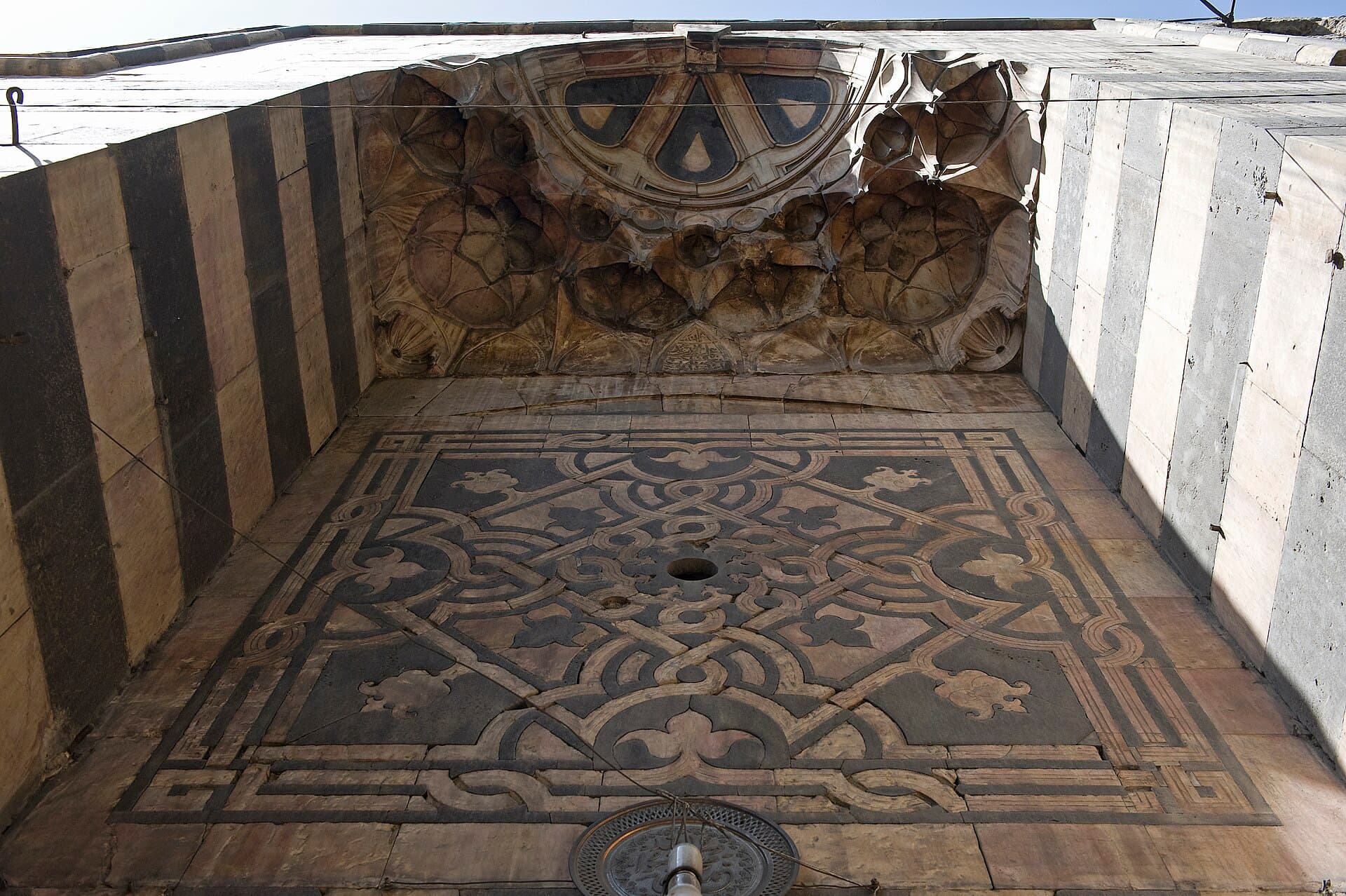
The first five minutes in front of a building decide the rest of the visit. This page is not about what you will see but about where to look. The names of the parts are in this section’s architectural glossary and the periods have their own page; what follows is only the order of looking.
Walk the outside first
Circling a building before you enter saves half an hour inside. Three things are worth finding on that circuit: how many facades there are, which one is the real front, and whether a vertical seam shows in the wall. The seam says the most. If the coursing changes along one line, if the height of the courses shifts, or if the colour jumps, the building grew in two separate periods.
In a mosque, a khan or a madrasa the real front faces the courtyard rather than the street. A blank street wall is not a lack; it is the plan.
Where the inscription sits
Inscriptions are not placed at random. Four spots are worth checking: the rectangular panel directly above the portal, the line where a minaret shaft begins, the head of a fountain, and the band running around a mihrab. If a building has been repaired, the repair text is usually added as a second panel beside the first. Where two panels sit together, the smaller one is generally the later.
Not being able to read the script is no obstacle, because the numerals read easily and the date usually sits on the last line. The year is Hijri: for a rough conversion add 622, then subtract one year in every 33. Hijri 1000 works out at 1591. The sum is approximate and does not replace a published date; its job is to place what you are looking at in a century while you stand there.
How to spot a reused stone
Spolia are pieces taken from an older building and set into a newer one. Three signs give them away. The first is mismatch: if two capitals standing side by side do not agree, both came from somewhere else. The second is size — a column shorter than its neighbour has been given a base, a longer one has been cut down. The third is subject matter. A vine scroll, a cross or a Greek letter on a door lintel means the stone is older than the wall holding it.
The lintel over the main door of the Great Mosque of Hama is the textbook case. The columns inside the Halawiyya Madrasa came out of a fifth century cathedral. None of this is concealed; it was ordinary building practice.
Traces of repair: colour, mortar, tooling
New stone is always lighter, and it takes decades to catch up with what surrounds it. Look at the mortar. Lime mortar is beige, soft and as old as the stone; cement mortar is grey, hard and sharp at the edges, which puts it in the twentieth century. Tooling talks too. A hand-dressed face carries fine parallel lines that wander, while a machine-cut face comes out glassy and flat.
Steel ties, epoxy fills and blocks with numbers written on them are also repair. Telling war damage from age works the same way: weathering rounds an edge, while a blast leaves an angular break and a spray of pitting across the face of the stone.
What the courtyard is doing
A courtyard is not empty space but a device for shade, air and water. In a Syrian house there is a basin at the centre and citrus and jasmine at the edges; the water evaporating keeps the yard cooler than the street outside. In most houses the main iwan faces north, because that is the side left in shade at midday in summer.
A mosque does the same work at another scale. The arcade props the shade against the wall while the courtyard holds the crowd, and the court of the Umayyad Mosque, finished in 715, is the largest version of the scheme. Once you are in a courtyard, turn around once and find the shade. It tells you which hours the building was built for.
Where the mihrab points
In Syria the qibla runs roughly south, tipped a little to the east. On entering a prayer hall, find the mihrab first: the wall holding it is the qibla wall and the rest of the plan is set out from there.
Two things should catch your eye. A mihrab that is not centred on its wall means the building grew to one side. Two mihrabs in the same wall mean a bay was added, or the building was converted from another use. A church does the opposite and puts its apse to the east, so if you can see an apse facing east and a mihrab facing south in one building, two layers are sitting on top of each other.
The floor rises, the door sinks
In an old city the ground level climbs over the centuries as rubble, fill and new paving pile up. The result shows at the door: a few steps down to the threshold, a column base half buried, a window left at pavement height. If you go down into a building, the building is older than its street.
Blocked doors and windows read clearly as well, because the infill stone differs from the wall around it and the line of the arch stays visible. At Bosra the doors of the theatre were walled up and the whole thing turned into a fortress. From outside you see a citadel; inside, the theatre is still standing.
What to ask the keyholder
The custodian at the door is the best source most buildings have, and a concrete question gets an answer. Four that work: when was this last repaired, why is that stone a different colour, why is the closed part closed, and what does the inscription say. Some of the answer will be hearsay, which is fine — sorting out which part is yours to do.
One question stays unasked: whose hands the building was in during the war years. Anyone who wants to talk about it opens the subject themselves.
Tips
- Circle the building before you go in; the seams are visible from outside
- Look for the inscription above the portal, at the minaret base and on the fountain head
- Grey hard mortar is cement, so it is repair; lime mortar is beige and soft
- If two capitals side by side disagree, both are reused stone
- Two mihrabs in one wall mean the building grew or changed use
Transparency
- How this was chosen
- This page carries the fastest-ageing information on the site: visa rules, exchange rates, border crossings and SIM prices change several times a year. The verification date above says when the facts were last put through their sources; for anything later, check your own foreign ministry travel advice and a Syrian consulate. No figure that is not known for certain is written here.
- Facts checked
- September 2026
- Last updated
- September 15, 2026