Travelling the north: Idlib and the Dead Cities
Which village belongs to which day, what to do about unexploded ordnance, how to behave around families living in the ruins, and how to get out here from Aleppo.
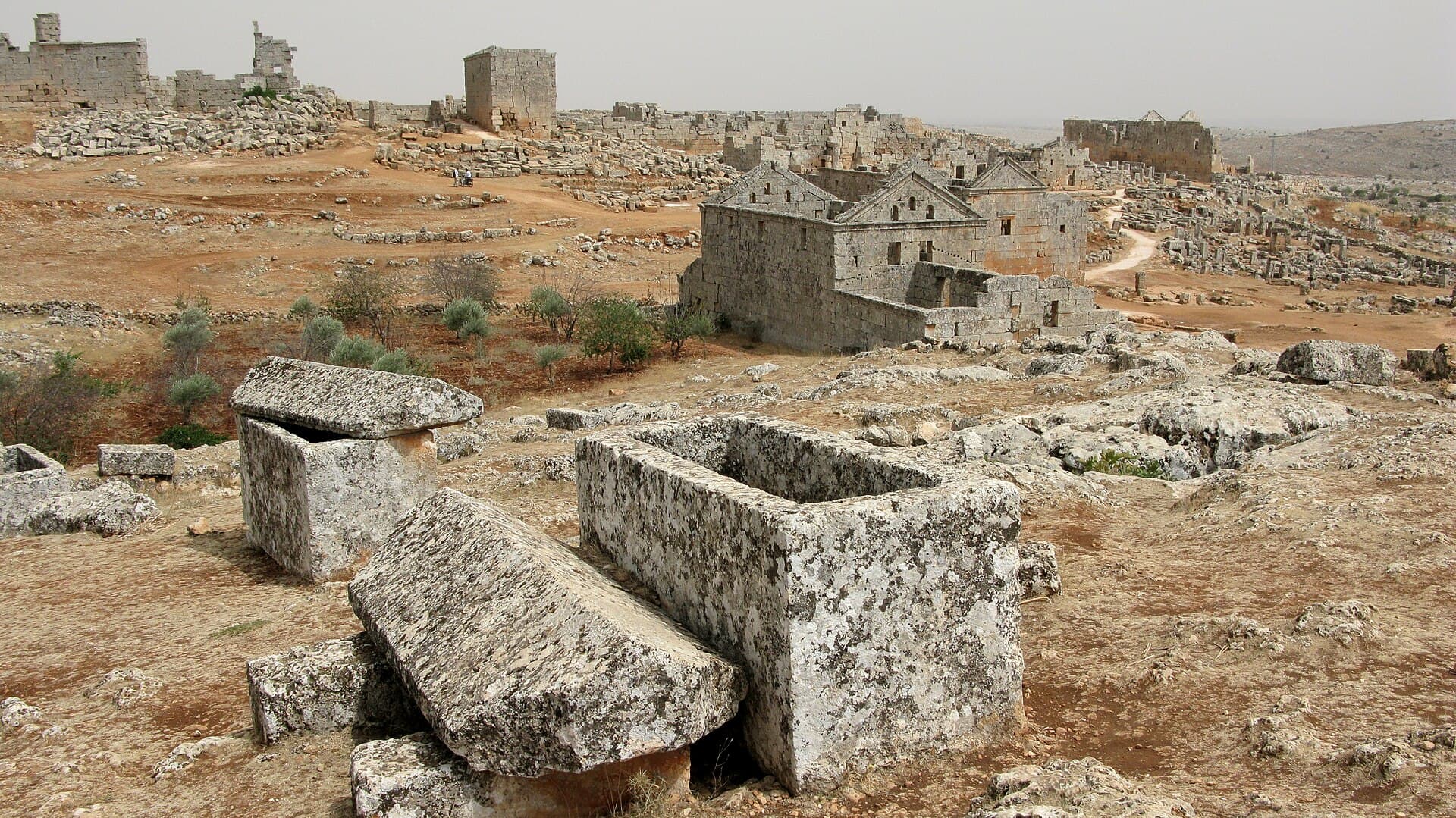
Nobody comes to Idlib for the city; they come for what surrounds it. On the slopes between Jebel Zawiya and Jebel al-Ala are hundreds of villages founded between the first and the seventh century and then abandoned; most of their walls are still standing and nobody built anything new on top of them. This page is about how to visit them: which village belongs to which day, and which warning applies where.
Safety first: unexploded ordnance
Unexploded ordnance is a reported risk in rural Idlib, and that is the most important sentence on this page. Acting on it is simple and not up for discussion: stay on the road and the path, do not walk into fields or into collapsed buildings, and do not touch metal lying on the ground. Stepping one pace off the path for a photograph counts. Most of the sites have no fence and no guard, so nothing will stop you; the limit is one you set yourself.
Ask a local guide or your hotel about how the area stands that week. For the country as a whole, read your own foreign ministry’s advice; official warnings sit at their highest level for the whole of Syria.
Families living in the ruins
Some of the Dead Cities sheltered families displaced during the war years, and some of them are still there. At al-Bara the modern village is built into the ruins; among the buildings at Deir Semaan there are houses used for livestock. The rule is one sentence: do not enter an inhabited building uninvited, do not step into a courtyard, do not frame a wall with washing hanging on it.
This is not a suggestion about manners; it is the boundary itself. A church fourteen centuries old and somebody’s house today can sit in the same heap of stone, and what separates them is your attention. Ask before photographing people, and if the answer is no, leave it.
Day one: the southern massif
On Jebel Zawiya, al-Bara and Serjilla are 7 kilometres apart and the two fit into a single morning. Al-Bara is the largest of the Dead Cities: two pyramid-roofed tombs among the olive groves, churches, and olive presses on an industrial scale. Serjilla is the best preserved; its bath and the andron opposite are the pair with the most complete walls in the whole region, roofless but otherwise in place.
In the afternoon cross north to Jebel al-Ala: the west front of the church at Qalb Lozeh carries two towers with a wide arch between them, an arrangement that does not appear in Europe for another four centuries. See the front in the late afternoon, when it takes the light head on. Three stops and 180 kilometres in all, with around five hours behind the wheel. It is an early start.
Day two: Ebla, Ruweiha and the north
The second day runs longer: 190 kilometres. The mound at Ebla is 55 kilometres southwest of Aleppo beside the Damascus road; it rises alone out of the plain and is visible from the tarmac. Find the ceremonial staircase of the burnt Palace G — the archive rooms were beside it. You will not see the tablets here; they are in the museums at Aleppo and Idlib.
Ruweiha is one of the largest Dead Cities on Jebel Zawiya: the standing arch of the Bissos church, a second basilica and a two-storey market building. The arch reads in the late afternoon, in the western light. The day ends at Saint Simeon — over the provincial boundary, but the same stone and the same century.
A third option: the northern massif
With a third day the northern massif earns one of its own: 146 kilometres. Harim castle sits on a mound overlooking the Amuq plain and the climb takes an hour; the rock-cut ditch on its northeast side makes more sense seen from above, and there are no railings. Babiska on Jebel Barisha has two Byzantine churches and a market building dated to 547. Qalb Lozeh can be added to the same day.
What the city has and what it does not
This needs saying plainly: central Idlib was inside the fighting between 2011 and 2024 and was damaged in air strikes. There is no old city fabric here, no line of markets, no run of monuments, and you should not set aside a day for the city centre. The one place to visit is the museum: the Idlib Museum holds the cuneiform tablets from the Ebla archive. It closed in 2013, was looted and bombed; two halls reopened in 2018 and it was damaged again in the earthquakes of 2023. Ask whether it is open before you go.
The Maarat al-Numan museum is a separate stop: inside the sixteenth-century Ottoman caravanserai of Khan Murad Pasha are Roman and Byzantine mosaics gathered from the churches of the Dead Cities. It was badly damaged in the war and is open all the same; its hours vary, so confirm before you go.
Where to stay, how to get there
Accommodation for visitors in central Idlib is limited and the options change month by month. In practice most visitors stay in Aleppo and come out for the day: about an hour by road, with an easy return in the evening. If you do stay in Idlib, arrange the room in advance and carry cash. There is nowhere to sleep in the villages beside the ruins, and you do not drive back along dirt roads after dark.
Idlib is 70 kilometres southwest of Aleppo, and about five hours from Damascus on the M5. No public transport reaches the ruins; you hire a car with a driver, and the driver has to know the area, because the sites are not signposted.
Season and hour
March to May and October to November. Spring is a reason on its own: green comes up between the stones and the ruins never look better than they do then. Summer is hot and none of the sites has shade. After winter rain the dirt tracks turn to mud and you will struggle without a vehicle with clearance. The order of hours is fixed too. Al-Bara in the morning, because the olive groves give shade and the tombs take side light; Serjilla while the ground between the stones is green and before the heat comes. Qalb Lozeh and Ruweiha come in the late afternoon, both of them reading in western light.
Tips
- Stay on the path; unexploded ordnance is a reported risk in the countryside
- Never enter an inhabited building or courtyard uninvited; ask before photographing people
- Al-Bara and Serjilla fit one morning; they are 7 kilometres apart
- Put Qalb Lozeh and Ruweiha late in the day, when the west fronts read
- Most visitors stay in Aleppo; there is nowhere to sleep beside the ruins
Transparency
- How this was chosen
- This page carries the fastest-ageing information on the site: visa rules, exchange rates, border crossings and SIM prices change several times a year. The verification date above says when the facts were last put through their sources; for anything later, check your own foreign ministry travel advice and a Syrian consulate. No figure that is not known for certain is written here.
- Facts checked
- September 2026
- Last updated
- September 15, 2026