Monasteries and churches in Syria
The oldest securely dated church went up in 372; another has not closed since 515. Which community is where, how old each building is, and how to visit.
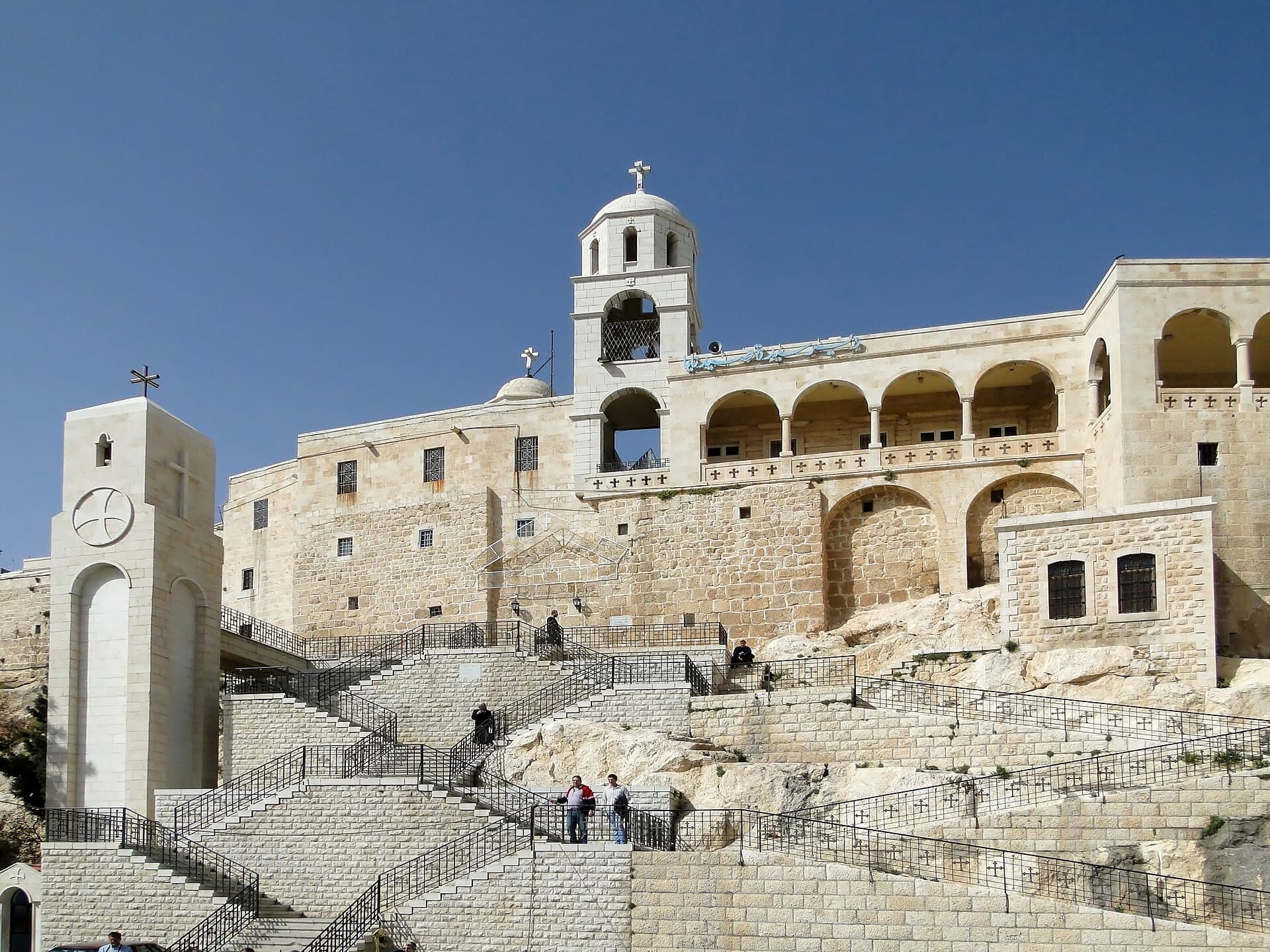
In Syria a church is not the remains of one period. It is an unbroken line. The apse still standing at Fafertin belongs to the oldest securely dated church in the country: 372. The church of Saint George at Ezraa was raised in 515 and its door has not closed since — the liturgy is still celebrated inside it. And at Kirkbize in Idlib there is a house church built inside a Roman house, the oldest surviving after the one at Dura Europos.
The monasteries
Deir Mar Musa sits on rock on the side of a dry valley above Nebek. You cannot drive up. The road ends at the valley floor and the remaining 350 or so steps are walked. Layers of fresco from the 11th and 12th centuries survive on the walls of its small church. Saydnaya is thirty kilometres north of Damascus, on top of the mass of rock above the town. Its foundation is placed in the 6th century, and both Christians and Muslims make vows before the icon it holds. Mar Simeon stands apart for its scale: four basilicas were built around the column on which an ascetic lived for thirty-seven years, and the complex was finished about half a century before Hagia Sophia.
Valleys and towns
The Valley of the Christians lies west of Homs, a green valley holding thirty-two villages, twenty-seven of them Christian and mostly Greek Orthodox. In the middle of it stands the monastery of Mar Girgis al-Humayra, a few kilometres from Krak des Chevaliers. In the Qalamoun mountains there is Maaloula: Western Neo-Aramaic is still spoken here and in neighbouring Jubbadin, the surviving branch of the language Jesus spoke. Outside Kara, the four-storey tower of Deir Mar Yakub watched the caravan road, and its crypt still holds the relic of the martyr.
Which community is where
In the Christian quarter of Damascus stands the Cathedral of the Dormition, seat of the Greek Orthodox Patriarchate of Antioch and All the East. A few streets away is the Greek Catholic church known as the Zaytoun. In Homs there is the Syriac Orthodox church of Umm al-Zunnar, and Mar Elian, founded in 432, whose crypt frescoes are held to be the oldest surviving church paintings in Syria. In Aleppo the communities are gathered into a few quarters. Four churches stand back to back around one courtyard in Jdeideh, and the present building of the Armenian Cathedral of the Forty Martyrs was completed in 1491. The same city has Armenian Catholic, Armenian Protestant, Syriac Catholic, Chaldean and Latin churches, the newest of them from the second half of the 20th century.
War and repair
The monastery of Mar Elian at Qaryatayn was destroyed in 2015; its church and tomb chamber have been under reconstruction since 2022. The Syriac Catholic cathedral in Aleppo was badly damaged, reopened in 2018, and its 700 square metres of wall painting were made again from scratch. The roof of the Emmanuel church in Aziziyeh, hit by a rocket in 2016, was repaired and the church opened in 2018. The reason to carry all this is simple: which church is open changes, and you have to ask before you set out.
How to visit
Most of these churches belong to a living congregation. They are not museums. Entry is usually free. There is a caretaker or a warden at the door, and you go in outside service times. Keep shoulders and knees covered, do not walk around during a service, and ask before photographing. Monasteries sometimes take guests, but that is arranged in advance rather than at the door. The places in Qalamoun and the Valley of the Christians are far from public transport, and a car with a driver is in practice the only way.
Tips
- Go outside service times; asking the caretaker at the door is the shortest route
- Shoulders and knees covered; ask before you photograph
- The climb to Mar Musa is about 350 steps; wear solid shoes
- Maaloula and Saydnaya are on the same road and fit into one day
- Which church is open changes; ask before you set out
Transparency
- How this was chosen
- This page carries the fastest-ageing information on the site: visa rules, exchange rates, border crossings and SIM prices change several times a year. The verification date above says when the facts were last put through their sources; for anything later, check your own foreign ministry travel advice and a Syrian consulate. No figure that is not known for certain is written here.
- Facts checked
- September 2026
- Last updated
- September 15, 2026