The religious communities of Syria
Sunni, Alawite, Druze, Ismaili, Greek Orthodox, Syriac, Armenian and Yazidi. Where each community is concentrated, what it keeps, and why that helps you.
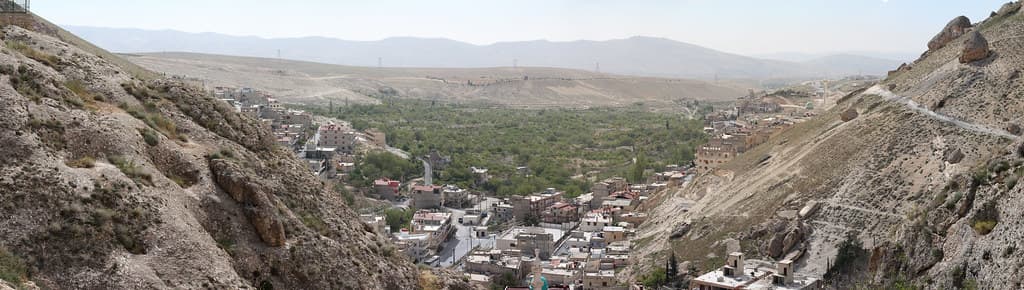
In Syria a mosque, a church and the meeting house of another community can stand within sight of one another on the same street. Travellers notice this. What they usually cannot do is say who is where. This page draws that map: which community is concentrated in which region, what buildings it keeps, and how to place what you are looking at.
One caution first. Every figure here rests on pre-war estimates, and much of the population moved after 2011. Read the proportions as a frame for how the fabric was put together, not as a current census. Etiquette for visiting has its own page; this one is about who is who.
The Sunni majority
The largest community is Sunni Muslim, put at roughly 74 per cent of the population in pre-war estimates. It is not one ethnic group: Arabic speakers form the bulk, alongside Kurds, Turkmens and Circassians. In eleven of the fourteen governorates the capital city has a Sunni majority.
Two schools of law are common, the Shafi’i and the Hanafi. Most of the large buildings a visitor sees come out of this tradition — the Umayyad Mosque in Damascus, the Great Mosque of Aleppo, the madrasas, the khanqahs, the Ottoman complexes. There is no separate Sunni region. The community is everywhere.
The Alawites
The second largest community, estimated at around 11 per cent. Its heartland is the Coastal Mountain Range: the western slope in the countryside of Latakia and Tartus, the eastern slope in the countryside of Homs and Hama. In Latakia and Tartus governorates they are the majority.
One of the older names of the mountain range comes from this community. That older label is now considered insulting and is not used. On maps and in conversation you will hear the Coastal Mountains, or Jabal al-Ansariyah. Belief and worship stay largely within the community, so do not expect a building open to visitors. The villages on the roads running north from Masyaf belong to it.
The Druze
About 3 per cent of the population. The centre of gravity is Sweida governorate and the basalt plateau around it — the name says as much, Jabal al-Druze, the Mountain of the Druze. Smaller communities live in Quneitra, the Damascus countryside and Idlib.
The faith grew out of the Ismaili tradition, but most Druze do not identify as Muslims; they do not accept the five pillars and they believe in reincarnation. The khalwa, their meeting house, is closed to outsiders. That is the rule itself rather than a discourtesy. What you will see around Sweida is basalt architecture, terraced fields and the shape of the towns; Qanawat and Shahba sit in the same day out.
Ismailis and Twelvers
The Ismailis are a small community with a very legible geography. Their centre is Salamiyah in Hama governorate; Masyaf and its countryside, and Qadmus and the Khawabi valley towards Tartus, are theirs as well. Masyaf Castle and Qalaat al-Kahf, both covered on this site, are the fortresses of exactly that network.
Twelver Shia Muslims are fewer still. In Damascus they cluster in the Amara quarter around the Umayyad Mosque and Sayyida Ruqayya, and in the town of Sayyida Zaynab. Bab al-Saghir cemetery belongs to the same circuit of visits. In pilgrimage season these three become the busiest religious places in the country.
The Christian churches
Before 2011 Christians made up between 5 and 6 per cent of the population; estimates for 2022 fall to about 2 per cent. This is not one church but a cluster of them.
The largest is the Greek Orthodox Church of Antioch. The patriarchate sits in the Christian quarter of Damascus, at the Mariamite Cathedral, and the Church of Saint George in Ezraa belongs to the same community — its doors have not closed since 515. The Syriac Orthodox are the second largest group, and Umm al-Zunnar in Homs is their church. Armenian Apostolic and Armenian Catholic congregations are concentrated in Aleppo, in the Midan quarter, where the Holy Trinity church stands. The Melkites, that is the Greek Catholics, separated in 1724 through a split in the Greek Orthodox patriarchate of Antioch and have been a distinct church since. Chaldeans and the East Syriac communities live mainly in the north-east, out in the Jazira.
Monasteries are a layer of their own: Saydnaya, Deir Mar Musa, Maaloula. Western Aramaic is still spoken in Maaloula, which with two neighbouring villages is the last place in the world where it survives.
Yazidis and the communities that left
Yazidis live around the Jazira and Afrin, with population estimates spread over a wide range. The religion is strictly endogamous, so the community stays within itself. Both regions lie outside the cities this site covers; a traveller is unlikely to pass a Yazidi village on the way.
The Jewish community is another story. It existed in Damascus and Aleppo for centuries. By 2020 no Jews were known to remain in the country. The synagogue buildings stand and the congregation has gone. Writing that down is not a lament, it is the page being honest.
What this gives the traveller
Three things place a building. The proportion of dome to minaret, the shape of the cross, and the language of the writing: Greek and Arabic side by side in Greek Orthodox churches, Syriac script in Syriac ones, Armenian letters in Armenian ones. Quarter names tell you as well — Bab Touma, Bustan al-Diwan, Midan and Jdeydeh are all Christian quarters.
One thing you do not do: nobody is asked which community they belong to. Whoever wants to tell you will tell you. How to visit, which buildings are open and where to leave a donation are set out on a separate page of this site.
Tips
- Every figure is a pre-war estimate; much of the population moved after 2011
- The Druze khalwa and Alawite meeting houses are closed to outsiders — that is the rule
- The older name of the Coastal Mountains is now considered insulting; do not use it
- The script gives the church away: Greek, Syriac or Armenian letters
- Nobody is asked which community they belong to; whoever wants to tell you will
Transparency
- How this was chosen
- This page carries the fastest-ageing information on the site: visa rules, exchange rates, border crossings and SIM prices change several times a year. The verification date above says when the facts were last put through their sources; for anything later, check your own foreign ministry travel advice and a Syrian consulate. No figure that is not known for certain is written here.
- Facts checked
- September 2026
- Last updated
- September 15, 2026