The castles of Syria: which one is for you
There are 25 castle entries on this site and you do not need all of them. Which you can drive to, which means a climb, which still stands, which is a ruin.
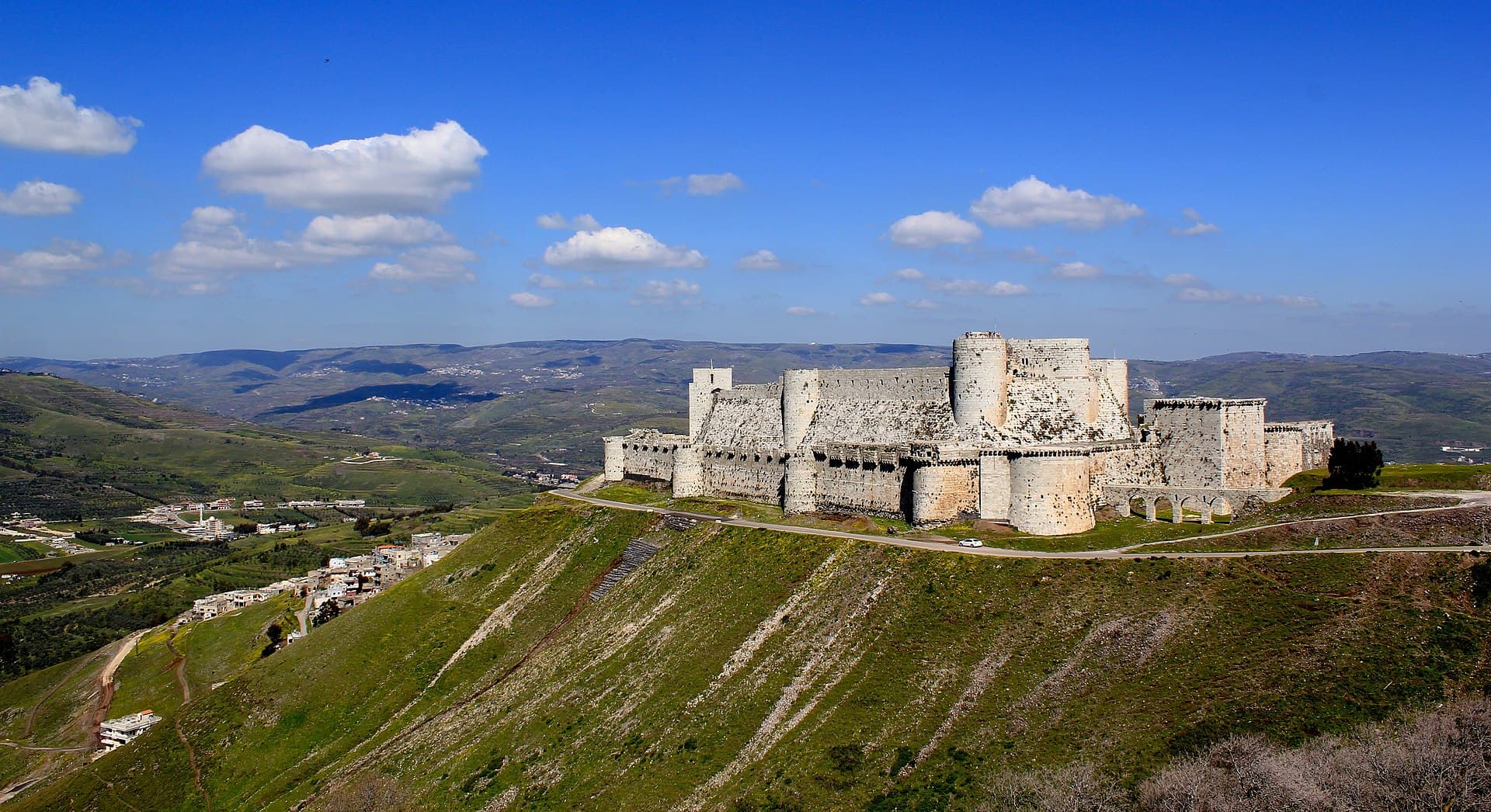
Syria has more castles than any trip can hold: 25 separate entries on this site, and they do not promise the same thing. One sits on a city square, another on a ridge between two ravines; one is close to complete, another is a ditch and a few tower bases. This page does not retell those entries — it helps you pick.
The ones you can drive to
If time is short or a climb is out, five castles stand inside a city or right beside one.
- Aleppo Citadel. On the mound in the middle of the city, entered over an eight-hundred-year-old stone bridge. 120 minutes, entry 1500 SYP.
- Damascus Citadel. Built on the flat rather than a hill: 230 metres by 150, and 12 of its 14 towers still stand. At the western end of Souq al-Hamidiyah, 60 minutes.
- Homs Citadel. An artificial mound rising 32 metres above the plain. No standing castle; a stone-clad slope and fragments of wall. 45 minutes.
- Palmyra Castle. On the hill west of the ruins; you drive up. 90 minutes.
- The citadel at Bosra. Not a separate building: the Ayyubids wrapped a castle entirely around the Roman theatre. Visiting the theatre is visiting the castle.
The ones that mean a climb
Here the car gets you part of the way and your feet do the rest. Slick soles are a problem; most of these have no shade at all.
- Safita White Tower. At the highest point of the town; the streets are steep and the last stretch is on foot. 45 minutes.
- Salkhad Castle. On the cone of an extinct volcano southeast of Suwayda. 90 minutes.
- Qalaat al-Kahf. Its only way in is a narrow path on the north slope. 90 minutes, free.
- Qalaat Burzey. Steep, on the eastern flank of Jabal Ansariyah. Saladin took it in 1188 after a three-day siege; 21 of its towers survive.
- Qalaat al-Mehelbe. At 750 metres, with winter fog and ice.
- Shayzar Castle. On a narrow rock spine above the Orontes, with no shade.
- Masyaf Castle. On the rock mass above the town; the terrace falls into shade in the afternoon.
The ones still standing
Four castles keep their walls, vaults and stairs — which is to say, you walk inside them rather than over them.
- Krak des Chevaliers. The most intact Crusader castle anywhere. A double curtain wall, a Gothic-arcaded refectory, and the Mediterranean from the southwest tower on a clear day. 120 minutes.
- Marqab Castle. The same order’s castle on the coast, built of black basalt. The chapel and the great tower stand; from the western walls the sea runs unbroken. 90 minutes.
- Saladin Castle. A Byzantine core at the east end, a Crusader keep with walls up to 5 metres thick in the middle, Ayyubid and Mamluk additions to the west. 90 minutes.
- Qalaat Najm. On the Euphrates, with a palace and bath inside and a rare double-arcaded mosque facing the river. Ask about access before setting out.
The ruins
These are not a poor choice — they are quiet, free, and usually empty. Just go knowing you are visiting a plan on the ground, not a building.
- Barin Castle. The Crusaders built it in 1126 and lost it in 1137; today the ditch and the tower bases remain.
- Abu Qubays Castle. An unattended ruin inside an oak wood.
- Qalaat al-Qadmus. On the isolated rock above the town; ruined, and sections may be shut for repair.
- Qalaat Bani Qahtan. The outer wall line survives, the interior has merged into the village. No sign, no gate.
Two castles people still live in
Neither is a museum; both are addresses. Inside the walls of Qalaat al-Khawabi there is an inhabited village, and a village lives in the streets of Qalaat al-Mudiq too, where the museum in the khan is a separate entry. Here a courtyard is somebody’s garden and a door is somebody’s door: ask before you photograph.
Which one for the view
- Palmyra Castle. The only point that puts the whole ruin field in one frame. Go up an hour before sunset.
- Marqab. The Mediterranean from the western walls, with the horizon straight ahead on a clear day.
- Safita. Look east from the terrace: the direction of Krak opens up behind the hills. The two were built within sight of each other.
- Qalaat al-Mudiq. The Ghab plain from the wall line, clearest in the morning.
- Harim Castle. Facing the Amuq plain, lit from the west in the late afternoon.
- Qalaat Jabar. The reservoir turned the hill into an island; the castle now stands in open water.
Which one for the architecture
- Saladin Castle. To cut the ridge off from the land a ditch 28 metres deep was carved into the rock, and a single stone needle was left standing in the middle to carry the bridge. Walk to the northern lip of the ditch.
- Qalaat Yahmur. A Crusader castle at its plainest: a keep of 16 metres by 14, inside a rectangular wall of 42 by 37. It sits on flat ground because its job was signalling rather than defence — it is in line of sight with Tartus, Safita and Areimeh.
- Safita White Tower. A working church on the ground floor and a fighting floor above it. Two functions stacked in one block.
- Krak des Chevaliers. The clearest lesson in how a double wall works, and in what the sloped stone glacis between the two lines is for.
How many castles in a day
Two big ones at most, or one big and two small. The visit times say so: Krak 120 minutes, Marqab and Saladin 90 each, Safita and Yahmur 45. Once road time and the checkpoint allowance go in, three big castles do not fit a day — force them in and you have walked past all three.
Four things true of all of them
The stone stairs are worn and slippery; shoes with grip are not optional. Most have no shade, so carry water. Entry prices are not published outside Aleppo — Kahf and Khawabi are free, the rest are confirmed at the gate. At castles with no keeper, do not leave the path or hard ground; the reason is on the safety page and it is concrete.
The short answer
One castle: Krak. Two: Krak and Saladin — one a lesson in defence, the other in engineering. Staying in a city: Aleppo Citadel. Avoiding crowds: Yahmur, Barin and Abu Qubays. For photographs: Palmyra Castle, an hour before sunset.
Tips
- Two big castles a day at most; the third one you only walk past
- Shoes with grip are essential — the stone stairs are worn and slippery
- At unattended castles, stay on the path and on hard ground
- Go up Palmyra Castle an hour before sunset
- Khawabi and Mudiq hold living villages inside the walls; ask before photographing
Transparency
- How this was chosen
- This page carries the fastest-ageing information on the site: visa rules, exchange rates, border crossings and SIM prices change several times a year. The verification date above says when the facts were last put through their sources; for anything later, check your own foreign ministry travel advice and a Syrian consulate. No figure that is not known for certain is written here.
- Facts checked
- September 2026
- Last updated
- September 15, 2026