Syrian sweets: what to try, and where
Aleppo is the city of karabij, Hama of halawet el-jibn, Homs of kurmashliyeh. Which sweet comes from where, how it is sold, and which one travels well.
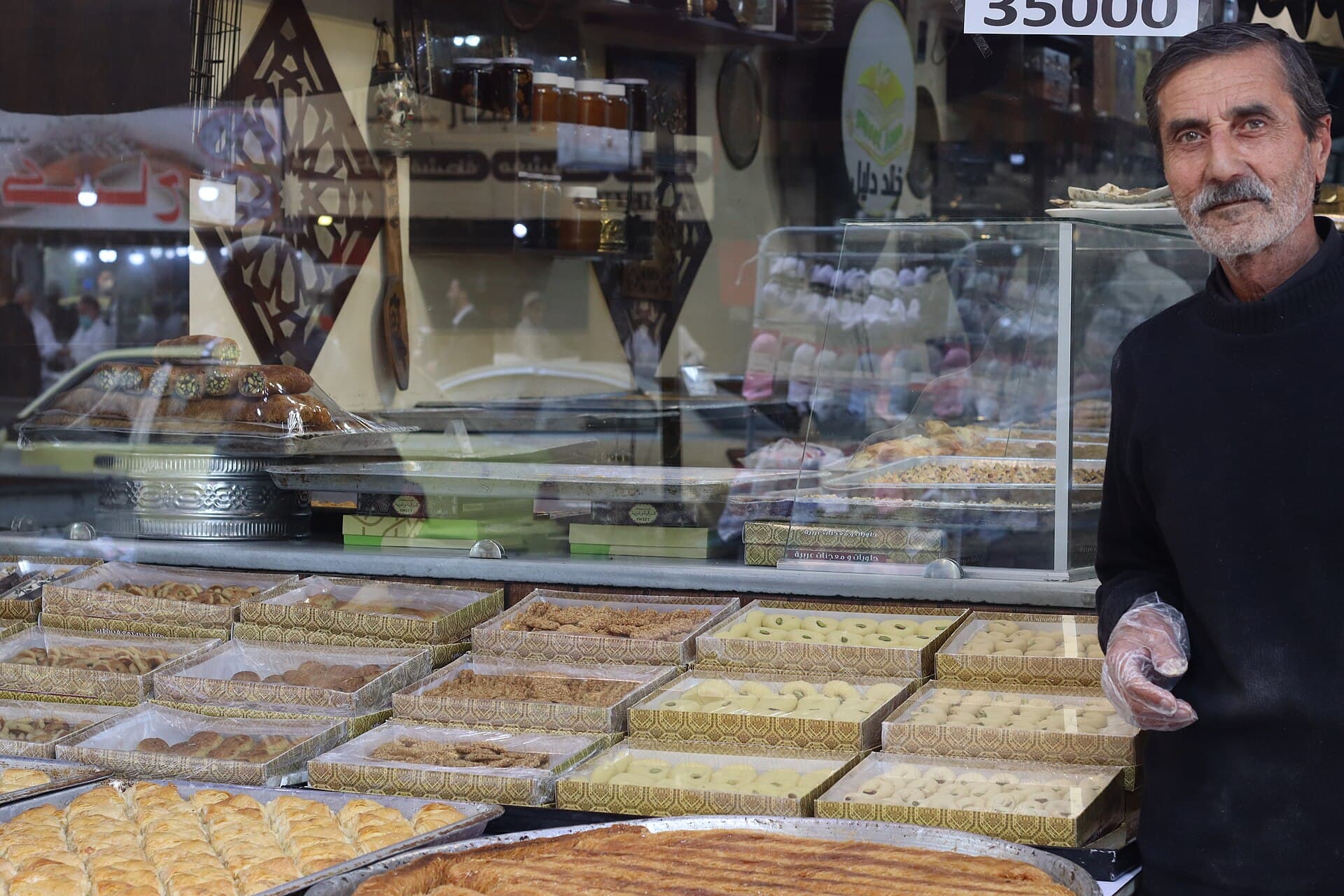
Syrian confectionery is not one kitchen but a craft that divides city by city. In Damascus it has passed from family to family since the 19th century, and some shops are more than a hundred years old. This page gathers which sweet comes from which city, how it is sold and what to look at when choosing; each sweet has its own page.
Which sweet belongs to which city
Aleppo is the city of the pistachio. Karabij arrives with a bowl of natef, the white foam whipped from soapwort root; ballouriyeh carries pistachio between two layers of shredded pastry; knafeh comes hot and cheese-filled; and mamouniyeh is a breakfast sweet of semolina browned in ghee. Damascus works in kataifi and clotted cream: mabroumeh, znoud es-sit, osmalieh, ush al-bulbul. The same city is the home of the biscuit — barazek, sesame on one side and pistachio on the other, and the pale, buttery ghraybeh. Hama is named for halawet el-jibn, a dough of melted cheese wrapped around cream. Homs has its own three: kurmashliyeh, bashmina and balat jahannam. Idlib and Ariha belong to shuaybiyat, Suwayda to lazaqiyat, and the Jazira to klicheh.
Sweets with a season and a date
Some sweets sit on the calendar. Qatayef is the sweet of Ramadan, and naim, awameh, mushabbak, kellaj and madlouqa share that month’s counter. Maamoul is the biscuit of the holidays and of Easter, shaped in a carved wooden mould. Burbara is cooked on one night a year: the feast of Saint Barbara, on 4 December. Hama’s halawet el-mahya is tied to the month of Shaban. Karawiya follows news rather than the calendar — it is boiled when a child is born.
How it is sold
Sweets are sold by weight, not by the piece. Trays are shown to you one by one from the window, and a mixed tray is the safest first purchase: eight or ten kinds in the same box. Before the holidays and before Ramadan the order queue grows and gift boxes are ordered days ahead. The price per kilo changes with the kind, because the amount of pistachio changes; ask what a tray costs before it goes on the scale.
How to tell quality
Three signs. First the fat: a sweet made with baladi ghee behaves differently in the mouth, while vegetable fat leaves a coating and sets hard as it cools. Second the pistachio: Aleppo pistachio is deep green, coarsely broken and clearly scented, so a pale, yellowish nut has come from somewhere else. Third the pastry: fresh kataifi separates into threads, stale kataifi breaks and refuses the syrup. Asking which tray is the shop’s own signature also works; every shop has one it puts forward.
Which ones travel
Anything with clotted cream is eaten the same day. Halawet el-jibn, znoud es-sit, osmalieh, kellaj and shuaybiyat all belong to that group — the cream is made daily and sours by the next. The dry side travels: barazek, ghraybeh, maamoul, klicheh and tahini halva keep for days and go into a suitcase without trouble. Karabij sits between the two: the little logs keep, the bowl of natef beside them does not, so ask for it separately and do not take it on the road.
Where to start
You do not have to pick one sweet; the mixed tray exists for that. On a first round, one pistachio pastry, one biscuit and one cream-filled sweet put three different schools on the same table. After that, ask for the sweet of whichever city you are in: halawet el-jibn in Hama, kurmashliyeh in Homs, karabij in Aleppo. The answer differs in every city, and the shop will tell you when asked.
Tips
- Buy a mixed tray; it is the safest first purchase
- Eat cream-filled sweets the same day — the cream is made daily
- Look at the pistachio: deep green and coarsely broken means Aleppo
- Order queues grow before the holidays; ask for a box early
- The price per kilo changes with the kind; ask before it goes on the scale
Transparency
- How this was chosen
- This page carries the fastest-ageing information on the site: visa rules, exchange rates, border crossings and SIM prices change several times a year. The verification date above says when the facts were last put through their sources; for anything later, check your own foreign ministry travel advice and a Syrian consulate. No figure that is not known for certain is written here.
- Facts checked
- September 2026
- Last updated
- September 15, 2026