Travelling the south: the Hauran and Bosra
Three provinces of the basalt plain, built from the same stone but not in the same state. Bosra is open, Deraa needs care, Sweida is not a destination now.
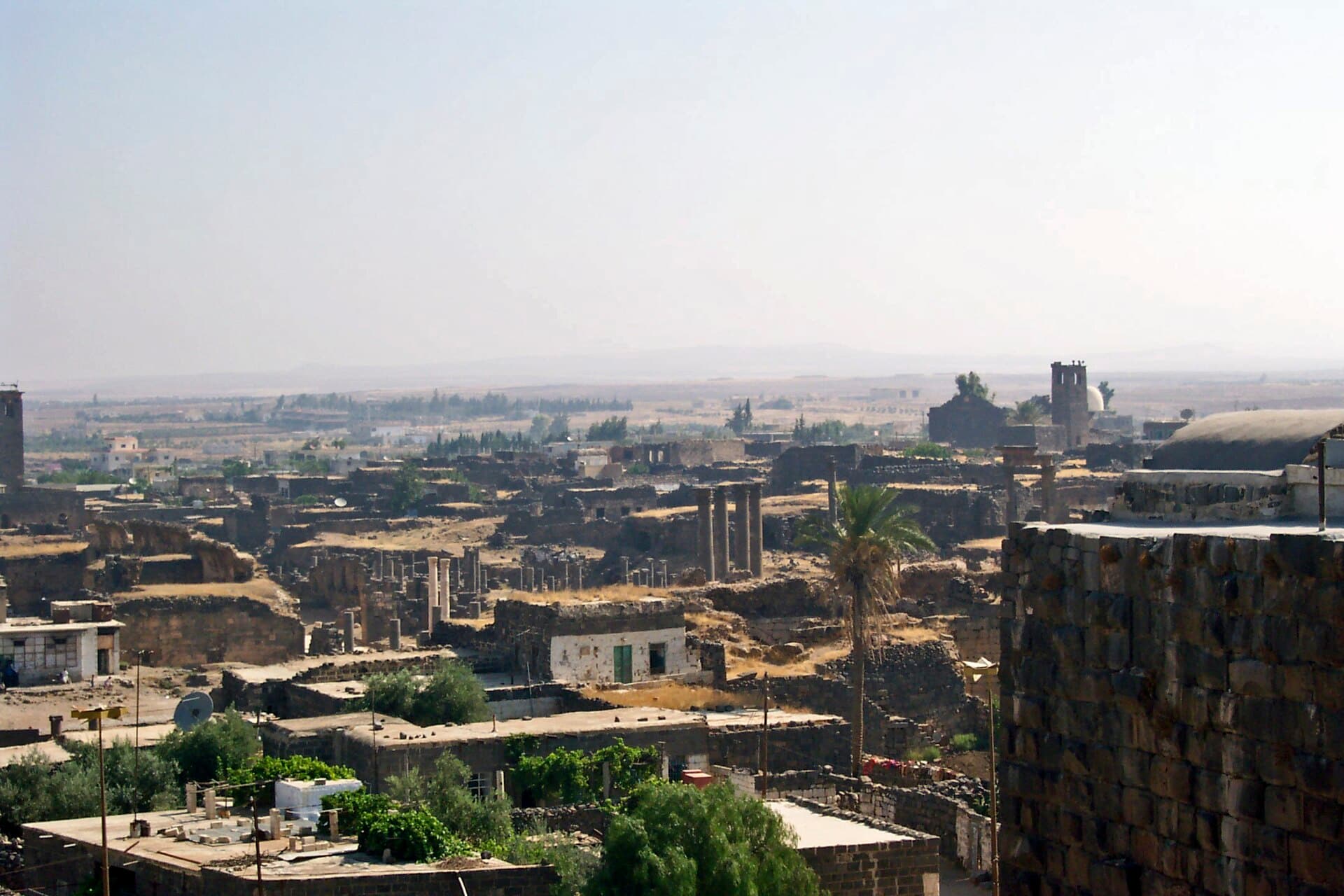
South of Damascus there is a single geography, and it is made of a single material: black basalt. On the Hauran plain the column, the mosque and the house lived in today all come from the same stone. But the region is not one piece — the three provinces differ sharply in how far they can be reached today, and this page sets that out rather than blurring it.
Basalt: the material that explains the region
The Hauran plateau lies at 850 metres and the volcanic rock beneath it has decided everything. Basalt is hard and dark and breaks in thick blocks; on a plain with little timber even the roofs were made of stone, which is why flat roofs resting on stone arches are the region’s own architecture. The Roman theatre, the sixth-century cathedral and a twentieth-century village house all come out of the same quarry. There is a practical consequence too: basalt takes in heat all day and gives it back until evening, so a site stays hot through the afternoon.
Bosra: the open stop
Bosra is around 140 kilometres from Damascus, two and a half to three hours one way with the checkpoints. Walking from one end of the ancient town to the other does not reach a kilometre. From the theatre north along the colonnaded street come the Roman market, the central baths and the Mosque of Omar, with the remains of the sixth-century cathedral at the eastern end. The theatre survived so intact because it was enclosed inside an Ayyubid fortress; according to UNESCO it is the only Roman theatre whose upper colonnaded gallery is preserved complete.
As things stand: Bosra is open to visitors, there is a tourist police patrol on site, and foreign groups came through between 2025 and 2026. The ancient town is not a fenced enclosure — people still live among the remains, and a two-thousand-year-old wall goes on being the wall of a house. Be at the theatre in the first hour of daylight: the seating is in shade then and the town is still quiet.
Deraa and Ezraa
Deraa is 117 kilometres from Damascus, an hour and a half on the motorway, and up to two with checkpoints. Half a day covers the city. In the old town — Deraa al-Balad — the Mosque of Omar is the oldest building still standing, and the fabric around it is the Hauran’s own architecture. Northeast is the Hejaz railway station; the line was completed in 1908 and Deraa was the junction of the Medina route and the Haifa branch. There are no trains now.
The way to fill the day is to go north. Ezraa is 40 kilometres away and holds more to see than the city itself: the Church of Saint George, built in 515, is the oldest church in Syria still in use, and has been working ever since. The day linking the two is 84 kilometres and three stops. Do not squeeze Bosra into it — it is 40 kilometres east, but the ancient town wants four hours at least and should have its own day.
As things stand: the city is under government control and the motorway is running. Against that, there is unexploded ordnance in the ruined quarters, Deraa al-Balad above all. There were armed incidents and tribal clashes across the province through 2025, and cross-border military operations continue in the western countryside. In the ruined quarters stay on the path and do not climb into rubble.
Sweida: this page does not say you can go
This has to be written directly. Sweida has been inside armed conflict since July 2025. In the fighting between Druze armed groups, Bedouin tribes and government forces, more than 1300 people were killed, most of them Druze civilians. The United Nations reported more than 93 thousand people displaced across Sweida, Deraa and the Damascus countryside. A ceasefire was declared in mid-July 2025, but violations continued through 2026.
What that means in practice: the province is not in effect under central government control, and the roads in from Damascus cross the front line. There is no accommodation in the city that can be recommended to a visitor, and that is not a matter of preference. This page describes the region. It does not say it can be visited today.
The Decapolis: when the area opens
The three stops around Sweida are at the top of the list for whenever conditions change. Qanawat is 7 kilometres northeast of the city: the temples of the Decapolis city of Canatha, its rock-cut theatre and a palace converted into a basilica are there. Shahba is 20 kilometres north, the town the emperor Philip the Arab was born in and rebuilt, left unfinished at his death; its mosaics are in the Sweida museum. Salkhad is 30 kilometres southeast, with an Ayyubid castle on the cone of an extinct volcano.
A day linking the three starts at the museum and closes at 41 kilometres — but that route, like this page, is written conditionally. If the situation in the province changes, this is one of the least known ancient clusters in Syria.
Season and hour
The climate on the Hauran plain is semi-arid: almost all the annual rain falls in winter and none at all between June and September. In those months there is no shade either. April to May and October to November are the right windows; the plain is green in April and just harvested in October. Winter nights drop below freezing and snow falls on the Sweida plateau. For the hour, one rule is enough: the first hour of daylight. The basalt has not warmed yet and the sites are empty.
Getting there and sleeping
Public transport works through Deraa: for years the Deraa and Suwayda minibuses left Damascus from Bab Musalla, and in July 2026 the lines were set to move gradually to the new southern garage on Thalathin Street. Ask which garage they leave from before you set out. Those going to Bosra usually change at Deraa. A car with a driver keeps the day flexible and lets you link Ezraa and Bosra as separate days. The Nasib crossing into Jordan is on the Damascus–Amman road and the border is 13 kilometres south of Deraa, which makes this a stop on the way for anyone combining the region with a Jordan crossing.
Accommodation is this region’s weak point. There is effectively nothing aimed at visitors in Bosra, the choice in Deraa is thin and changes fast, and in Sweida there is nothing. Almost every visitor uses Damascus as a base and comes for the day, and in practice that is the right answer. If you must stay, confirm by phone before you set off.
The honest summary
The Hauran looks like one region and divides into three. Bosra can be visited today and earns a day from Damascus on its own. Deraa can be visited, but half a day in the city comes with care in the ruined quarters. Sweida and the Decapolis cities around it are written up on this site because what they are is worth telling; when they can be seen is a separate question, and the answer is not on this page but in current advice and on the ground. A plan that erases that distinction has been built wrong.
Tips
- Plan Bosra as one day from Damascus; you need to leave at seven
- Deraa and Ezraa make one day, Bosra another; do not merge the three
- In ruined quarters stay on the path and do not climb into rubble
- For Sweida province read current advice; this page does not say go
- Be on site in the first hour of daylight; basalt heats through the afternoon
Transparency
- How this was chosen
- This page carries the fastest-ageing information on the site: visa rules, exchange rates, border crossings and SIM prices change several times a year. The verification date above says when the facts were last put through their sources; for anything later, check your own foreign ministry travel advice and a Syrian consulate. No figure that is not known for certain is written here.
- Facts checked
- September 2026
- Last updated
- September 15, 2026