Sheikh al-Batrani Mosque, Latakia
A mosque in Latakia’s al-Kamiliyah quarter where a small Mamluk-era vaulted hall survives inside the 2005 and 2015 extensions, and how to tell old from new.
- Opening hours
- Current status not verified — check at the door
- Entry
- Not verified — check at the entrance
- Duration
- 20 minutes
- Best time
- Daytime, outside prayer times, when the historic hall is quiet
- Period
- Mamluk (most likely 14th–15th century); extensions in 2005 and 2015
- Address
- Al-Kamiliyah quarter, Latakia
A shrine and mosque in the al-Kamiliyah quarter of Latakia, linked to Sheikh Abu Bakr al-Batrani. Most of what you see is recent. Major extensions in 2005 and 2015 added the tall minaret, the portico and most of the small domed sections. Wrapped by them on three sides is a small vaulted hall thought to date from the Mamluk period, when Syria was ruled from Cairo. In front of the mosque lies a large garden that most people in the city know well.
Where it is
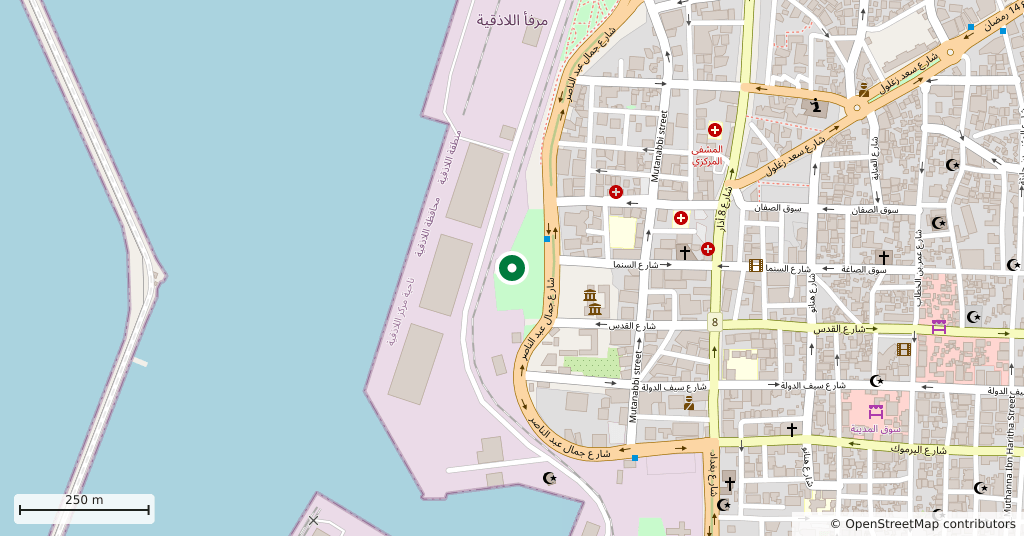
The mosque is in the city centre, in al-Kamiliyah, close to the Latakia National Museum. Flower fairs and book fairs are held every year in the big garden in front, and locals often speak of the mosque and the garden together. At times the garden also turns into a small zoo.
Which part is old
The historic section is rectangular. Two cross vaults form its ceiling, resting on massive stone piers. In the south wall is a plain mihrab, the niche that marks the direction of prayer, set under a pointed arch, and it is original. The Turkish Kültür Envanteri database places this hall in the Mamluk period, most likely the 14th or 15th century, and Arabic Wikipedia gives the same estimate. From outside, the minaret and portico catch the eye first, but both are recent work.
Who was Sheikh al-Batrani?
The sources do not agree. The mosque’s name ties it to Sheikh Abu Bakr al-Batrani al-Andalusi, a title that points to origins in al-Andalus, Muslim Spain. Arabic Wikipedia, however, counts him among the sheikhs of Yemen in the 7th century of the Hijri calendar. Some local accounts give the date 675 AH, or 1277 AD. That is earlier than the 14th–15th century estimate based on the architecture. The sources available today cannot settle which is right.
How long it takes
Twenty minutes is enough. The historic hall is what to look at; the modern sections take little time. Its current status has not been verified: no source specific to this building from the past year could be found. Ask at the door about opening times and entry.
Don’t miss
The plain mihrab in the south wall. Among the decoration of the new sections it barely stands out, yet it is the clearest sign of the building’s Mamluk core. Looking up from in front of it, you see the cross vaults and the piers that carry them in one view.
Tips
- To find the historic part, look for the massive stone piers and cross vaults; the modern additions have none
- The plain pointed-arch mihrab in the south wall is original; the decorated sections are new
- The tall minaret and the portico come from the 2005 and 2015 extensions, not the old building
- The Latakia National Museum is close by; both fit into one walk
Transparency
- How this was chosen
- Written by hand; opening hours, entry fee and coordinates are kept as data. A field that is not known for certain is marked as variable rather than guessed.
- Facts checked
- September 2026
- Last updated
- September 15, 2026