St Nicholas Church, Latakia
Latakia’s Greek Orthodox church on the goldsmiths’ souq, repaired in 1722 and merged with Mar Musa in 1845. A street now runs over part of the older building.
- Opening hours
- Current status not verified — check at the door
- Entry
- Not verified — check at the entrance
- Duration
- 20 minutes
- Best time
- Daytime; the façade and plaque read best in daylight
- Period
- Origin disputed (6th century suggested); repairs 1722 and 1845
- Address
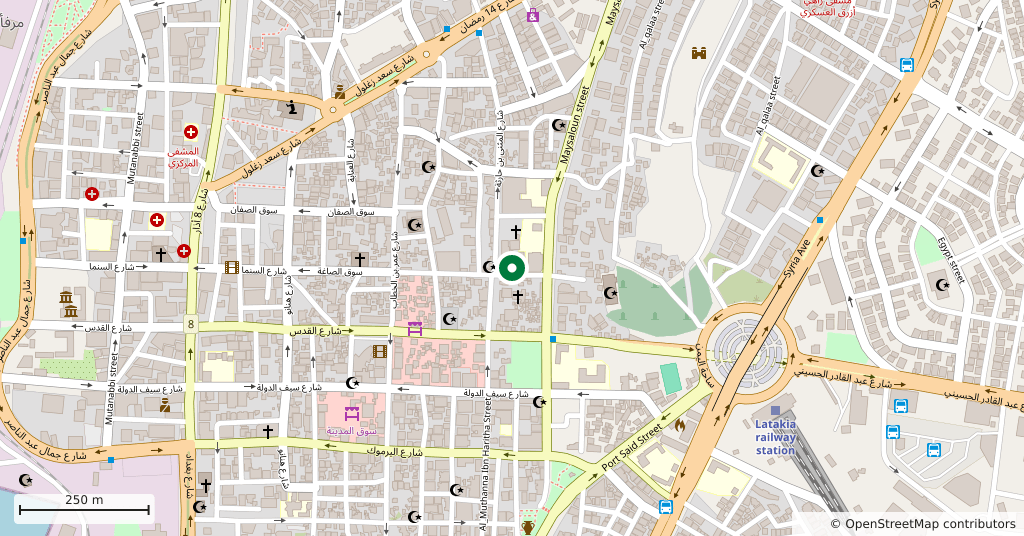
- Corner of Souq al-Sagha and al-Muthanna ibn Haritha Street, al-Qalaa quarter, Latakia
A Greek Orthodox church in Latakia’s old al-Qalaa quarter, on the corner of Souq al-Sagha, the goldsmiths’ souq. It is often called the oldest surviving church in the city, but when it was built is not certain. The present building is only the eastern end of a much larger church: a street now runs over part of the old building, and the mosque across the road stands on the foundations of another part.
Where it is
The church stands at the north-east corner where Souq al-Sagha meets al-Muthanna ibn Haritha Street. Across the street, to the west, is the Ubada ibn al-Samit Mosque. The old Armenian church of the Holy Virgin is about 60 m to the south-east, and St George, the city’s Greek Orthodox cathedral, about 300 m to the west. All three fit into one short walk.
When was it built?
Two sources say two different things. German Wikipedia dates the church to the 6th century and calls it the oldest surviving church in Latakia. Arabic Wikipedia says the real date of construction is unknown and that the first known date is a repair in 1722. What is certain is a long history of repairs. Earthquakes struck Latakia again and again and brought the church down more than once. In 1722 it was repaired after its north and west walls collapsed. In July 1845, after another earthquake, it was joined to the neighbouring church of Mar Musa (St Moses) and rebuilt. Mar Musa is thought to have been built by the Syriac community.
What to see
The walls are sandstone and vaulted arches carry the roof. The front is a flat, plain wall, topped by a small bell tower with a small cross. The street level has risen since the church was built, so the main entrance now sits below the road. Inside is a marble plaque with verses dating the 1845 merger. According to German Wikipedia, a large share of the icons date from the 17th and 18th centuries, and some were brought from Russia.
How long it takes
Twenty minutes. Its current status has not been verified: no source specific to this church from the past year could be found. Whether the door is open, and the times of services, need asking on the spot.
Don’t miss
Reading the church’s old size in the street itself. The main entrance sitting below street level shows the building’s age, and the Ubada ibn al-Samit Mosque opposite stands on the foundations of the old church’s westernmost end. The road in front of you runs where the inside of one building once was.
Tips
- The main entrance is below street level; look down when searching for the door
- Ask to see the marble verse plaque inside, dated 1845
- The Ubada ibn al-Samit Mosque opposite stands on the old church's western foundations; look at the two together
- The Armenian Church of the Holy Virgin is about 60 m away and St George Cathedral about 300 m
Transparency
- How this was chosen
- Written by hand; opening hours, entry fee and coordinates are kept as data. A field that is not known for certain is marked as variable rather than guessed.
- Facts checked
- September 2026
- Last updated
- September 15, 2026