Akkoub, the spring thistle
A thorny wild thistle of spring. What is eaten is the unopened flower head and the young stem, picked between March and May and, in Syria, baked into pies.
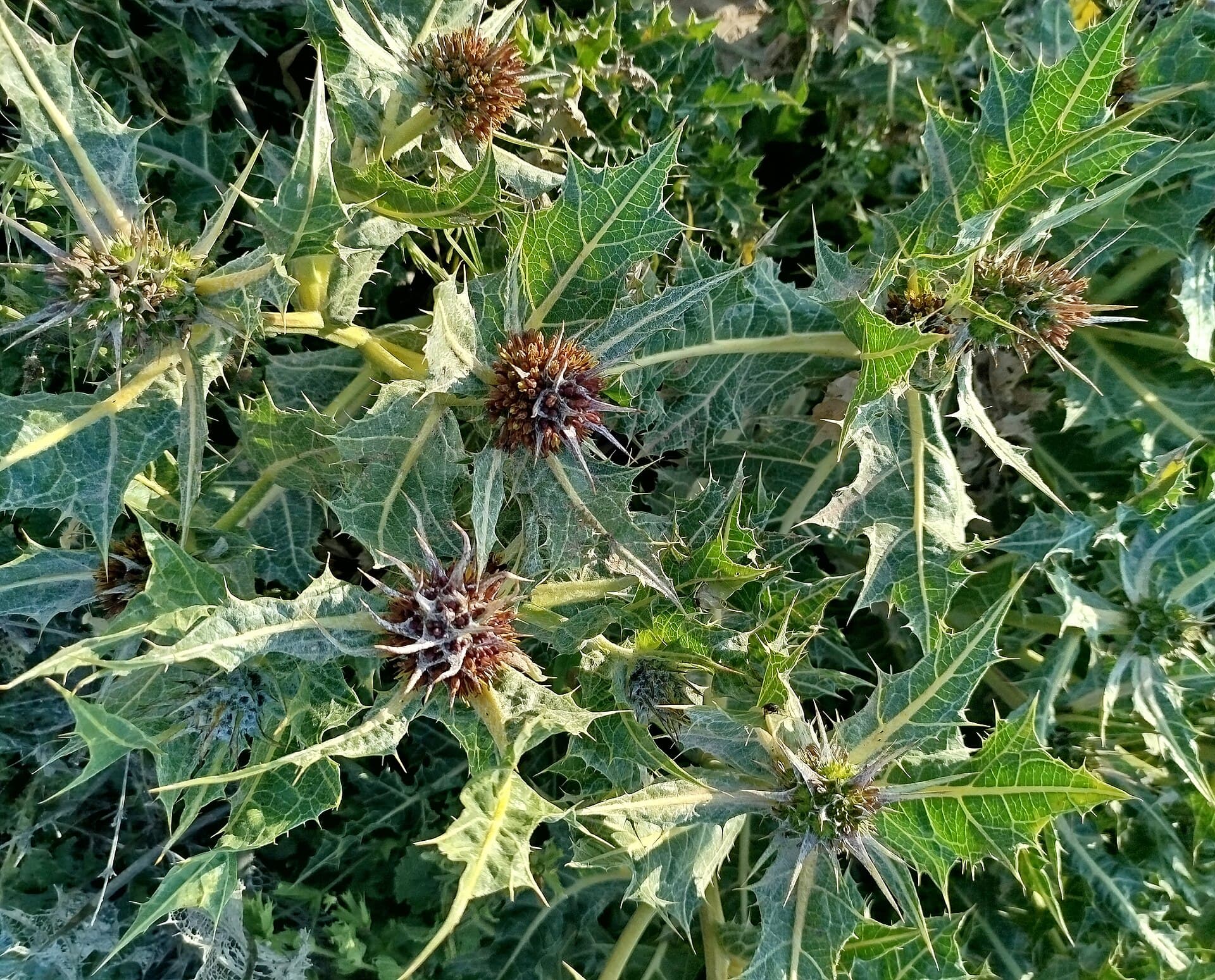
- Where to eat it
- In spring at home tables and in bakery pies; at the market in bunches through the season, most often with the thorns still on.
- Price
- Seasonal and unsteady — ask the price of a bunch at the market
- When it is eaten
- Between March and May; the season lasts a few weeks
On the stall akkoub does not look like food: grey-green, the size of a palm, thorned from top to bottom. What is eaten is the unopened flower head, the young stem, and the base of the leaves just under the soil. The taste is usually described as somewhere between artichoke and asparagus. In Syria the best known form is baked into pies, and the season runs a little over a month.
When it appears
The season is short. The plant flowers between February and May, and the picking is done between March and May. After that the stem dries, breaks free of the root and rolls away with the wind, scattering seed as it goes. The bunch you see on a market table in April is gone a few weeks later, and out of season there is no fresh akkoub to look for.
How it is cleaned
The work comes in two stages, and this is where the labour sits. The stem is cut at the base. Then the thorns and the membranes around the head are taken off one by one with a knife and scissors, and at home that is usually a table full of people rather than one pair of hands. Every part of the plant carries latex, so hands and blades go sticky. Cleaned bunches are also sold at the market, and the difference in price is the price of that work.
How it is cooked
The Syrian way is the pie: the cleaned heads go inside dough and into the oven. The second way, common across the region, is to fry them in olive oil, cook them with pieces of meat, and serve them with yoghurt. A third puts a trimmed head inside a meatball, fries it, then simmers it in a lemon sauce. Bedouin and Arab kitchens also make akkoub soup from the base of the young leaves.
The plant’s other uses
The table is not the only use. The latex from the stem is made into a chewing gum, known in Turkish as kenger gum. Seeds and roots, roasted and ground, stand in for coffee. Salted roasted seeds reach the nut sellers and are called sissi in Iraq. Pressing oil from the seed is very old: charred flower heads found at Neolithic sites point to it.
A plant under pressure
Akkoub is not farmed. It is gathered, which leaves it exposed to the pressure of collection. Overharvesting is a documented problem in the region, and in some places gathering from the wild has been restricted by law. So the question worth asking over a bunch at the market is not the price but where it came from.
Tips
- A cleaned bunch costs more but the work is done; an uncleaned one means hours at the table
- Every part of the plant is thorny and full of latex; gloves help when you clean it
- If it is your first time, start with the pie; the version with meat and yoghurt is heavier
- There is no fresh akkoub out of season; once April has passed, do not press for it
Transparency
- How this was chosen
- Two kinds of record live here: the dish itself, and the place that serves it. Both are chosen and written by hand; ranking is not for sale and there are no sponsored entries. If a price range is not known for certain, it says so. Venues that serve alcohol are not listed on this site at all.
- Facts checked
- September 2026
- Last updated
- September 15, 2026