Arabic Coffee and Murra
Cardamom-heavy, boiled rather than filtered, poured a mouthful at a time. How the bean is roasted, how murra is brewed, and what the three cups really mean.
- Where to eat it
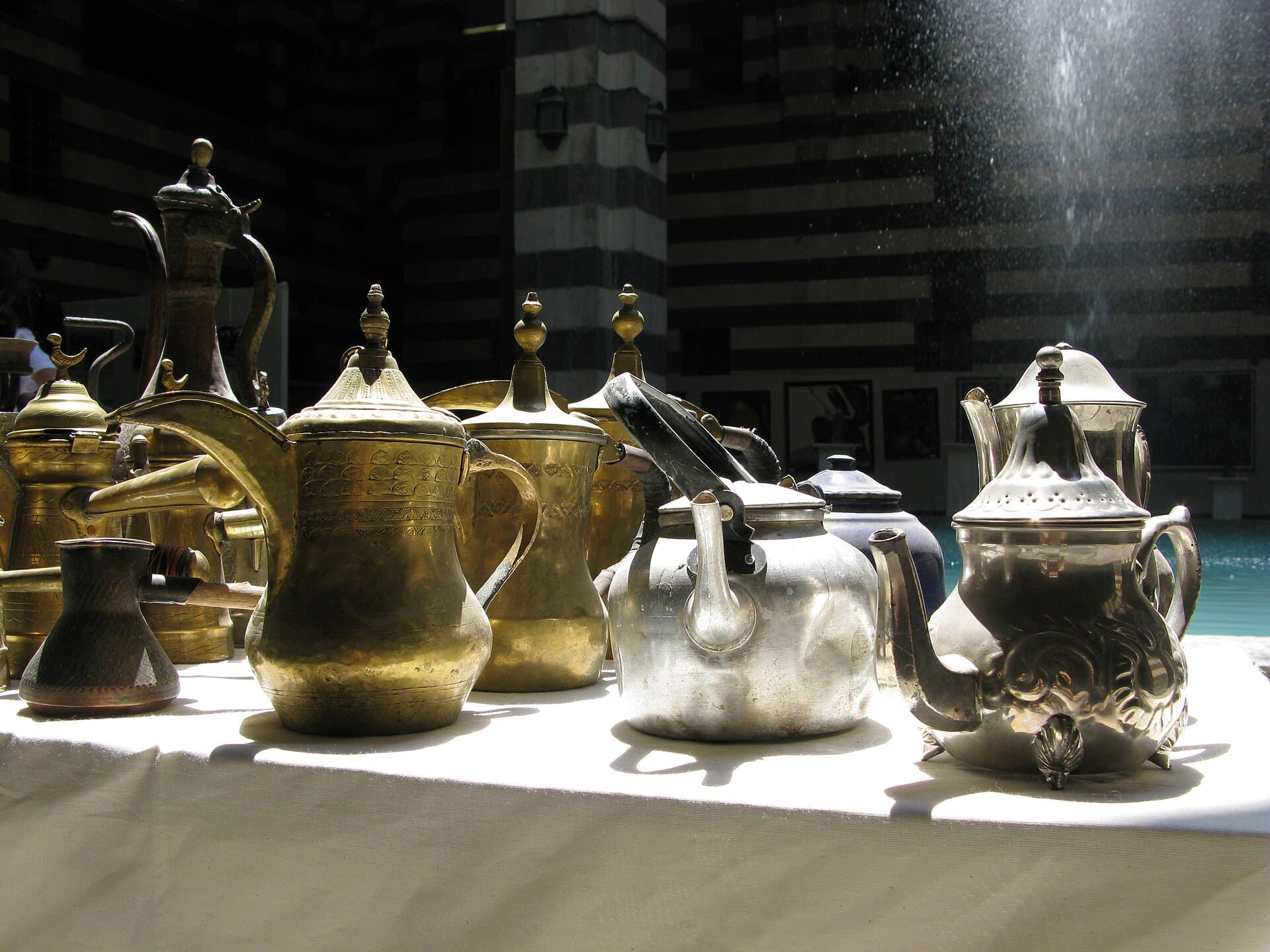
- Poured at home and in the guest room from a brass dallah into handleless cups; in coffeehouses as Damascene coffee. Beans and cardamom at spice merchants.
- Price
- Variable — coffee offered at home is never paid for; ask a café's price before you sit
- When it is eaten
- All year; as a hospitality coffee it belongs to morning and late-afternoon sittings
The Arabic word for the drink is simply qahwa. It is made from Arabica beans and it reached Damascus by way of Yemen. Coffee was being drunk in Yemeni Sufi lodges in the 15th century to hold off sleep through night devotions, and from there it travelled to Mecca and Medina and on to Cairo, Damascus, Baghdad and Constantinople. A court in Mecca banned it in 1511; the ban was overturned in 1524 by order of the Ottoman sultan Suleiman.
How the bean is prepared
The traditional route needs two tools. Green beans are roasted in a mihmas, a flat long-handled pan, then cooled and crushed in a mihbaj, a mortar of wood, stone or brass. The rhythm of the pestle told the neighbours that coffee was on and guests were welcome; the sound was the invitation. Roasts run from light to dark. Cardamom goes in, sometimes cloves or saffron.
How murra is brewed
The coffee is boiled rather than filtered, which is why it comes out strong and concentrated. In the Levant it is made in a long-handled rakwa; among Bedouin and in the countryside a long-spouted bakraj takes over. The bitter Bedouin coffee, qahwa murra, is brewed for hours from coarsely ground beans and whole cardamom, sometimes with a fermented starter called khamira, and it is always served unsweetened.
How the serving works
The pouring follows an order: the host, or the eldest son, moves clockwise and fills according to age. The cup is small and has no handle, and it is never filled — a mouthful goes in each time. It is polite to accept three cups and to close the last one with daymen, “always”, a wish that the host may always have coffee to give. For the signal that stops the pouring, and for the sugar words used in cafés, see the coffeehouse culture page on this site.
Where to drink it, where to buy it
Murra belongs to the house and the guest room rather than the café; it is also the coffee of condolence visits and weddings. What arrives in a coffeehouse is usually Damascene coffee, unfiltered and made in a long-handled pot. Beans and cardamom are sold by spice merchants, and buying roasted beans unground keeps the aroma for longer.
Tips
- Accepting three cups is the polite number, and "daymen" closes the last one
- Murra is served without sugar; try it as it comes rather than asking for sweetening
- If cardamom is too strong for you, ask for less of it when you order
- Buy roasted beans unground — ground coffee loses its aroma much faster
- The cup is small and never full; that is the rule of the service, not meanness
Transparency
- How this was chosen
- Two kinds of record live here: the dish itself, and the place that serves it. Both are chosen and written by hand; ranking is not for sale and there are no sponsored entries. If a price range is not known for certain, it says so. Venues that serve alcohol are not listed on this site at all.
- Facts checked
- September 2026
- Last updated
- September 15, 2026