Khubz Arabi — Syrian Flatbread
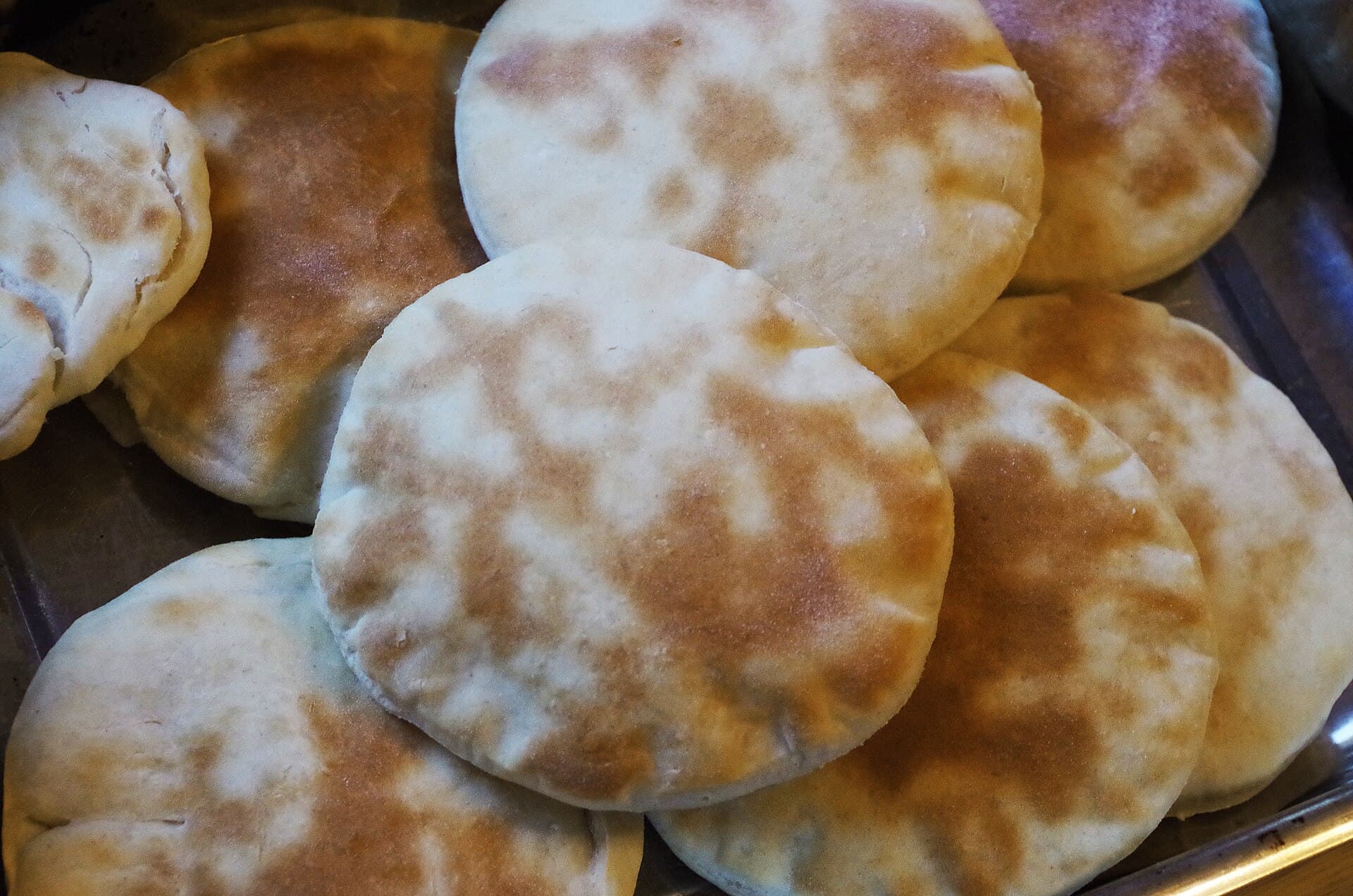
Syria’s everyday loaf: leavened, two-layered, hollow in the middle. It puffs and falls in the oven in seconds, and at the table it does the work of a fork.
- Where to eat it
- At every bakery and on every table. A stack is bought in the morning and finished the same day; it is also the bread of a shawarma or falafel wrap.
- Price
- Variable — ask the price of a stack at the bakery
- When it is eaten
- Morning, straight off the oven belt
This is what reaches the table in Syria most of the time: white flour, leavened, flat and round. Passing through the oven it swells at once in the high heat. It balloons, then falls as it comes out. A pocket is left between the two layers. That pocket is what sets the bread apart from everything else.
Why it is hollow
Moisture in the dough turns to steam in the heat and pushes the top surface away from the bottom. The loaf stands like a ball for a few seconds. When the heat drops it sinks. The two layers never rejoin. The result is a pocket that opens without a knife. The shawarma seller slits it along the edge and fills it with meat or falafel.
What it does at the table
It does the work of a fork. A piece is torn off, folded between two fingers into the shape of a spoon and used to lift hummus, mutabbal or beans off the plate. This is why bread arrives in a stack rather than in slices, and sits in the middle of the table. Yesterday’s bread is not thrown out: it is broken under a fatteh and fried into fattoush.
How it differs from markook and tannour bread
All three can appear at one table, and they are often confused. Markook is unleavened, single-layered and as thin as paper, cooked on a convex griddle. Tannour bread is wholewheat, thick and brown, pressed onto the inner wall of a clay oven. Khubz arabi is neither. It is leavened, made from white flour, two-layered, and baked on an oven belt. In English writing this is the bread called Syrian bread.
Buying it
Bakeries sell it in plastic-wrapped stacks. A warm stack stays soft in the hand well into the evening. It is also the subsidised loaf, the one Syrians call tayin. Its price and the queue outside the bakery are a permanent subject of daily conversation, and the first piece of economic reality a traveller meets. The price shifts often; ask at the counter.
Tips
- Buy the stack warm; once cold the pocket stays but the bread dries
- For a wrap, ask for it slit along the edge rather than across the middle
- Do not throw out the stale loaves; they go under fatteh and into fattoush
- The price moves from month to month — ask at the counter, do not assume
Transparency
- How this was chosen
- Two kinds of record live here: the dish itself, and the place that serves it. Both are chosen and written by hand; ranking is not for sale and there are no sponsored entries. If a price range is not known for certain, it says so. Venues that serve alcohol are not listed on this site at all.
- Facts checked
- September 2026
- Last updated
- September 15, 2026