Mafroukeh
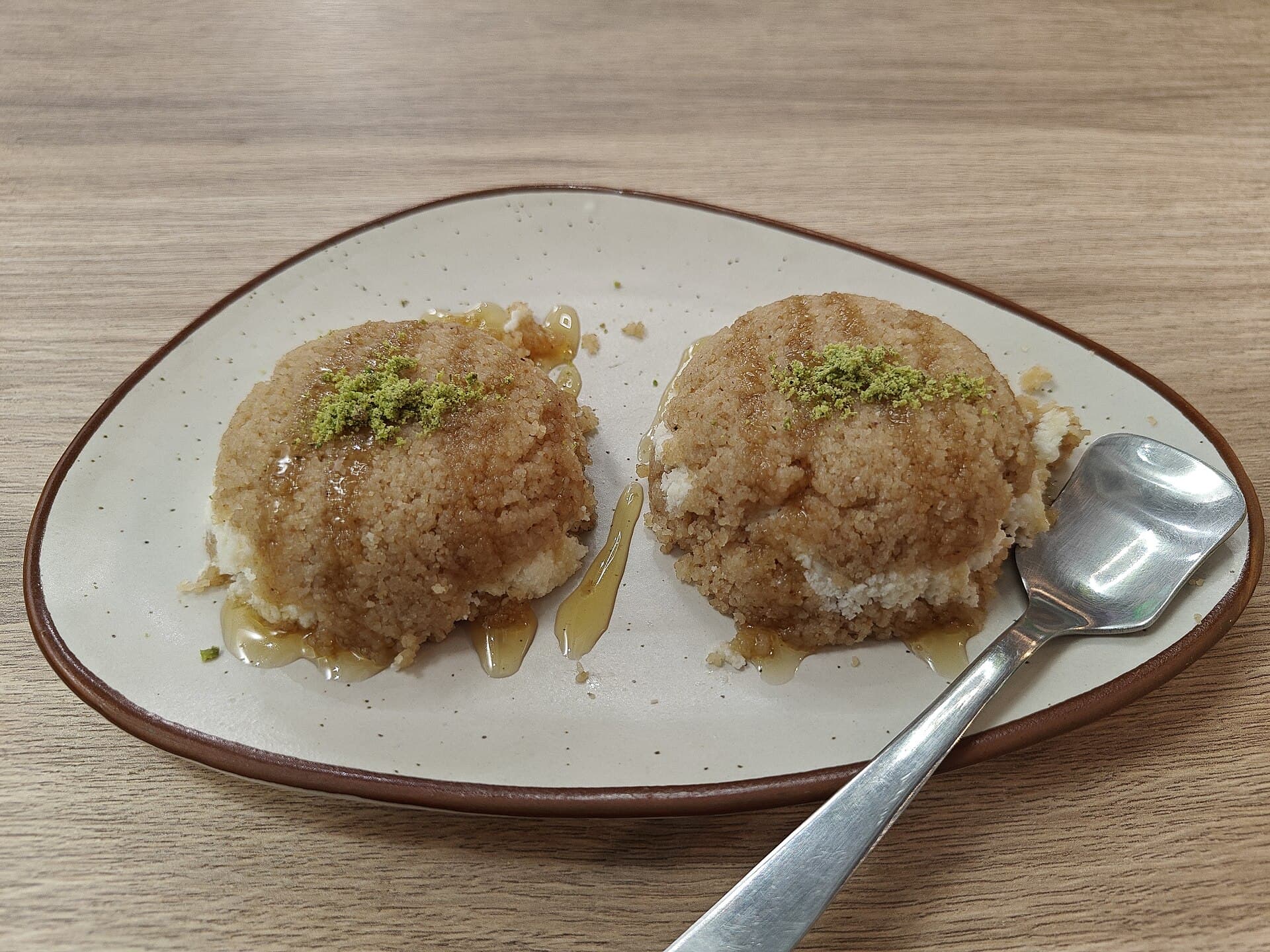
Semolina roasted in butter and kneaded with sugar, under a layer of clotted cream and crushed pistachio. The records give its origin as Lebanon. Share the plate.
- Where to eat it
- In the clotted cream section of a sweet shop, served on a plate for the table. The records tie the dessert to Lebanese cooking.
- Price
- Variable — ask the price of the plate at the counter
- When it is eaten
- Warm, while the cream has only just been spread
Semolina roasted in butter and kneaded with sugar is spread on a plate, a layer of qishta clotted cream goes over it, and crushed pistachio finishes it. The name means kneaded. The records give its origin as Lebanon, and nothing on hand documents its place in Damascus — it belongs to the Levantine family of desserts built on clotted cream, and it is a close relative of medlouka.
How it is made
The semolina is roasted in butter. When the colour turns and the smell comes up, sugar goes in and the mixture is worked by hand, which is where the name comes from. It is then spread on a tray or straight onto the plate, the cream is smoothed over it, and crushed pistachio goes on last. Qatr syrup and rose water are in it too. The list is short: semolina, butter, sugar, almond, pistachio, pine nuts, syrup, rose water and clotted cream.
Two kinds
The source names both: mafroukeh with qishta and mafroukeh with pistachio. The first is led by the cream layer, the second by the nuts. They are also made together. Telling them apart through the glass can be hard, because pistachio covers the top of either one.
How it differs from medlouka
Medlouka also pours hot semolina onto a plate and finishes it with cream, so from a distance the two look alike. The difference sits in two places. Mafroukeh’s semolina is roasted first and then kneaded, and roasted semolina leaves a grainier texture. The second is the nut ratio: almond, pistachio and pine nuts all go in.
Where to eat it
It is a plate for the middle of the table. A portion of around 200 grams carries 633 calories and 25 grams of fat, most of it saturated. The number also tells you how it is eaten: not as one person’s dessert, but shared a few spoons at a time. Plain coffee alongside balances it.
Tips
- Two kinds exist — the glass will not tell you which, so ask
- It is a plate for the table; as a single portion it sits heavy
- People confuse it with medlouka; mafroukeh's semolina is roasted and grainy
- Butter and cream are in it — skip it if lactose is a problem
Transparency
- How this was chosen
- Two kinds of record live here: the dish itself, and the place that serves it. Both are chosen and written by hand; ranking is not for sale and there are no sponsored entries. If a price range is not known for certain, it says so. Venues that serve alcohol are not listed on this site at all.
- Facts checked
- September 2026
- Last updated
- September 15, 2026