Markook — Syrian Saj Bread
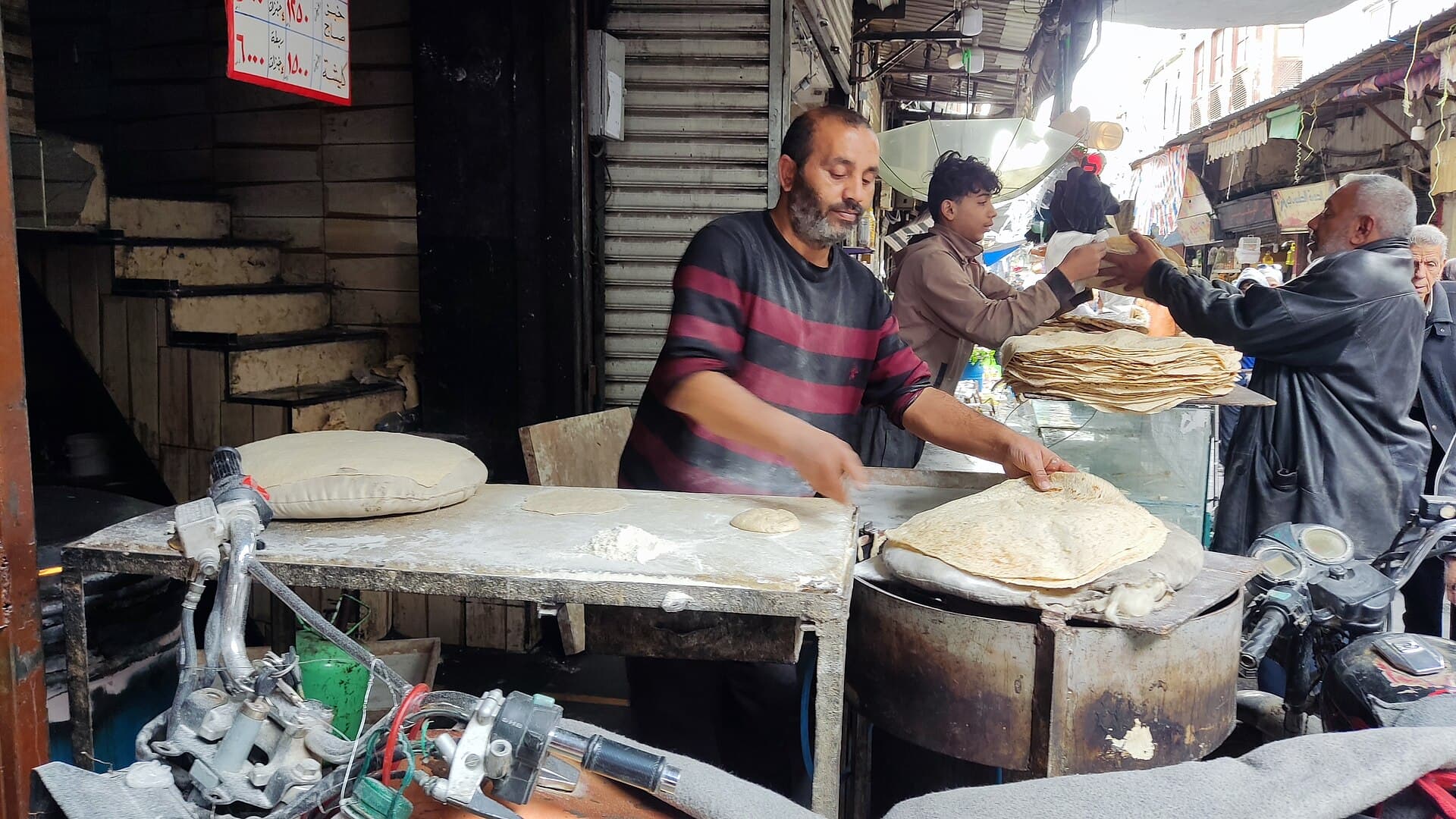
Flour, water and salt. The unleavened dough is stretched over a cushion until it is translucent, then cooked on a domed griddle in seconds. Buy it warm.
- Where to eat it
- At market counters and village bakeries, as long as the saj is hot. Used for wrapping, for scooping and under a fatteh; it sits beside every dish.
- Price
- Variable — sold in stacks at the counter; ask the price
- When it is eaten
- Morning and late afternoon; best bought while the saj is hot
This is the thin bread of Syria. Nothing goes into the dough but flour, water and salt; there is no yeast. The balls are turned and stretched over a round cushion until the edges let the light through, then flipped onto a convex iron griddle, the saj. Cooking is measured in seconds: one side blisters, it is turned, lifted and folded at once. The stack on the counter can reach half a metre.
Where the name comes from
The name rests on the Arabic raqiq, meaning thin or delicate. The same bread appears in the 10th-century cookbook of Ibn Sayyar al-Warraq under the name ruqaq, and the description matches: large, paper-thin, unleavened. The name shifts by region — shrak, ruqaq, mashrouh.
How it differs from tannur bread
The difference is method, not ingredient. Tannur bread is slapped onto the inner wall of a clay oven and comes out thick and open-crumbed. Markook cooks on the outer face of the saj and stays as thin as paper. The two do different jobs at the same table: tannur bread for scooping, markook for wrapping and for breaking under a fatteh.
What you go to see is the baking, not the bread
You understand this bread at the counter, not in a shop window. The baker turns the dough over the back of the hand, throws it against the cushion and drops it onto the middle of the saj; the hands never stop and one loaf takes under a minute. In mountain villages and out in the country the same work is done over a stone hearth. Ask before you photograph.
Tips
- Buy it warm; folded and a day old it breaks apart
- Ask while you wait at the saj — most places bake it in front of you
- For wrapping ask for the thin one; for scooping ask for tannur bread
- Do not throw out the dry sheets; crumbled, they go under a fatteh
Transparency
- How this was chosen
- Two kinds of record live here: the dish itself, and the place that serves it. Both are chosen and written by hand; ranking is not for sale and there are no sponsored entries. If a price range is not known for certain, it says so. Venues that serve alcohol are not listed on this site at all.
- Facts checked
- September 2026
- Last updated
- September 15, 2026