Mfarakeh
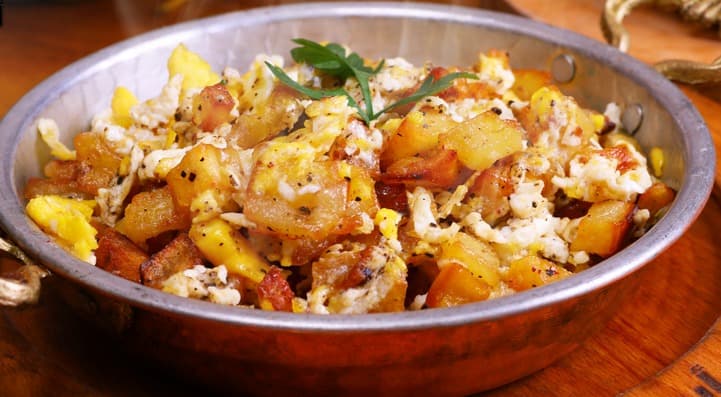
Potato cubes fried in clarified butter with eggs broken over them, scattering through the pan as they set. The inland breakfast pan, eaten with bread.
- Where to eat it
- At breakfast restaurants and guesthouses in Damascus and the inland cities; in homes as a morning or light evening meal.
- Price
- Variable — ask the price of a pan when you order
- When it is eaten
- Breakfast, with tea
Potato is cut into cubes and fried in clarified butter, then eggs are broken over it and stirred through. The egg does not hold together as one piece; it scatters between the potatoes and sets that way. Cumin, salt and black pepper go in, and fresh coriander at the end. Tea beside it.
What the name says
Mfarakeh comes from the Arabic root farak, to crumble or to scatter. The name describes the movement in the pan: the egg breaks up rather than setting like an omelette. The same root is used for ripe wheat rubbed apart by hand, so the word is already familiar in a Syrian kitchen.
Tomato on the coast, potato inland
The Syrian morning egg dish runs along two lines. On the coast there is jaz maz: tomatoes cook in fat and eggs are broken over them. Inland there is mfarakeh: potato fries in clarified butter and eggs are broken over that. Same movement, different base.
The difference shows on the table. Jaz maz is a wet pan, loose with tomato juice; mfarakeh is dry and more filling, because the potato takes the fat into itself. In Latakia you ask for the first, in Damascus and the inland cities for the second.
How it is eaten
The pan goes to the middle and everyone dips with bread; sharing it out onto plates is not the custom. Using a spoon is not wrong, but nobody does. It comes out as a morning meal, and a household wanting something light in the evening puts the same pan on. It takes minutes and the ingredients are in every kitchen.
Where to find it
In Damascus and the inland cities at restaurants serving breakfast, at guesthouses and in homes. If it is not on the menu, asking is enough. The breakfast page in this section covers the Syrian morning as a whole, and mfarakeh sits there as the inland plate.
Tips
- If it is not on the menu, ask; the ingredients are in every kitchen
- The pan goes to the middle — dipping with bread is the local way rather than asking for a plate
- Fresh coriander goes in at the end; say so when you order if you would rather not have it
- If clarified butter is too heavy for you, you can ask for it made with olive oil
Transparency
- How this was chosen
- Two kinds of record live here: the dish itself, and the place that serves it. Both are chosen and written by hand; ranking is not for sale and there are no sponsored entries. If a price range is not known for certain, it says so. Venues that serve alcohol are not listed on this site at all.
- Facts checked
- September 2026
- Last updated
- September 15, 2026