Osh el-bulbul
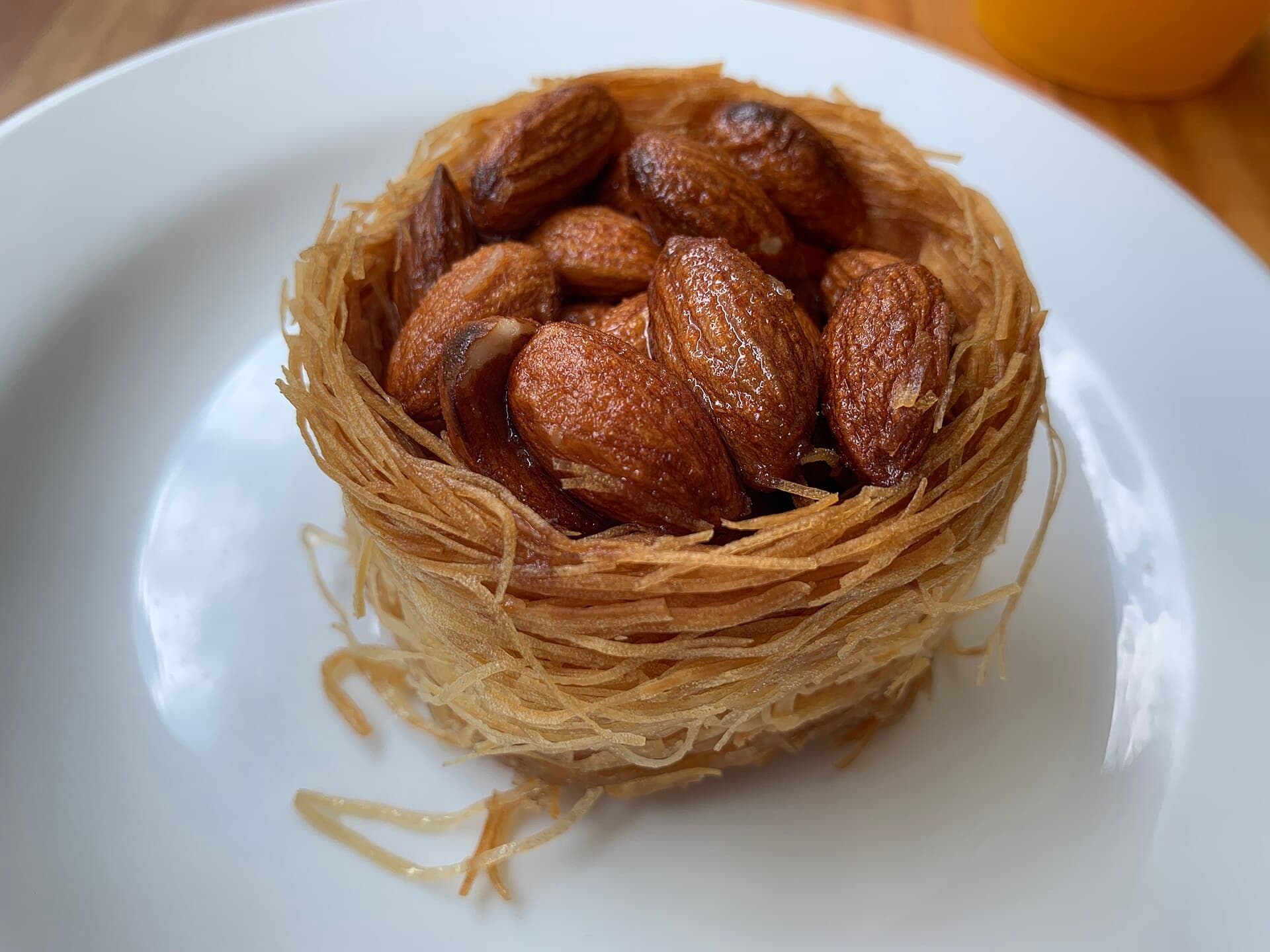
A small nest coiled from shredded kadayif pastry, filled with pistachio or almond and soaked in syrup. The name is the shape: a nightingale’s own nest.
- Where to eat it
- At sweet shops, by weight or by the piece; by the tray for feasts and weddings.
- Price
- Variable — the pistachio version costs more than the almond; ask at the counter
- When it is eaten
- All year; a sweet to eat the same day
A palm-sized nest that sits singly on a sweet shop counter. Shredded kadayif pastry is wound round the fingers into a ring with the middle left open, and it goes into the oven. Warm syrup is poured over it when it comes out, and the hollow is filled with whole pistachios or almonds just before serving. It counts as part of the baklava family, though it is coiled rather than layered.
The name and an old record
The name describes the shape directly: round and hollow in the middle, a nightingale’s nest. Turkish uses the same name. In some Arabic-speaking places it is also called siwar al-sitt, the lady’s bracelet, another name taken from a shape.
The name appears in old records too. An Egyptian and Levantine dictionary published in 1844 by the Swedish orientalist Jacob Berggren describes pastries called osh al-bulbul. They were small box-shaped cases of flour and butter dough, stuffed with minced meat and nuts such as pine nuts, seasoned with pepper and salt, and baked on large metal trays. The same book mentions sweet versions filled with pistachio or almond, and describes siwar al-sitt as a pastry made like baklava and shaped into bracelets. Savoury and sweet ran side by side for a long time.
How it is eaten
Not one mouthful but two: taken by hand rather than with a fork, and syrupy enough to need a napkin. Arabic coffee goes with it, and the pair is usually ordered together.
On the counter it shares a window with baklava. The difference is in the texture: baklava is crisp in layers, while this comes apart in threads and the nut in the middle stays whole.
Where to buy it
At sweet shops, by weight or by the piece. It is a same-day sweet; left standing, the threads soften and take up the syrup. If you are buying a box to travel with, allow for the fact that it does not keep in heat.
For feasts and weddings it is ordered by the tray. The pistachio version costs more than the almond one, and you can say which you want at the counter.
Tips
- Say whether you want pistachio or almond; the price follows
- Eat it the same day; the threads soften if it stands
- Order Arabic coffee with it — the two are served together
- It is syrupy, taken by hand, and needs a napkin
Transparency
- How this was chosen
- Two kinds of record live here: the dish itself, and the place that serves it. Both are chosen and written by hand; ranking is not for sale and there are no sponsored entries. If a price range is not known for certain, it says so. Venues that serve alcohol are not listed on this site at all.
- Facts checked
- September 2026
- Last updated
- September 15, 2026