Shakriyeh
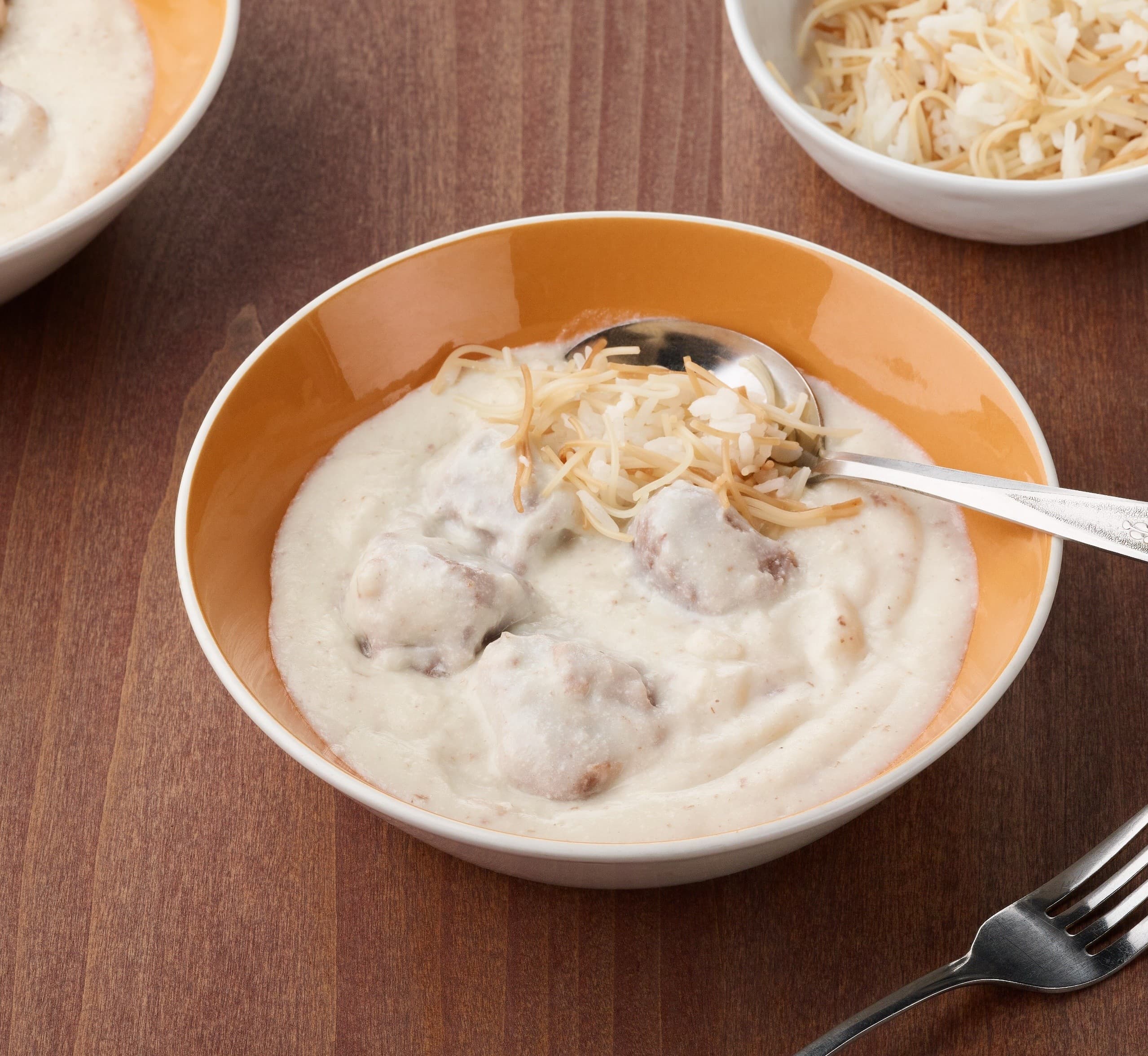
Lamb cooked in yoghurt, served with vermicelli rice. A dish for feast days and for Christmas, and in some places its name is simply his mother’s milk.
- Where to eat it
- At home-cooking restaurants in Damascus as the dish of the day; in homes at the feasts and through spring.
- Price
- Variable — ask the price of a plate when you order
- When it is eaten
- Feast weeks and spring, when yoghurt dishes come out more
Yoghurt here is not a sauce but the medium: lamb cooks inside it over a low flame, and the yoghurt thickens without splitting. Vermicelli rice comes beside it and in most places crushed garlic goes over the top. It is the best known member of the Syrian family of yoghurt dishes, alongside kubbeh labaniyeh, shish barak and sheikh al-mahshi.
Where the name comes from
There is no agreement on the name. One view takes it from the Arabic root for thanks and from the personal name Shakir, though nobody can say whose name it was; other sources trace it to Aramaic. In some places, particularly on the Lebanese side, the dish is simply called laban ummo, his mother’s milk, after cooking a lamb in the milk of its own mother. The Aleppine scholar Khayr al-Din al-Asadi connects that naming to a prohibition in Jewish law.
Cooking meat in yoghurt is old work. Medieval Arabic cookery books carry recipes for it, and Claudia Roden records that the tenth century poet Badi al-Zaman al-Hamadhani wrote a story about a related dish called madira. The name shakriyeh itself goes back at least to the nineteenth century: Butrus al-Bustani defined the dish in his dictionary Muhit al-Muhit of 1867 as a cooking of meat and yoghurt.
When it is cooked
Not an everyday plate but a plate for a particular day. Muslim households traditionally cook it for the two Eids and on the first day of Ramadan, and Syrian Christians put it on the Christmas table. Yoghurt dishes generally increase in spring, and shakriyeh comes out more often in that season.
The name turns up in Syrian proverbs and traditional verse. Through the war years meat and dairy became harder to get, and it appeared on tables less often.
Do not confuse it with mansaf
Both are meat with yoghurt, but they work differently. Mansaf is made with jameed, a dried yoghurt; shakriyeh uses fresh yoghurt and the dish stays lighter. Mansaf has its own page on this site.
Versions made with chicken instead of lamb exist. So does a close relative called arman, where the meat is fried in a pan before it goes into the yoghurt.
Where to find it
In Damascus at restaurants doing home cooking, usually as the dish of the day. Your chances rise in the weeks around a feast. You can ask for the rice on the side; the heat of the yoghurt softens it immediately, and many people prefer it kept apart.
Tips
- Ask for the rice on the side; the hot yoghurt softens it at once
- Some menus write it as laban ummo, which is the same dish
- A chicken version exists as well — ask which you are being served
- Do not confuse it with mansaf; mansaf uses dried yoghurt, shakriyeh fresh
Transparency
- How this was chosen
- Two kinds of record live here: the dish itself, and the place that serves it. Both are chosen and written by hand; ranking is not for sale and there are no sponsored entries. If a price range is not known for certain, it says so. Venues that serve alcohol are not listed on this site at all.
- Facts checked
- September 2026
- Last updated
- September 15, 2026