Taboon Bread
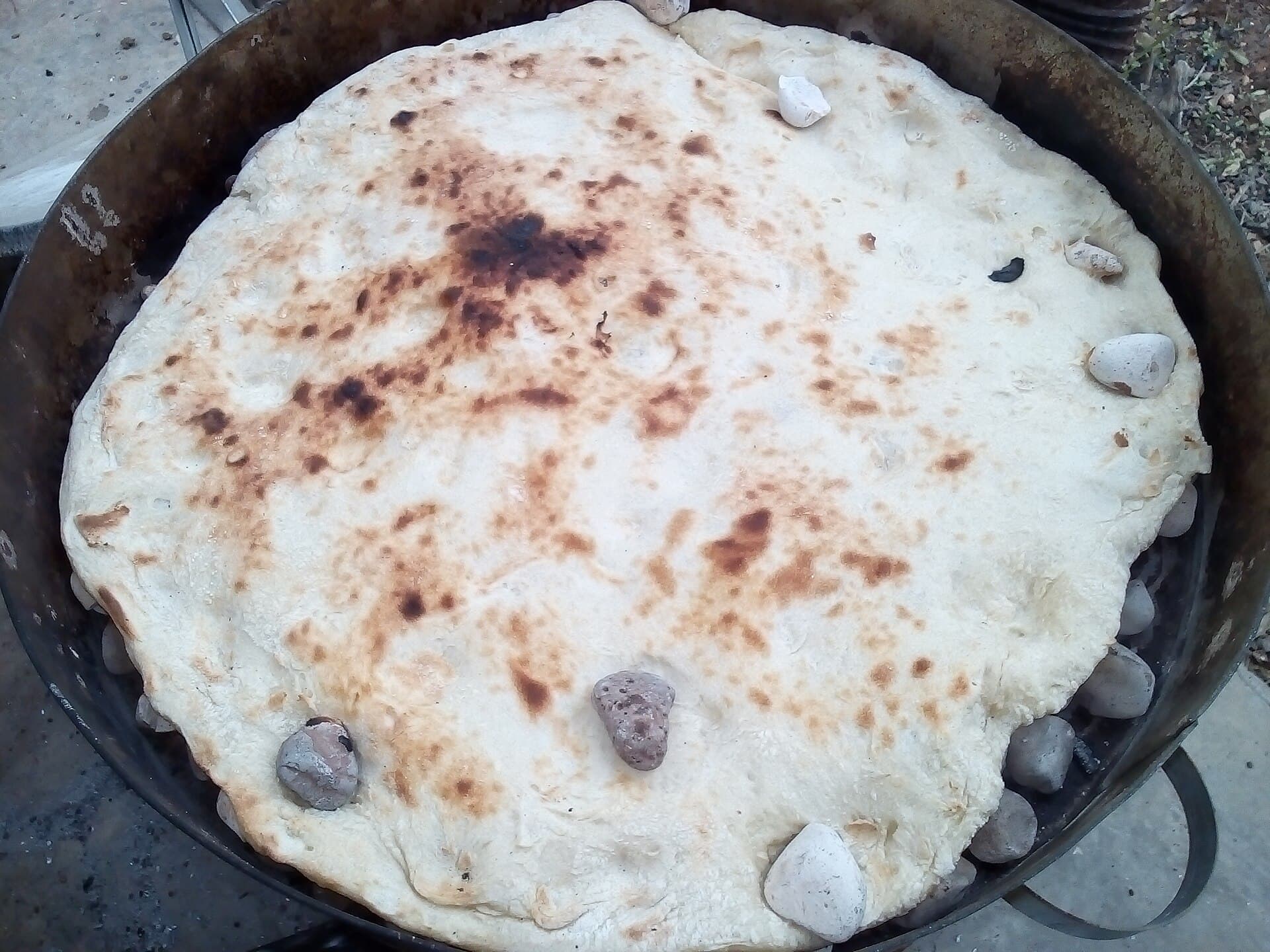
Baked on a bed of hot pebbles laid in the floor of a domed clay oven. The dimples underneath the loaf are the marks of those stones, and its signature.
- Where to eat it
- In Hauran villages, at home ovens and shared neighbourhood ones; at breakfast with olive oil and za'atar, at midday under meat and vegetable dishes.
- Price
- Variable — ask the price per loaf at the village bakery
- When it is eaten
- Early morning, while the stones still hold the night's fire
The taboon is a portable oven of clay, shaped like a truncated cone. What sets its bread apart is the method: the dough is not slapped onto a wall but laid on a bed of hot pebbles spread across the oven floor. The loaf comes out with the hollows those stones pressed into it, and that is how taboon bread is recognised by eye.
How it differs from a tannour
The two are constantly confused, and they are not the same oven. A tannour is cylindrical and deep; the dough is pressed onto its inner wall with a wet hand and bakes against a vertical face. A taboon is domed and low, and the bread rests on a horizontal bed of stone. Tannour bread comes out thick and open-crumbed; taboon bread is denser, its underside pitted. Mistaking a taboon for a tandoor is the commonest error in Western writing.
How the fire is built
The fuel is dung and olive pomace. Both burn slowly and long. The fire is kept through the night and the oven is ready by morning. Heat gathers in the stones and the bread bakes on that stored heat. A taboon is therefore not an oven for one meal but for a day: lit once, it turns out loaf after loaf.
Where it is baked in Syria
In the Hauran — the countryside of Suwayda and Daraa — and in villages. The taboon was never only a family oven. Whole neighbourhoods kneaded at home and carried the dough to a shared one, which makes it the rural ancestor of today’s neighbourhood bakery. The archaeology points to Syria as well: at Abu Hureyra and Tell Bouqras, traces of domed ovens are dated to around 7500 BC.
How it is eaten
Hot, thick and filling. At breakfast with olive oil and za’atar; at midday spread under meat and vegetable dishes, where its thickness lets it take up the juices without falling apart. The dimples on the surface hold the oil. Looking at the loaf tells you which oven it came out of.
Tips
- Look at the underside; without the hollows it did not come from a taboon
- Do not confuse it with a tandoor — there the bread sticks to the wall, here it lies on stone
- Brush it with olive oil while hot; the hollows hold the oil
- A village oven is lit once in the morning; arrive in the afternoon and the bread is cold
Transparency
- How this was chosen
- Two kinds of record live here: the dish itself, and the place that serves it. Both are chosen and written by hand; ranking is not for sale and there are no sponsored entries. If a price range is not known for certain, it says so. Venues that serve alcohol are not listed on this site at all.
- Facts checked
- September 2026
- Last updated
- September 15, 2026