Crusader traces in Syria
Krak, Marqab, Safita, Yahmur and Saladin Castle sit on one route; Tartus’s castle-town, its cathedral and Arwad do not. Who came, what is left, what you see.
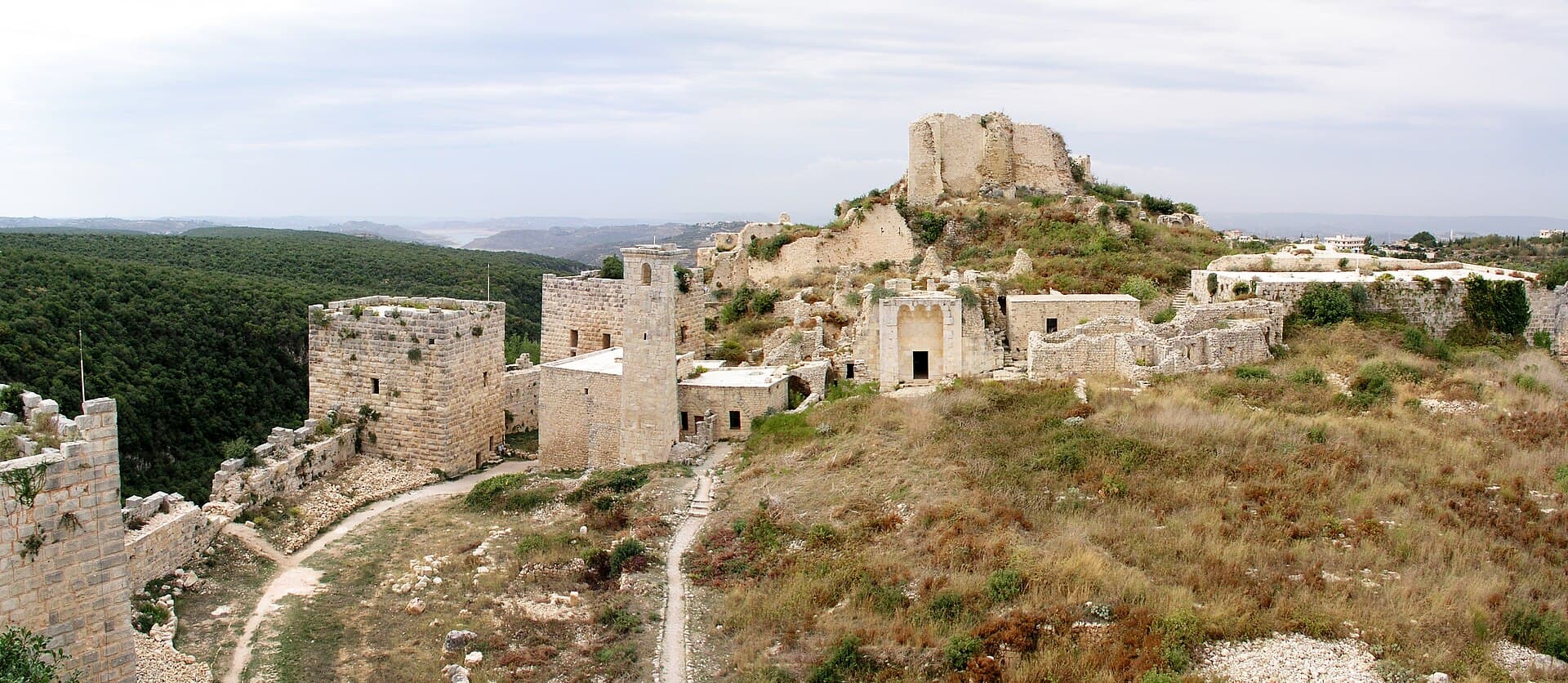
The Crusader period on the Syrian coast lasted two centuries and left a scattered but legible line behind it. This site already carries a route that ties five of its castles into three days. This page covers what that route does not say: who came, which order held what, which buildings fall outside the route, and what you actually see today.
Who came, and where they settled
The coastal strip was divided between two Crusader states, one based at Antioch in the north and one at Tripoli in the south. The castles were more often run by an order than by a state. The Hospitallers held Krak des Chevaliers and Marqab; the Templars held Tartus, Safita and Arwad. The small castles between them were links in a chain rather than positions in their own right.
Qalaat Yahmur shows this most plainly. It sits on flat ground with no natural defence, because its job was signalling rather than walls. Tartus lies north, Safita east and Areimeh south, and the castle is in line of sight with all three.
The five castles on the route
- Qalaat Yahmur. Chastel Rouge to the Crusaders, named for the reddish sandstone in its fabric. A two-storey keep of 16 metres by 14, inside a rectangular wall of 42 by 37. A Crusader castle at its plainest.
- Safita White Tower. Chastel Blanc: a keep, with the town grown around it once the rest of the castle went. The chapel of Mar Mikhail on the ground floor is a working church; the floor above was for fighting.
- Krak des Chevaliers. The most intact Crusader castle anywhere. A double curtain wall and a Gothic-arcaded refectory; 120 minutes.
- Marqab Castle. Krak’s counterpart on the coast and its opposite: not pale limestone but the black basalt of an extinct volcano. Sultan Qalawun took it in 1285 after a long siege.
- Saladin Castle. To cut the ridge off from the land, a ditch 28 metres deep was carved into the rock, leaving a single stone column in the middle to carry the bridge. It joined the UNESCO list with Krak in 2006.
What falls outside the route
The three-day route gathers the castles; the Crusader trace on the coast does not end there.
- The old town of Tartus. The town sits inside a castle. The Templars took it over in 1152 and built a double-walled fortress on the shore. Over the following centuries people built houses on and inside those walls. The east front says it best: the lower eight or ten metres are 12th-century wall, the floors above are flats with balconies.
- Tartus Cathedral. The soundest religious building left from the Crusader period; three aisles, 40 metres long and 27 wide. Thick walls, narrow openings, a tower at the north corner — built as much as a refuge as a church. It is the Tartus Museum today, and the coast’s excavations are displayed inside it.
- Arwad island. The Crusaders used it as their last foothold in the Levant and left it in 1302. Twenty minutes by boat from Tartus; the island wants three hours, and the castle at its centre is now a museum.
- Barin Castle. Inland: the Crusaders built it in 1126 and lost it in 1137. The ditch and the tower bases remain.
- Harim Castle. In the north, facing the Amuq plain. The Byzantines founded it, and it changed hands six times between Crusaders and Zengids.
- Qalaat Burzey. A steep castle over the Ghab plain; Saladin took it in 1188 after a three-day siege, and 21 of its towers survive.
- Qalaat al-Mehelbe. It passed from Byzantines to Crusaders and from Saladin to the Mamluks, and was never resettled after the earthquake of 1408.
Castles taken for Crusader that are not
A second party held the coastal mountains in the same century, and its castles are not Crusader work. The Nizari Ismailis had their Syrian centre at Masyaf, where Rashid al-Din Sinan lived; Qalaat al-Kahf was his base, Qadmus was the main seat for a time, and a village still lives inside the walls of Khawabi.
The distinction is practical: these four do not belong on the route and are visited on a line of their own. Their architecture differs too. Instead of the massing logic of a Crusader castle you get an irregular plan that follows the shape of the rock.
Shayzar: where neighbourliness got written down
Shayzar, on a narrow rock spine above the Orontes, was the castle of Usama ibn Munqidh. His family both fought and traded with their Crusader neighbours, and Usama wrote it down. That book is what keeps two centuries of coastal history from reading as a list of sieges. The castle was badly damaged in the earthquake of 1157.
Seven dates, two centuries
- 1126. The Crusaders build Barin.
- 1137. Barin is lost.
- 1152. The Templars take over Tartus.
- 1188. Saladin takes Burzey; at Tartus he takes the town, but the Templars withdraw into the inner castle.
- 1285. Qalawun takes Marqab.
- 1291. The inner castle at Tartus falls, closing the last Templar position on the mainland.
- 1302. Arwad is abandoned.
What you see today
Standing: four castles and a church — Krak, Marqab, Saladin, Safita and Tartus Cathedral. Readable as a plan: Yahmur and Barin. Absorbed into a town: the old town of Tartus and Arwad, where what you are looking at is a neighbourhood rather than a monument. Ruined: Mehelbe and Qadmus, while the towers of Burzey still stand.
How to see it
The route that links the five castles starts at Tartus and ends at Latakia: 273 kilometres, three days, a car required. For the additions on this page the practical order is this — the old town and the cathedral of Tartus go into the same morning and cost the first day about half an hour. Arwad adds half a day, so either a castle drops out or the route becomes four days. Barin and Harim lie in another direction and do not attach to this route.
Tips
- Yahmur sits on flat ground because its job was sight lines, not defence
- At Tartus the castle is a neighbourhood: flats stand on a 12th-century wall
- Masyaf, Kahf, Qadmus and Khawabi are Ismaili castles, not Crusader ones
- Arwad adds half a day: drop a castle or let the route run to four days
- Tartus Cathedral is now a museum; church and museum are one visit
Transparency
- How this was chosen
- This page carries the fastest-ageing information on the site: visa rules, exchange rates, border crossings and SIM prices change several times a year. The verification date above says when the facts were last put through their sources; for anything later, check your own foreign ministry travel advice and a Syrian consulate. No figure that is not known for certain is written here.
- Facts checked
- September 2026
- Last updated
- September 15, 2026