Day trips from Damascus
Monasteries to the north, Bosra to the south, the Barada valley to the west. How long each takes, how to find a car, and which season suits which trip.
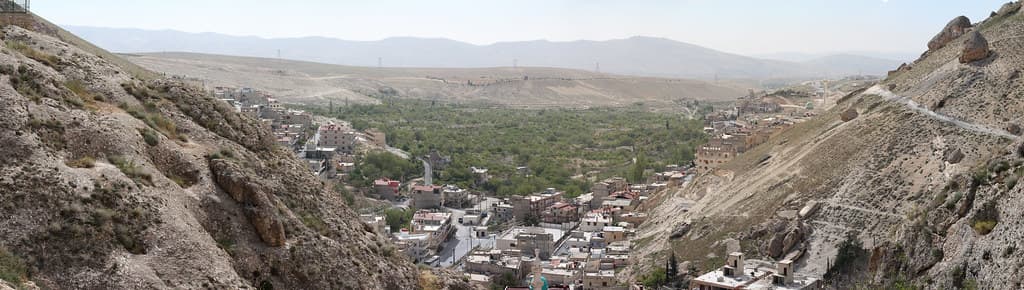
Damascus divides into three days, but the country does not end where the city does. This page collects the trips that use Damascus as a base and get you back by evening: distance, hours, transport and season for each. All of them are places with records on this site; somewhere with no directions does not get in here.
The rule: hours, not kilometres
On none of these trips is the distance the real constraint. Checkpoint waits cannot be predicted, and the midday heat makes open sites unwalkable. So the measure is this: leave in the morning, be back before dark. A day that starts from Damascus at 07:30 and one that starts at 10:00 are not the same day.
The monasteries north: Saydnaya, Maaloula, Deir Mar Musa
The three fit into one day, but it is a long one: 200 kilometres in all and eleven hours door to door. Saydnaya is 29 kilometres from Damascus; the monastery sits on top of the rock above the town, and if you go early the chapel is empty, because the pilgrim coaches come after noon. Maaloula is 26 kilometres further on: a village pressed against the cliff, two monasteries and a gorge that splits the rock end to end. You leave the car below and walk the gorge. The last leg is the longest of the day — 52 kilometres by way of Nabk to Deir Mar Musa, unpaved at the end, and the monastery is reached by 350 steps.
No regular public transport ties the three together; this day needs a car with a driver. Deir Mar Musa receives visitors but asks to be told in advance, and there is no phone signal on the road: make the call before you leave Damascus. All three stops require shoulders and knees covered.
Bosra to the south
Around 140 kilometres from Damascus, and two and a half to three hours one way with the checkpoints. Walking from one end of the ancient town to the other does not reach a kilometre, so the time on the road is longer than the time on site. What you get for it: a Roman theatre preserved inside an Ayyubid fortress, a colonnaded street, the Mosque of Omar and a sixth-century cathedral, all in black basalt and all within walking distance.
To be at the theatre in the first hour of daylight you have to leave Damascus at seven. By public transport the change is at Deraa: a minibus or shared taxi from Damascus to Deraa, then a second vehicle to Bosra. A car with a driver goes door to door and keeps the day flexible. There is also a route that squeezes the Umayyad Mosque into the same day: two UNESCO sites, 271 kilometres and twelve hours. Full, but it works.
The Barada valley west: Ain al-Fijeh and Zabadani
This trip is unlike the others: what you go for is geography, not a monument. Ain al-Fijeh is 20 kilometres northwest of Damascus in the Barada valley, and the water the city drinks comes out of the rock there. The spring itself is inside the waterworks and closed; what you see is the valley and the river. The same road climbs on to Zabadani, a green plain between two ranges, with apple orchards and cool evenings while Damascus bakes. It is 47 kilometres from the city.
Snow can close the road in winter, so ask about its state before you set off. Repair in Zabadani did not move at the same pace in every quarter; there are damaged streets, and this page does not hide that.
A half-day trip: Qasyoun
Qasyoun is not outside the city, but it takes half a day and is planned like a proper trip. From Marjeh through Salihiyya to the viewpoint is 3300 metres, and most of the climb is done by car. Go late in the day and the same spot gives you two views, sunset and night. It is the right choice for the day after a long trip, when your legs are already tired.
Which season suits which trip
The monastery day runs comfortably in every part from April to June and from September to October. In winter there is snow and fog over the Qalamoun; at midday in summer there is no shade in the Maaloula gorge. Bosra wants April to May or October to November: the Hauran plateau gets no rain at all between June and September, and the black basalt gives back until evening the heat it took in all day. Zabadani runs the other way round — June to September, exactly the months when the capital is at its hottest.
How to find a car
All three of these trips are made in practice with a car and a driver; renting a car to drive yourself is not a common option for a foreigner. The car is taken by the day and the price is agreed before you set off: how many hours, how many stops, whether fuel is included, whether waiting time counts. A driver found through your hotel is usually the easiest route, because he needs to know the area — neither the last kilometres to Deir Mar Musa nor the entrance at Bosra is found from a signpost. No record on this site carries a fixed price; a daily rate moves with the city, the season and the cost of fuel, and inventing a figure would not help you.
Tips
- Leave at 07:30; checkpoint waits cannot be predicted
- Call Deir Mar Musa before leaving Damascus; there is no signal on the road
- Going to Bosra by public transport means changing at Deraa
- Put Zabadani in summer and the monasteries in spring or autumn
- Agree the fare, the hours and whether fuel is included before you get in
Transparency
- How this was chosen
- This page carries the fastest-ageing information on the site: visa rules, exchange rates, border crossings and SIM prices change several times a year. The verification date above says when the facts were last put through their sources; for anything later, check your own foreign ministry travel advice and a Syrian consulate. No figure that is not known for certain is written here.
- Facts checked
- September 2026
- Last updated
- September 15, 2026