Day trips from Hama
Apamea and Shayzar, Abu Qubays and Mhardeh to the west, Masyaf in the hills, Qasr Ibn Wardan in the steppe. How long each takes, finding a car, what to watch for.
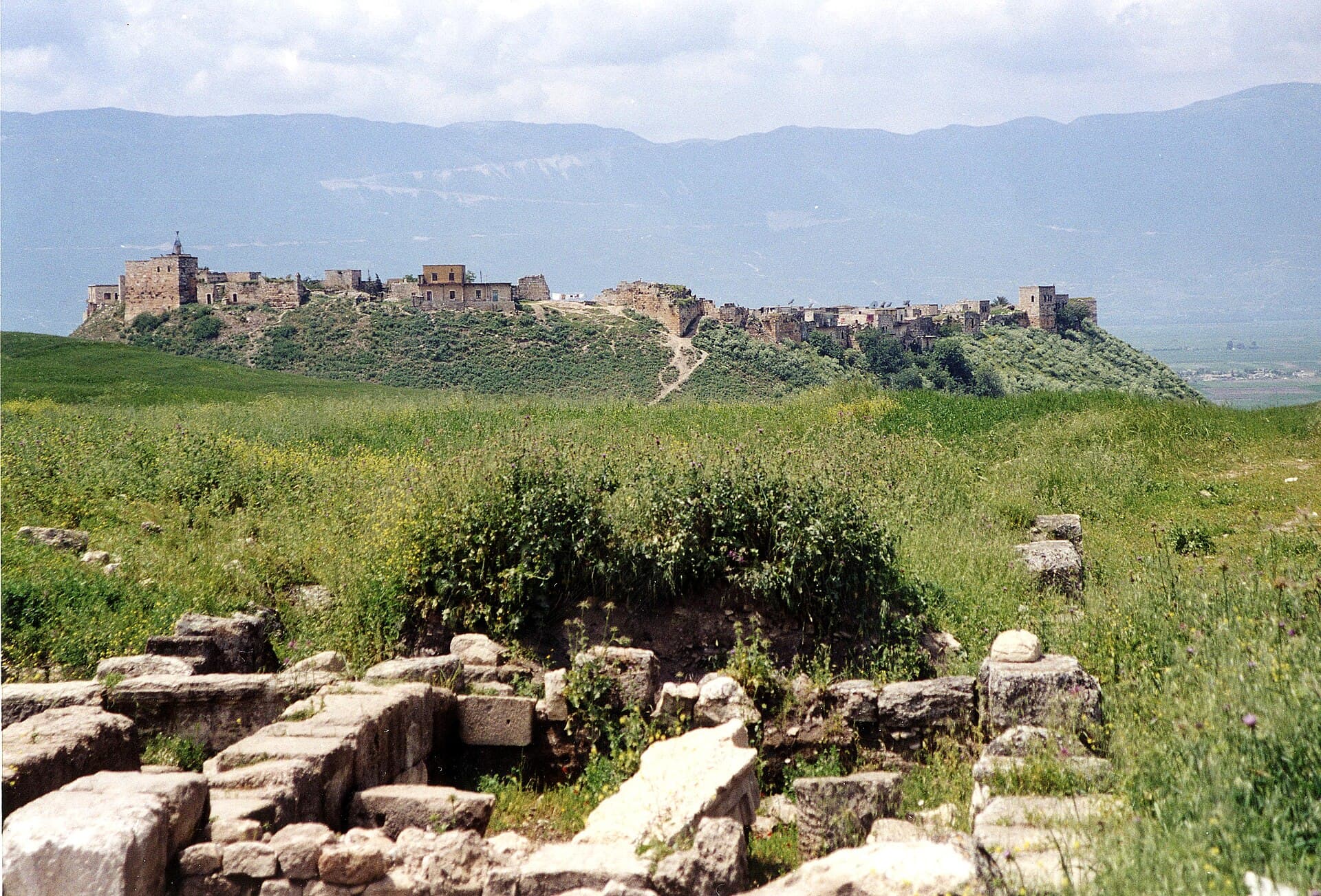
What makes Hama a good base for central Syria is what lies around it. To the northwest, the Orontes valley holds two castles and a Roman city. To the west, at the foot of the mountains, there is a Byzantine church and a castle. Masyaf has the Ismaili castles, and out in the steppe to the northeast stands a Byzantine palace. This page collects distance, time and transport for each trip, and every place on it has a record and a route on this site. The plan for the city itself is on the page two days in Hama.
The rule: a car with a driver and an early start
No public transport reaches Apamea, Shayzar, Abu Qubays or Qasr Ibn Wardan; these trips are made with a car and driver. Masyaf, Suqaylabiyah and Salamiyah, on the other hand, are linked to Hama by minibus lines. Vehicles gather at several points in the city: the western garages, the Pullman garage, the Bab Tarablus stop and the al-Hader garages. Which line leaves from which point can change, so ask at your hotel.
In November 2025 minibus fares in old pounds were 14000 to Masyaf, 15000 to Suqaylabiyah and 10000 to Salamiyah. With two zeros removed, that equals 140, 150 and 100 new pounds. The same report said services had been cut back for lack of passengers. On 13 September 2026 diesel went up from 125 to 175 new pounds; minibus fares are being recalculated, and some lines are charging their own rates in the meantime. The figures give only a sense of scale, so check before you get in.
Northwest: Shayzar, Qalaat al-Madiq and Apamea
The classic day in the Orontes valley: 129 kilometres in all and a little over three hours of driving. Shayzar is 28 kilometres from Hama, and the castle covers a 450-metre rock ridge on the west bank of the Orontes. At Qalaat al-Madiq a village still lives inside the walls, and the colonnaded street of Apamea lies one kilometre east of the castle. The drive back from Apamea is 69 kilometres. Times hour by hour are on the route from Hama to Shayzar and Apamea.
If you are going to Apamea alone, it is 55 kilometres from Hama, an hour by car. The column shafts read best in late-afternoon light, so spending the morning in the city and heading out after lunch works well.
There are two dated facts for this direction. By July 2026, 4000 families, about 32000 people, had returned to the town of Qalaat al-Madiq; but water, electricity and sewerage are inadequate and the municipality is still clearing rubble. Bring food and water from Hama. On the way, tension flared between Suqaylabiyah and Qalaat al-Madiq in March 2026 and a reconciliation was reached in April 2026. At the end of July 2026 a coffee house in Suqaylabiyah was hit by an armed attack and a stun grenade. Ask your driver or a local guide about the situation that day.
West: Deir al-Salib, Abu Qubays and Mhardeh
133 kilometres and nine hours. You leave on the Masyaf road. First comes a Byzantine church from the fifth and sixth centuries among fig trees, then an Assassin castle in oak forest. The day ends at Mhardeh, 23 kilometres northwest of Hama, with its many-arched stone bridge over the Orontes. Deir al-Salib and Abu Qubays have no guard, no ticket and no signpost; someone needs to know where you have gone. The hour-by-hour plan is on the route a day west of Hama.
Masyaf and the Ismaili castles
Masyaf is 45 kilometres west of Hama, an hour by car, and there is a minibus line. The castle sits on a single mass of rock above the town and takes half a day on its own. There are two ways to stretch the day: the 62-kilometre mountain road from Masyaf past Husn Suleiman to Al-Kahf Castle, or south by way of Baarin and Raphanea to Krak des Chevaliers, about 56 kilometres. Both make a nine-hour day.
Between 11 and 16 July 2026, 769 cases of acute diarrhoea were recorded in Masyaf. Cholera tests were negative, but many drinking-water and food samples failed bacteriological tests, and the Ministry of Health issued a warning about safe water and reliable food. Drink sealed bottled water and be careful with raw food.
The northeastern steppe: Qasr Ibn Wardan
60 kilometres northeast of Hama, with steppe road for the last stretch; an hour by car and an hour on site. It lies in the opposite direction to Apamea, so the two do not go into the same day. This direction has a rule of its own: in April 2026 a mine blast in the eastern Hama steppe killed 7 people, and the Hama disaster directorate said “there is no safe area in the steppe”. Do not leave the asphalt or the clear path on site.
Season and precautions
The season for these trips is April to June and September to October; none of the open sites has shade. In the first four months of 2026, 8080 cases of leishmaniasis, known locally as the Aleppo boil, were reported in the Hama countryside, mostly in the north, east and northwest. Sandflies carry it; if you stay out in the countryside in the late afternoon, clothes that cover your arms and insect repellent help.
One more dated sign: in May 2026 a group of 40 people from Germany and Turkey toured Hama with a tourist police escort, the first foreign group to visit in 14 years. It suggests that foreign visitors’ trips are for now arranged through a tour office or a local guide. If you set out on your own, leave your route with your hotel.
Tips
- Put Apamea in the late afternoon; the columns read best in side light
- Take food and water to Qalaat al-Madiq, where services are thin
- Drink sealed bottled water in Masyaf
- On the road to Qasr Ibn Wardan, do not leave the asphalt or the path
- Ask the minibus fare before you get in; fares changed in September 2026
Transparency
- How this was chosen
- This page carries the fastest-ageing information on the site: visa rules, exchange rates, border crossings and SIM prices change several times a year. The verification date above says when the facts were last put through their sources; for anything later, check your own foreign ministry travel advice and a Syrian consulate. No figure that is not known for certain is written here.
- Facts checked
- September 2026
- Last updated
- September 15, 2026