The gates and walls of Aleppo
Five of the old city’s nine gates still stand, and each did a different job: one opened into the souq, one onto the ironmongers, one onto a ceremonial road.
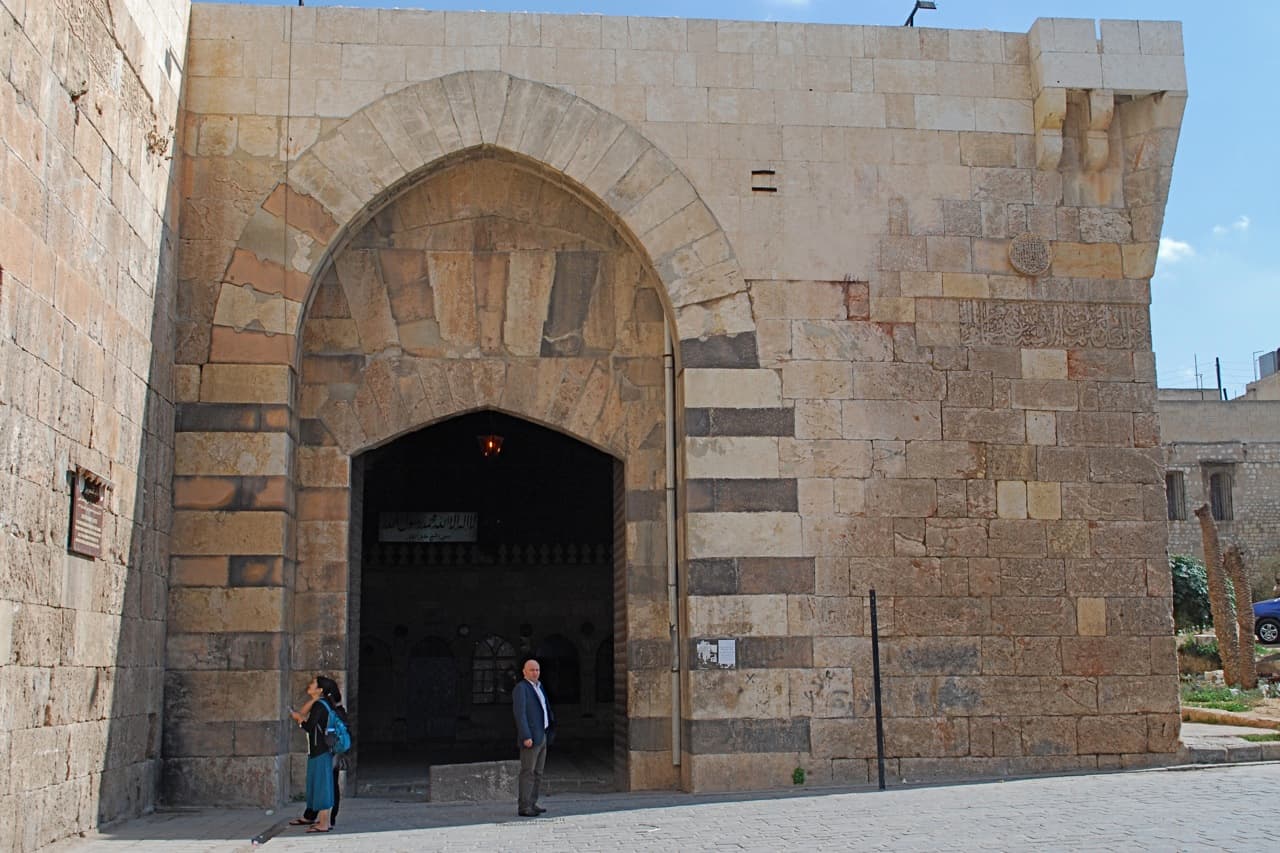
The old city of Aleppo sits inside a wall, and that wall had nine gates. Most of what stands today is Ayyubid and Mamluk work over older foundations. Do not hunt for them one by one. Take the citadel as your centre and follow the streets that run out from it in four directions; the gates are already at the end of those streets.
West: Bab Antakya
It takes its name from where the road went: the road out of this gate ran to Antioch. The gate is a deep passage between two towers, and the thickness of the stone is something you feel inside it, where the air is noticeably cooler than the street. Its real quality is its position. The moment you pass under the arch the open street ends and the covered Medina souq begins. For anyone who wants to walk the souq west to east, to the Great Mosque and on to the citadel, this is the natural start.
North: Bab al-Nasr
It was first known as Bab al-Yahud; the Jewish traders’ shops lay inside it and their cemetery outside. The Ayyubid ruler al-Zahir Ghazi pulled the gate down in 1212, rebuilt it and changed the name to Bab al-Nasr, the Gate of Victory. The long inscription band set into the arch is the best part of the facade; the letters are in relief and large enough to read from street level. The gate was damaged in the war and a local committee repaired and reopened it in 2018.
North-east: Bab al-Hadid
The best preserved of the nine. Its name comes from the shops beside it: iron was worked here, and the sound of the anvil is still around the gate today. Its older name was Bab al-Qanat, because the channel that brought water into the city entered at this point. Al-Zahir Ghazi planned the gate, his son Muhammad built it, and the last Mamluk sultan Qansuh al-Ghawri rebuilt it in 1509. It is not a single gate but two, with a passage between them and a tower above that passage.
South: Bab Qinnasrin and Bab al-Maqam
Bab Qinnasrin was first built by Sayf al-Dawla in 964; what stands now dates from 1256. Its story is not in the stone but in the door leaves: when Caliph al-Mu’tasim took Amorium in 838 he had the city’s gate leaves brought to Aleppo as spoils. Bab al-Maqam, by contrast, was not built for defence. On Yasser Tabbaa’s reading, the absence of a bent entrance and a narrow throat points to a ceremonial rather than a military purpose: the road out of it led to the shrine attributed to Abraham in the south.
The wall, and war damage
The wall today is intermittent: in places it disappears into the street fabric, in others it is simply gone. The name Bab al-Faraj no longer belongs to a gate but to the square north-west of the old city and to the clock tower raised there in 1898-1899. The areas around the gates were badly damaged between 2012 and 2016; repair is going on section by section and which arm of the souq is open changes. That is the one thing to ask before you go in.
Tips
- Enter at Bab Antakya and walk east; the souq delivers you to the Great Mosque
- The smiths around Bab al-Hadid are still working — go in the morning
- The inscription band on Bab al-Nasr reads from street level; stop and look up
- Use the citadel as your centre; the gates sit at the end of the streets from it
- Which arm of the souq is open changes; ask before you go in
Transparency
- How this was chosen
- This page carries the fastest-ageing information on the site: visa rules, exchange rates, border crossings and SIM prices change several times a year. The verification date above says when the facts were last put through their sources; for anything later, check your own foreign ministry travel advice and a Syrian consulate. No figure that is not known for certain is written here.
- Facts checked
- September 2026
- Last updated
- September 15, 2026