How many days do you need in Syria?
Scenarios at three, five, seven, ten and fourteen days: what each length covers, what it gives up, and why it is waiting rather than distance that eats the day.
This is the question you answer when you book, and the answer is not “as many as possible”. In Syria the number of days is set less by how many places there are than by what reaching them takes out of the day. The five scenarios below rest on the route and city records on this site. A day-by-day itinerary sits on its own page; this question comes before that one.
Three things that eat the day
The distances are short. Damascus to Aleppo is 350 kilometres, 4 to 5 hours. Damascus to Homs is 160 kilometres, 2 hours. Homs to Krak des Chevaliers is 65 kilometres. Anyone reading a map assumes these can be pushed into a single day.
They cannot, because three things get in the way. Waiting time at checkpoints is not knowable in advance, so every intercity leg is written into the morning and an afternoon departure loses the day. The second is the closed door: which museum hall is open today is published nowhere central, and a wasted morning is a real possibility. The third is the day you arrive and the day you leave. Neither counts as a day out.
Three days: one city
What you get. Damascus. Three half-days inside the walls, across the Ottoman face of the city and up Qasyun, all three on foot. Three days is enough to walk the city properly.
What you give up. Aleppo, the coast, the castles and Palmyra. A day trip can be added, but a half-day then comes off the city itself. Three days is time given to one city rather than to a country — and the trip goes well when that is accepted at the start.
Five days: one line, no spare day
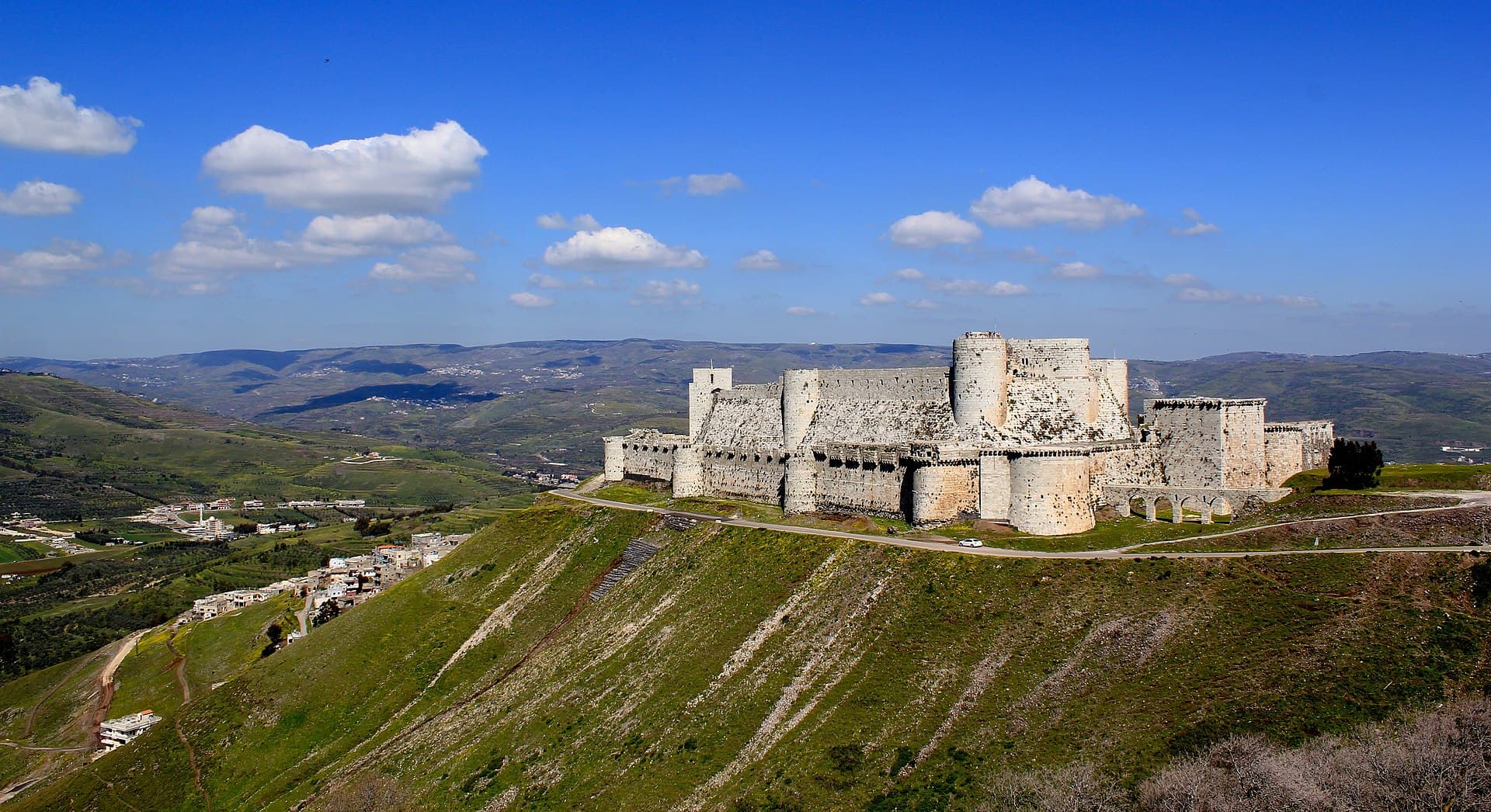
What you get. Two days in Damascus, one at Homs and Krak des Chevaliers, two in Aleppo. The shortened form of the country’s main line, with both big cities in it.
What you give up. The spare day. A five-day plan absorbs no setback at all: one closed hall or one slow crossing shifts every remaining day. The coast and the south are not in it.
Seven days: the main line
What you get. The same line with two days added. One goes on a day trip out of Damascus — the monasteries to the north or Bosra to the south — the other on Hama and the Orontes. Lodging gathers in three places, so the case is not unpacked every night.
What you give up. The coast and the desert. Palmyra is 250 kilometres from Damascus, and forcing it into seven days spends two of them on the road. The day-by-day version of this week has its own page here.
Ten days: the line plus one branch
What you get. The main line and a single branch. The coastal branch is the one most people take: Ugarit, Kessab, Saladin’s Castle, Tartus and Arwad. The south or the desert can be chosen instead, though not both.
What you give up. The other two branches. Ten days still does not cover the whole country, and aiming at that damages the plan itself.
Fourteen days: a second branch and an empty day
What you get. A second branch and, more usefully, two empty days. Palmyra wants a day of its own; the Dead Cities around Idlib want a full day and a vehicle. At fourteen days these fall into place without pressure.
What you give up. Not much. At this length the limit becomes the north-east and the eastern desert, neither of which appears as a route on this site, for reasons set out on another page.
Which length suits whom
For a first visit on limited leave, five to seven days works: two cities, a castle, a river town. For someone coming for the architecture or the photography, ten is the floor, because the same building has to be visited twice at different hours.
Someone visiting family counts differently anyway: family days and sightseeing days are separate, and the plan leans on one city. Three days makes sense in one case only — when Damascus is where you land and where you stay.
What people forget to subtract
- Arrival and departure days: neither counts even as a half-day, both go on the crossing and the airport.
- Friday midday: mosque courtyards belong to prayer at that hour and the plan moves elsewhere.
- Feasts and public holidays: museum hours change and part of the souq closes.
- Closed halls: every unconfirmed museum is one possibility, not two.
- Summer midday: inland, nobody walks in the open between 11:00 and 16:00; those hours are for vaults and courtyards.
Tips
- Distance is not what sets the day: checkpoint waits, closed halls, morning starts
- Three days is enough for a city, not a country — land in Damascus and stay
- A five-day plan absorbs no setback; there is no spare day in it
- At ten days pick one branch: coast, south or desert — not two
- Do not count arrival and departure days as days out
Transparency
- How this was chosen
- This page carries the fastest-ageing information on the site: visa rules, exchange rates, border crossings and SIM prices change several times a year. The verification date above says when the facts were last put through their sources; for anything later, check your own foreign ministry travel advice and a Syrian consulate. No figure that is not known for certain is written here.
- Facts checked
- September 2026
- Last updated
- September 15, 2026