The neighbourhood bakery: dough is kneaded at home, baked at the furn
In Syria the baking is not done at home. Trays are carried through the street, marked, and queued at the oven. The liveliest custom a visitor can watch.
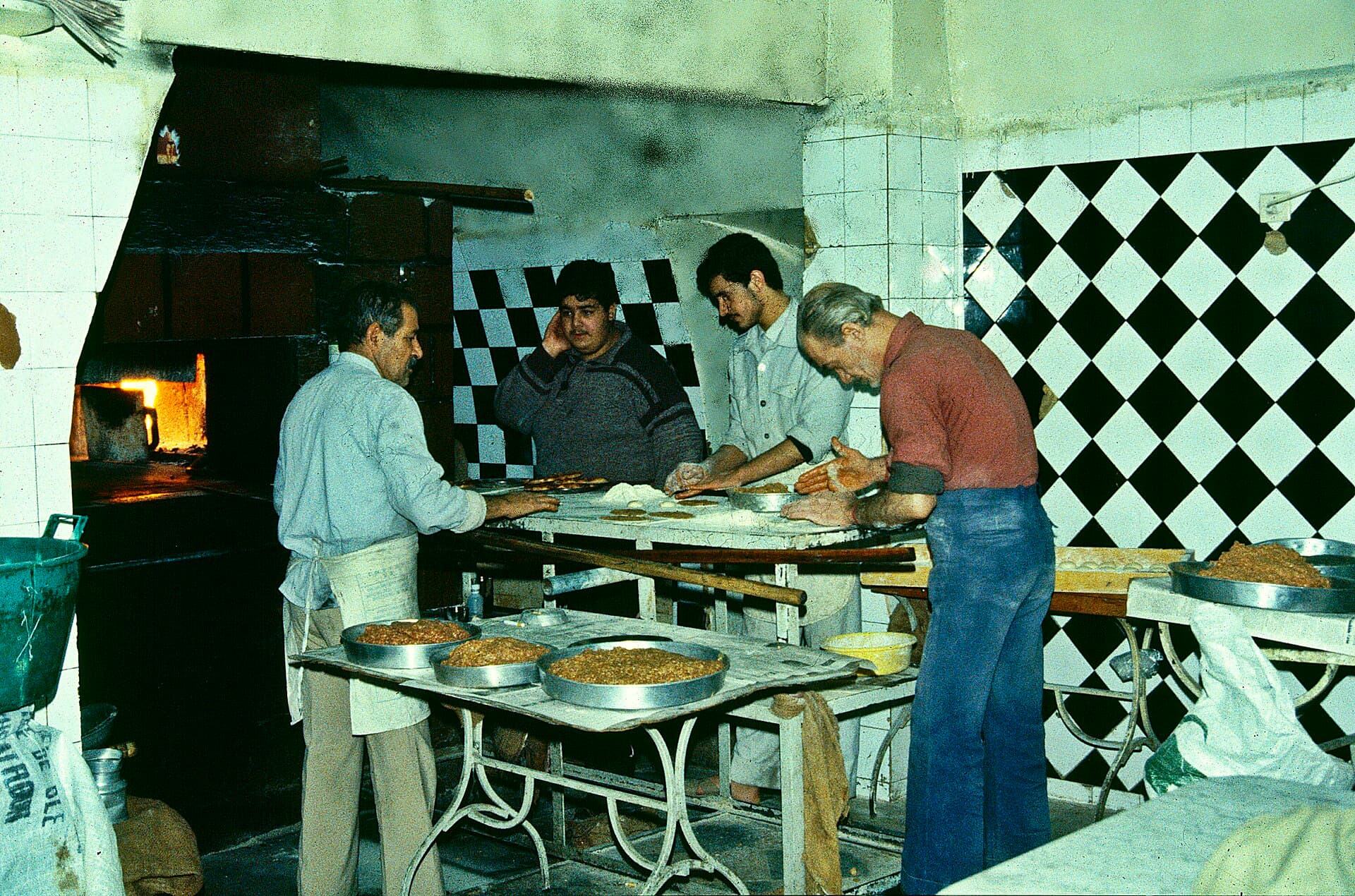
In Syria dough is kneaded at home and then carried to the oven to be baked. Every record on this site for manakish, fatayer, maamoul, su boereg and feast bread rests on that one sentence. The furn is not a shop so much as the shared kitchen of the neighbourhood, and in feast week it is the busiest place in it.
Why it does not go in a home oven
Two reasons, both practical. The trays are wider than a domestic oven will take, and the ones that fit come out browned unevenly underneath. A market oven fired with wood has a stone floor and an even heat, so a full tray of maamoul comes out at once and in the same colour. In the countryside the tabun does the same job — the family, neighbourhood or village oven, and the older ancestor of the custom.
What happens before the feast
A few days before the feast, women gather in one house to make the dough and the filling: dates, walnuts, Aleppo pistachio. The filling has a colloquial name, tahwija. The maamoul discs are shaped by hand and laid out on large brass trays. This is not one household’s work but several sitting at the same table, and when it is done the trays set off.
Why the trays are marked
Because dozens of trays sit in the oven at once and they all look alike. Each household puts its own mark on its tray: a pattern pressed along one edge, a letter scratched into the back, sometimes a scrap of cloth. The trays are carried through the streets to the market oven, and on feast days that procession moves to singing while wood smoke from the chimney mixes with the smell of clarified butter. The baker keeps the queue by tray, not by name.
How many ovens are left in Damascus
In the late Ottoman period and the early 20th century the old city of Damascus had around 70 neighbourhood ovens. Fewer than ten work today, and most of those open only intermittently or seasonally. The custom continues but it has thinned out: where every quarter once had its oven, several quarters now share one. The survivors work well over capacity in feast week.
What it means for a visitor
Three concrete things. First, mornings: manakish and fatayer are at their best as the first tray leaves the oven, so go early. Second, feasts: the crowd outside a furn is not a queue but a tray handover, and for anyone who wants to look it is the liveliest scene of the day. Third, the oven itself is the news desk of the quarter, and someone looking for a neighbour asks the baker first.
Tips
- Go early for manakish and fatayer; the first tray out of the oven is the best one
- Stand outside a furn on the morning of a feast; the tray traffic is the liveliest scene of the day
- Ask the baker before photographing; the working space is tight and the trays are hot
- Do not move the trays; each mark belongs to a household and the queue runs by them
- If you need to ask anything, ask the baker; nobody in the quarter knows more
Transparency
- How this was chosen
- This page carries the fastest-ageing information on the site: visa rules, exchange rates, border crossings and SIM prices change several times a year. The verification date above says when the facts were last put through their sources; for anything later, check your own foreign ministry travel advice and a Syrian consulate. No figure that is not known for certain is written here.
- Facts checked
- September 2026
- Last updated
- September 15, 2026