Roman and Byzantine Syria: what is left where
Palmyra’s colonnade, Bosra’s basalt theatre, Apamea’s two kilometres and the Dead Cities of the north. What each period left where, and how to build a route.
In Syria the Roman and the Byzantine are not in separate countries; more often than not they sit on the same hill. In one place the stone of a pagan temple ends up in a basilica wall five hundred years later; in another a church courtyard becomes a mosque. This page puts those two layers on the map and answers the traveller’s question: which branch will you take.
Two materials, two languages
In the south everything is basalt. Bosra, Shahba, Qanawat and Salkhad speak in a black stone that resists the chisel, so the forms stay heavy and flat. The north has limestone; the plateau between Aleppo and Idlib cuts well, and its buildings are finely worked with sharp gables.
The difference between the periods fits in one line too: Rome speaks in columns and streets, Byzantium in churches and apses. Where the two overlap is where both read best.
The desert branch · Palmyra
The spine of the city is a colonnaded street over a kilometre long, built in three separate phases; the brackets on the columns once carried statues of the merchants who paid for them. The Temple of Bel opened in AD 32; its main building was blown up in 2015, while the courtyard wall and the fortified gateway stand. The Roman theatre is 92 metres across, its cavea and orchestra in place, its stage front destroyed in 2017. Diocletian’s Camp lies at the western end: a late Roman military headquarters with a stepped terrace and a standards hall. The Elahbel tower tomb was dated AD 103 and was the one tower in the Valley of the Tombs open to visitors; it was blown up in 2015 and the site now holds a pile of stone.
The site wants 180 minutes and there is no shade. Qasr al-Hayr al-Sharqi lies on the same branch, but it belongs to the Umayyad period.
The southern branch · Bosra, Qanawat, Shahba
The Bosra theatre is black basalt, and the Ayyubids wrapped a castle entirely around it; 90 minutes. The Bahira basilica is the oldest church in town, its four walls standing to roof height. Bosra Cathedral was consecrated in 512: a centralised plan set inside a square, its dome gone but the plan fully legible on the ground.
Shahba is a city an emperor commissioned in the village where he was born, left half-finished at his death; 120 minutes, with its mosaics in the Suwayda museum. Qanawat is the Decapolis city in the mountains: a theatre cut into rock, a columned temple and a palace converted into a basilica. The three fit comfortably into two days based in Suwayda.
The Orontes branch · Apamea
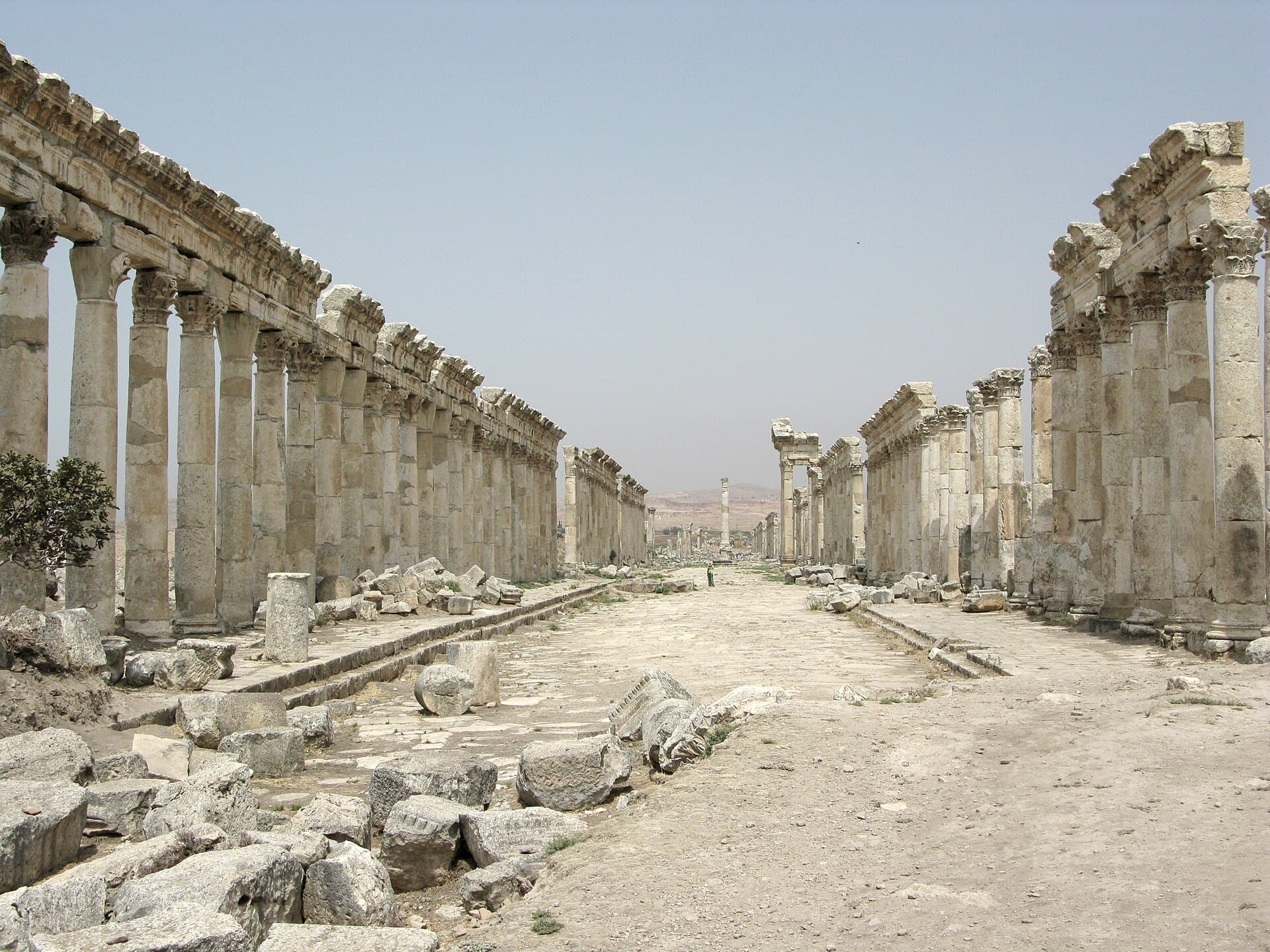
A Roman street on a Hellenistic foundation: close to two kilometres long, and set apart from the country’s other colonnades by its twisted fluted columns. 120 minutes. Just to the west stands Qalaat al-Mudiq — an Ayyubid castle on Roman foundations, with a living village inside and Apamea’s museum in the khan. Northeast, the rock spine of Shayzar has a Byzantine core as well. One day based in Hama takes all three.
The northern branch · the Dead Cities
Hundreds of villages were founded on the limestone plateau between Aleppo and Idlib between the fourth and sixth centuries, and they emptied in the seventh. Nobody built anything on top of them, so the plans are still on the ground.
- Serjilla. The best preserved: a bath, an andron facing it, two-storey stone houses. Founded around 473.
- Al-Bara. The largest. Two pyramid-roofed tombs and olive presses on an industrial scale.
- Ruweiha. The standing arch of the Bissos church, a second basilica, and a two-storey market building.
- Baqirha. A temple of Zeus dated 161 and two churches; the door lintel of the East Church reads 546. Pagan and Christian on the same hill.
- Babiska. A market building dated 547 and a church dated 609-610 — the late wave in one place.
- Fafertin. The oldest church with a certain date: 372. The apse is the only piece standing.
- Qalb Lozeh. Around 460; the two towers on its west front and the arch between them are held to be the earliest known example of the Romanesque facade.
- Deir Turmanin. Its twin-towered front, built around 480, was the most copied face in the region; a single stone in an olive grove is what is left of it.
- Deir Semaan. The pilgrimage town below Saint Simeon: two-storey pilgrim inns and the paving of the main street.
These split into two days: one on Jabal Zawiya (Serjilla, al-Bara, Ruweiha), one on the Simeon and Barisha ranges (Deir Semaan, Fafertin, Baqirha, Qalb Lozeh).
The coastal branch
The Jableh Roman theatre is 90 metres across and its seating rests on arched vaults rather than a hillside — the only example of its kind in the region. The Latakia arch opens in all four directions and stands two metres below street level. Husn Suleiman is a Roman temple in the coastal mountains at 950 metres, built of enormous blocks. Further south, Amrit goes back before Rome, to the Phoenician period.
The Euphrates branch
Halabiye is a walled city in the gorge where the river narrows; its walls, praetorium and two churches largely stand. Dura Europos was founded by the Seleucids and changed hands on the Parthian and Roman frontier. A synagogue dated by an inscription of 244, one of the earliest known house churches and a Mithraeum all sit in one place. The Sasanians took it by siege in 256 and the city was never rebuilt. This branch starts from Deir ez-Zor and wants days of its own.
One building that stands between them: Qasr Ibn Wardan
Northeast of Hama, in open steppe, is a sixth-century group of buildings: a palace, a church and a barracks. The banded brick and basalt facade is unique in the region, and its kinship with the building language of Constantinople is visible at first glance. It is the far point of a day out of Hama.
Where the stone changed hands
Seeing how many times one building changed job is the quickest way into these two periods. The Great Mosque of Hama was a Roman temple, then a Byzantine church, then a mosque. In Aleppo the Halawiyya Madrasa was built over a fifth-century cathedral, and the cathedral’s Byzantine capitals still stand in the prayer hall. At Qalota, a pagan temple, a basilica dated 492 and church buildings turned into a fort in the Middle Ages lie on top of one another on a single hill.
How to build the route
Five branches do not go into one trip. If you take one, take the north: two days, dozens of buildings, and all of them clustered within walking distance of each other. If you take two, the north and the Orontes complete each other, because Apamea gives you the street and the Dead Cities give you the village. Palmyra wants its own days and does not combine with another branch. The Euphrates branch is a separate journey rather than a day out.
Tips
- Basalt in the south, limestone in the north — the material names the region
- Split the Dead Cities across two days: Jabal Zawiya, then Simeon and Barisha
- Palmyra does not combine with another branch; it wants its own days
- At Baqirha and Qalota a pagan temple and a church share the same hill
- Shahba's mosaics are not on site but in the Suwayda museum
Transparency
- How this was chosen
- This page carries the fastest-ageing information on the site: visa rules, exchange rates, border crossings and SIM prices change several times a year. The verification date above says when the facts were last put through their sources; for anything later, check your own foreign ministry travel advice and a Syrian consulate. No figure that is not known for certain is written here.
- Facts checked
- September 2026
- Last updated
- September 15, 2026