Ain al-Arous spring, source of the Balikh
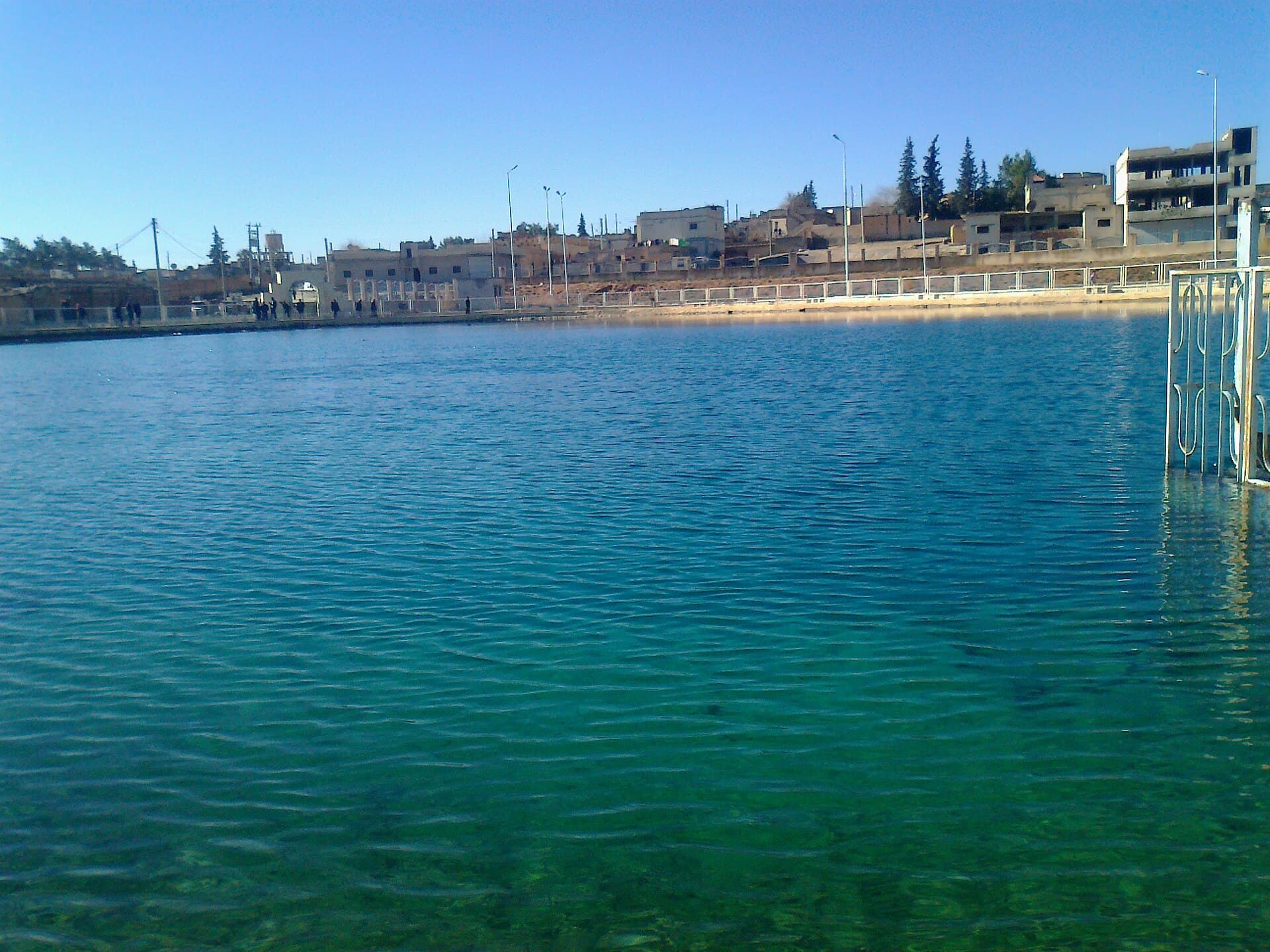
The karst spring 3 km south of Tell Abyad where the Balikh River rises: a clear pool, the shrine of Abraham and a mill from 1908. Access to the site is unconfirmed.
- Opening hours
- Open site; access unconfirmed
- Entry
- Variable — confirm on site
- Duration
- 45 minutes
- Best time
- Spring or autumn; summer afternoons on the steppe are very hot
- Period
- Natural spring; shrine recorded in the Middle Ages, mill from 1908
- Address
- Ain al-Arous village, 3 km south of Tell Abyad, Raqqa province
Ain al-Arous is the main source of the Balikh River: a karst spring that rises just south of the Turkish border, 3 kilometres south of Tell Abyad. The water gathers in a wide pool ringed by railings and flows 110 kilometres south to join the Euphrates at Raqqa. At the head of the spring stands a shrine to Abraham mentioned by medieval writers, and beside it the remains of a water mill built in 1908. After January 2026 the ministry listed the area among Raqqa’s main heritage sites; access for visitors could not be confirmed.
Where it is and can you go?
The spring lies beside the village of Ain al-Arous, which takes its name from it, south of Tell Abyad. There is only one map record for the spring itself, while the others point to the village, so this page has no map.
The site is in the Tell Abyad strip, whose administration has changed since 2019. On 1 February 2026 the newspaper al-Watan reported a field visit to Raqqa and Deir ez-Zor by the Minister of Culture and the Director-General of Antiquities. The report lists the Ain al-Arous area among Raqqa’s main heritage sites. A North Press Agency (NPA) report of 8 August 2026 says the conditions for the return of people displaced from Tell Abyad are still under discussion. Residents have asked for mines and war remnants to be cleared. No dated source was found on visitor access to the spring. This page is not a suggestion to visit; local information is needed before setting out.
What kind of place is the spring?
After the Khabur, the Balikh is the largest tributary of the Euphrates in Syria, and most of its water comes from here. Arabic Wikipedia gives the spring’s flow as 6 cubic metres per second. A few kilometres south the Jullab channel, which comes from north of Şanlıurfa in Turkey, joins the river; the Jullab itself dries up before it reaches Harran. News reports in 2023-2024 covered the river drying up and problems with the canals; the spring’s present flow could not be confirmed.
What medieval writers say
The spring’s medieval name was al-Zahbaniyya. Ibn Khurradadhbih mentions it as the source of the Balikh, and Yaqut al-Hamawi calls it the largest of the springs from which the Balikh rises. Ibn Jubayr writes that he saw a shrine dedicated to Abraham and Sarah at its head, and the shrine is still remembered today. Some scholars identify the spring with Davana, a Late Roman site; Stefan Heidemann finds this problematic because of the distances Yaqut records.
What happened here in the 20th century?
During the French Mandate there was a fort of the 24th light cavalry squadron near the spring, along with a military airfield and barracks; an aerial photograph of the fort from 1937 is on Wikimedia Commons. Max Mallowan came here in 1938 while surveying the Balikh valley, with his wife Agatha Christie. Christie describes the lake formed by the spring in her memoir Come, Tell Me How You Live. English Wikipedia also records a visit by the singer Asmahan in the 1940s.
What not to miss
The shrine and the mill. Most photographs show only the pool. The shrine of Abraham at the head of the spring shows that people have come to this water for eight centuries, and the remains of the 1908 mill show that the same water ground flour until recent times. The mound of Tell Jidle, which Mallowan excavated, is close by.
Tips
- Before heading to Tell Abyad, ask locally about the road and mine clearance
- The shrine and the remains of the 1908 mill are right beside the spring; do not stop at the pool
- Agatha Christie's Come, Tell Me How You Live describes the lake; a short passage worth reading on the way
- If you go on to the nearby mound of Tell Jidle, do not leave the farm road or the track
Transparency
- How this was chosen
- Written by hand; opening hours, entry fee and coordinates are kept as data. A field that is not known for certain is marked as variable rather than guessed.
- Facts checked
- September 2026
- Last updated
- September 15, 2026