The Uwais al-Qarni Shrine, Raqqa
The shrines of Uwais al-Qarni and Ammar ibn Yasir in Raqqa: a cemetery tied to Siffin, a 1737 Ottoman inscription, a 2003 complex blown up in 2014. Status unclear.
- Opening hours
- Unconfirmed — the current state of the site is unknown
- Entry
- Varies — check on arrival
- Duration
- 20 minutes
- Best time
- Morning, together with Bab Baghdad; the open ground gets very hot in the afternoon
- Period
- Siffin cemetery — Ottoman restoration (1737) — modern complex (2003); destroyed in 2014
- Address
- About 250 m east-south-east of Bab Baghdad, Raqqa
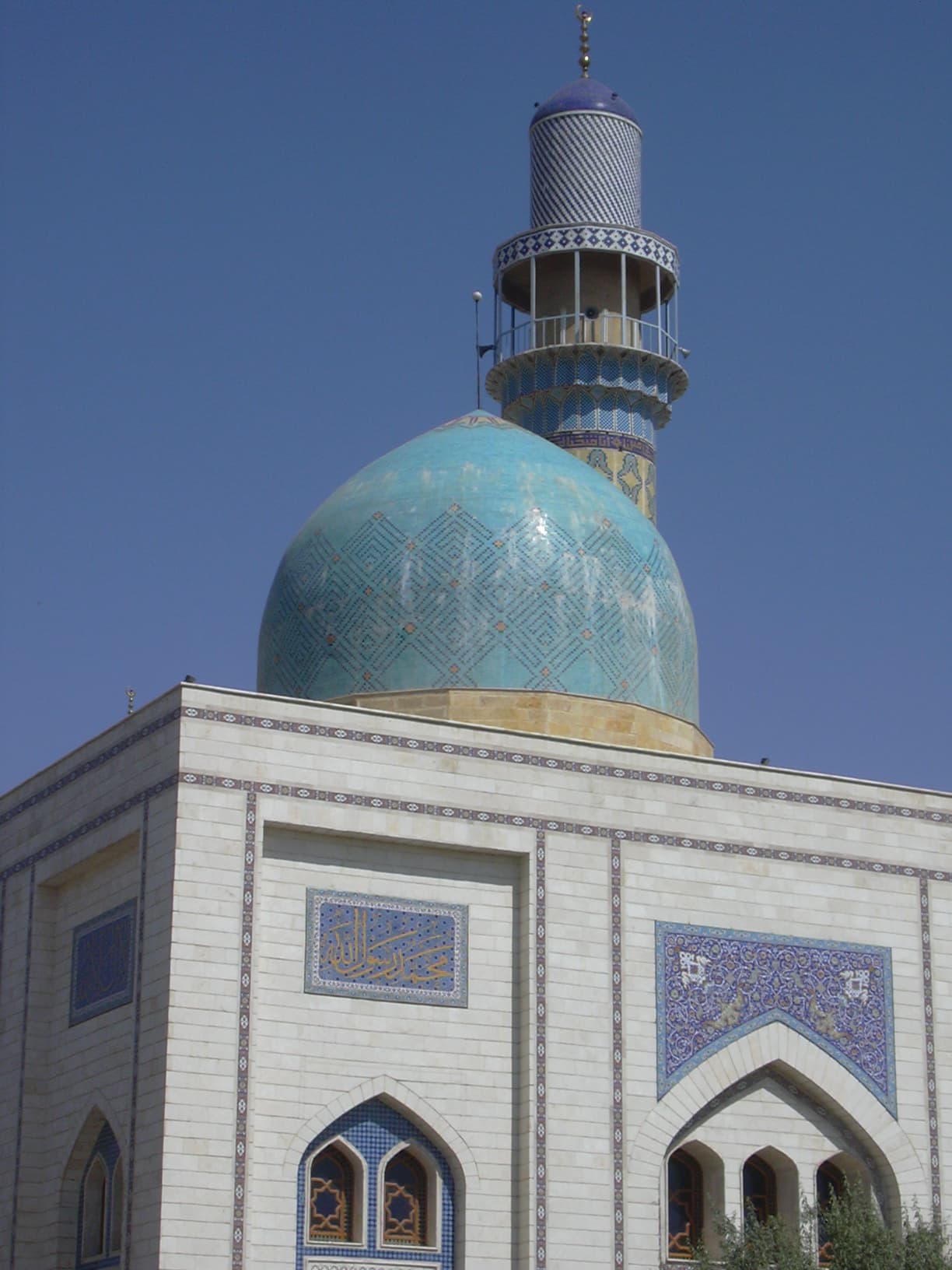
Raqqa’s old cemetery held three shrines: those of Ammar ibn Yasir, Ubayy ibn Qays al-Nakha’i and Uwais al-Qarni. In 1988 work began on a large complex to replace a small domed room from the 18th century, and it was finished in 2003 with blue-tiled domes and minarets. ISIS destroyed it in 2014 with two separate blasts. This page covers the layered history of the place, and what is not known about it today.
Where it is
The cemetery lies about 250 metres east-south-east of Bab Baghdad, the brick gate at the south-eastern end of the Abbasid wall. It is accepted as the burial ground of those killed at the Battle of Siffin in 657; the battlefield is about 40 kilometres west of Raqqa. Bab al-Hajiran, the south-western gate of ancient Callinicum, opened onto this cemetery. Ammar ibn Yasir was one of the earliest companions of the Prophet Muhammad and died at Siffin fighting on Ali’s side. Uwais al-Qarni was a Yemeni of the generation after the companions — a man who never met the Prophet but lived among those who had.
What stood here in Ottoman times
Most of the old graves disappeared over time. Two things survived: a grave with a headstone naming Ammar ibn Yasir, and a small domed room built over the grave of Uwais al-Qarni. The Arabic inscription above the room says Muslim al-Raqqi ibn Ali Agha ibn Ismail Agha had it restored under Ridwan Pasha, governor of Raqqa and Ruha (today’s Urfa). The date is 1152 AH, which is 1737. The dome was restored again under Sultan Abdulmejid I, and the German archaeologist Ernst Herzfeld noted this on his visit in 1907.
What the complex was like
In 1983 the governorate began clearing the cemetery for a park. In 1988, at Iran’s request, a project started for a new complex around the shrines. The work was finished in 2003; Arabic sources give 2004. The complex sat on a 50000 square-metre plot, with 17000 square metres of building.
- Shrine of Ammar ibn Yasir: 730 square metres, with a 12-metre dome.
- Shrine of Uwais al-Qarni: the same size.
- Shrine of Ubayy ibn Qays: 325 square metres, with a 9-metre dome.
Rooms for visitors took up the upper floor. Shia pilgrims came regularly from Iran, Lebanon and Iraq.
When and how it was destroyed
ISIS blew up the complex on 26 March 2014, and the minarets fell. What was left standing was blown up again on 15 May 2014. Some sources give 31 May, but the detailed accounts of events match 15 May. According to the sources available, no rebuilding had started as of 2026.
Can you visit today
This could not be confirmed. No current source shows whether the site now holds only rubble, a temporary structure or a building project under way. Rubble and unexploded ordnance remain a reported risk in Raqqa. If you plan to go, ask locally in Raqqa what the site looks like now; anyone visiting Bab Baghdad is already within a few hundred metres of the cemetery.
What not to miss
Look east through the arch of Bab Baghdad. In photographs taken in 2006, the arch framed the complex’s turquoise dome and minaret right in its centre, and the cover of this page dates from that year. Comparing today’s empty ground with those pictures is the quickest way to grasp how large the building was and how close it stood to the Abbasid gate.
Tips
- Ask in Raqqa whether the site is open before you go; its current state could not be confirmed
- Stay out of the rubble of the blown-up building; the ground and the wall remains are not stable
- See it on the same visit as Bab Baghdad; the two are about 250 metres apart
- The cemetery and shrine ground is considered sacred; clothes covering shoulders and knees are appropriate
Transparency
- How this was chosen
- Written by hand; opening hours, entry fee and coordinates are kept as data. A field that is not known for certain is marked as variable rather than guessed.
- Facts checked
- September 2026
- Last updated
- September 15, 2026