The Al-Jadid Mosque in Latakia
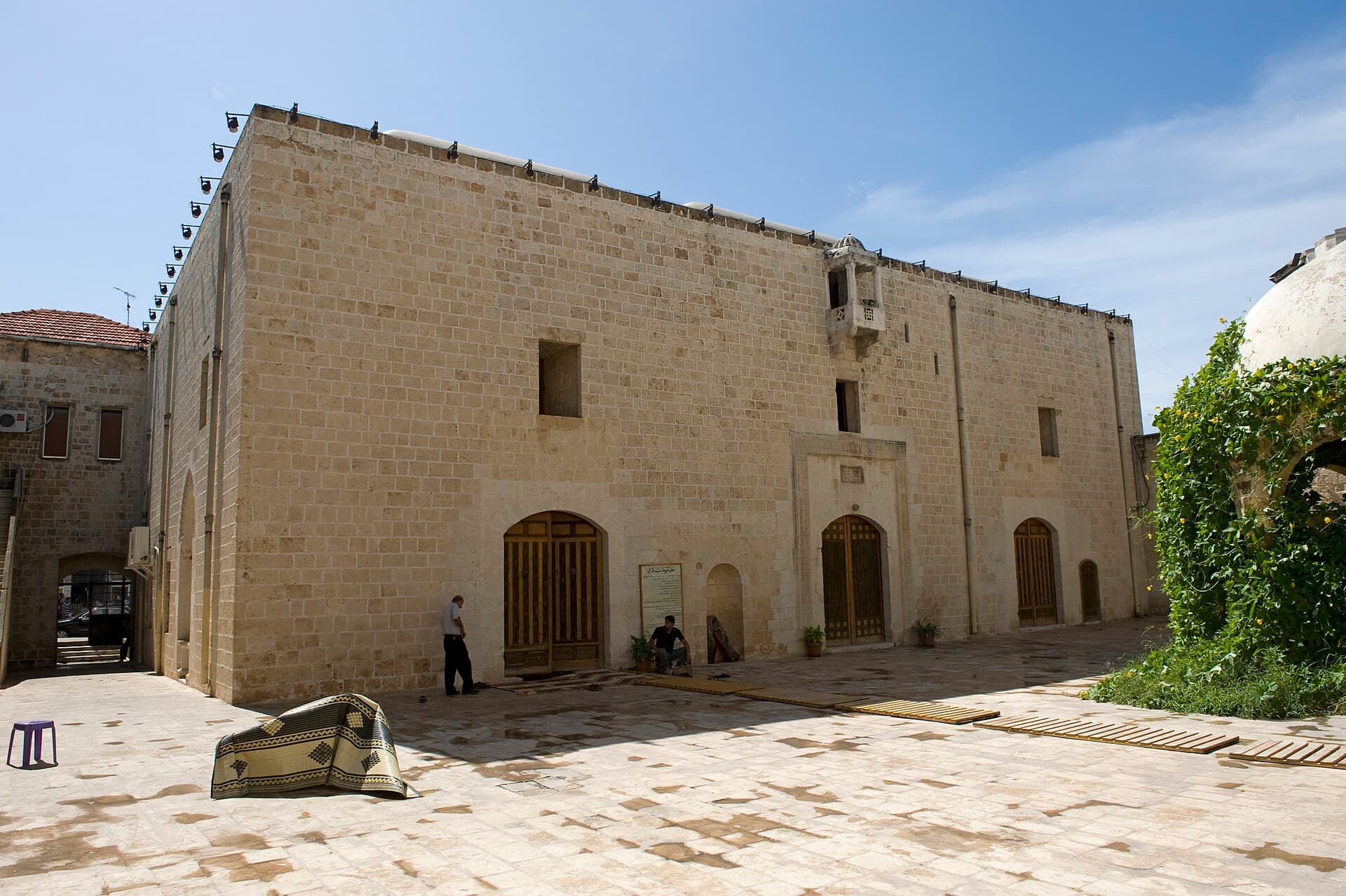
The Azm family’s mosque in Latakia, built in 1727: nine domes on basalt columns with Roman capitals, and two doorways angled to mark the noon prayer by shadow.
- Opening hours
- Daylight hours; the prayer hall closes at prayer times. Exact hours vary, check at the door
- Entry
- Free
- Duration
- 30 minutes
- Best time
- Close to noon, to see the shadows fall across the west and east doorways
- Period
- Ottoman
- Address
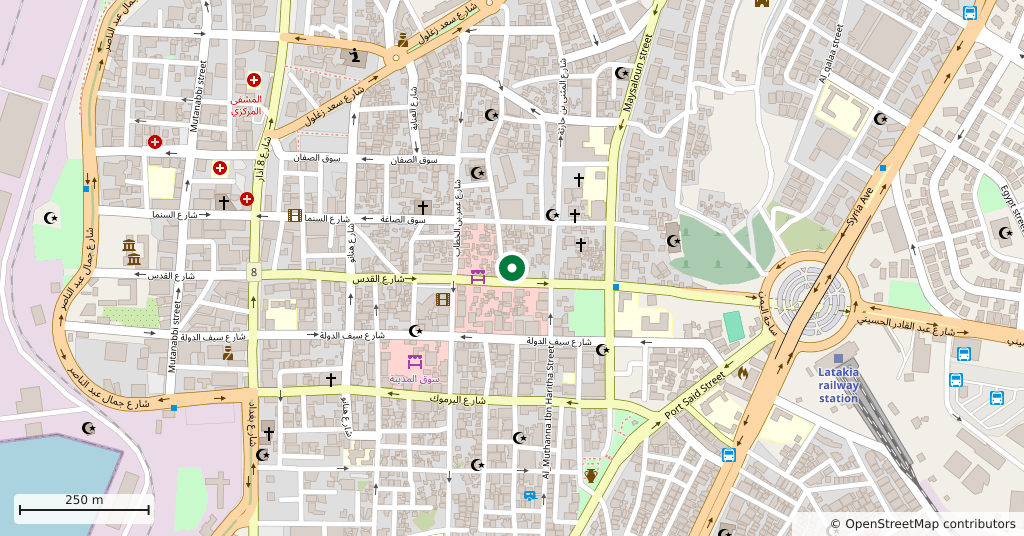
- Uwayna quarter, north of Ghafiqi Street, Latakia
A mosque in the old market district of Latakia, built in 1727 by Sulayman Pasha al-Azm, governor of Tripoli. The Azm family left palaces bearing their name in Damascus and Hama; this is their mark on the coast. People call it Al-Jadid, the New Mosque, because when it went up it really was new next to the city’s Ayyubid, Mamluk and early Ottoman mosques. Its other name is the Sulayman Pasha al-Azm Mosque.
Getting there
The mosque is in the Uwayna quarter, north of Ghafiqi Street. Khan al-Hinta, an old merchants’ inn, sits just west across a narrow lane, and Ugarit Square is a little further on. It is a walk from the city centre, and the minaret is visible from the surrounding streets.
What to see
The prayer hall is square, with walls more than two metres thick. Nine domes cover it, resting on the walls and on four basalt columns in the middle. The capitals are Corinthian and were not made for the mosque: they were gathered from Roman columns scattered around the city.
In the centre of the courtyard, the dome over the ablution fountain rests on eight columns. Clay jars were set into it to make it lighter. Local sources say no other mosque in the city or on the Syrian coast was built this way. The dome is cracked today. Tulip motifs over the main south door point to the Tulip Era under Sultan Ahmed III, and an inscription above the door gives the date of construction. The minaret is about 40 metres tall.
The room with a red tiled roof in the south-east corner is known as the Qaysariya. In Ottoman times it housed the religious endowments office, and under the French Mandate it was the seat of the Islamic council; today it is a centre for Islamic and historical studies. Two public water fountains line the south side, the eastern one with a carved front; neither works.
How long it takes
Thirty minutes is enough for the courtyard, the fountain and the prayer hall. The prayer hall closes to visitors at prayer times.
What most people miss
The west and east doorways. Both were deliberately set at an angle to the wall. At noon, when the north bench of each doorway fell into the shadow of the south bench and the sun lit both doors, it was time for the midday call to prayer: the doorways are a sundial. The same minaret long set the time for the whole city. For daytime prayers the muezzin raised a flag on it, at night a lantern, and the other muezzins watched for the signal. Inside, the south-west column of the prayer hall is called the Maghribi column, because Sheikh al-Maghribi taught his lessons at its foot.
Tips
- Look at the capitals on the four basalt columns in the prayer hall: Roman Corinthian pieces collected from around the city
- The fountain dome is cracked; look at it from a distance rather than lingering underneath
- This is a working mosque: cover arms and legs, and women need a headscarf
- On the way out, take the lane to the west to see the front of Khan al-Hinta, two minutes away
Transparency
- How this was chosen
- Written by hand; opening hours, entry fee and coordinates are kept as data. A field that is not known for certain is marked as variable rather than guessed.
- Facts checked
- September 2026
- Last updated
- September 15, 2026