The Colonnade of Bacchus in Latakia
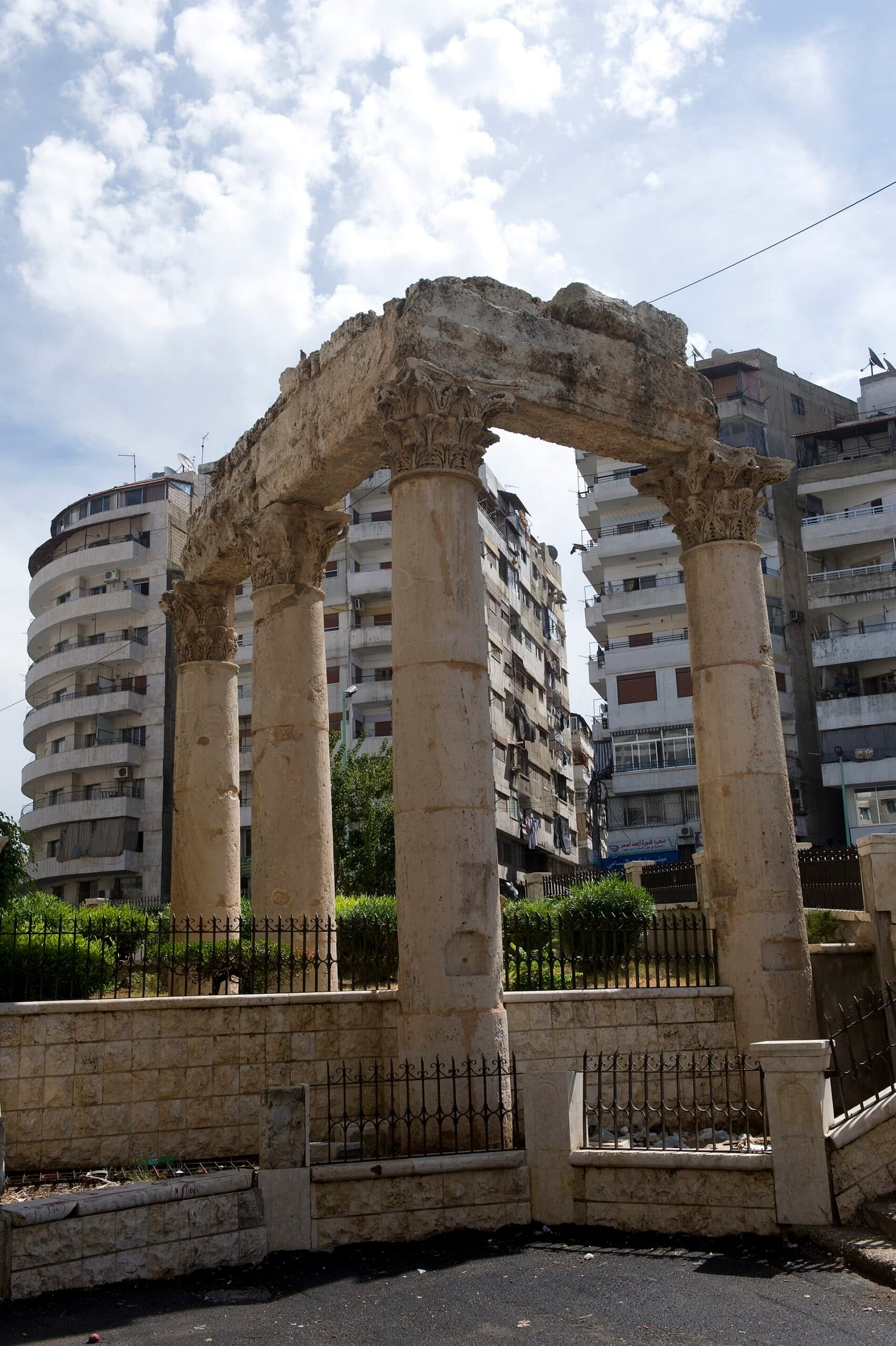
Four 8-metre Roman granite columns in Latakia, 200 metres north-east of the Roman arch. For centuries they were walled into a mosque, until a new road freed them.
- Opening hours
- Visible from the street at any hour; the plot is fenced
- Entry
- Free
- Duration
- 15 minutes
- Best time
- Morning or late afternoon, when side light brings out the carving on the capitals
- Period
- Roman
- Address
- Saliba (Ashrafiyeh), north-east of the Roman arch, Latakia
Four granite Roman columns, 8 metres tall, in the Saliba quarter of Latakia. They are said to come from a Roman temple traditionally attributed to Bacchus, though which god it served is not documented. After the Roman arch, they are one of the few classical pieces of ancient Laodicea still standing.
Getting there
The columns stand about 200 metres north-east of the Roman Arch of Latakia, where the Saliba and Ashrafiyeh quarters meet. It is a few minutes’ walk from the arch. The Qubba Mosque is just to the west. The columns rise from a small green plot with a low stone wall and railings, between apartment blocks.
What to see
Three of the four columns stand in a row; the fourth, on the left, meets them at a right angle. That is how you can read the corner of a temple. The capitals are Corinthian of the imperial type, with deeply cut acanthus leaves. Pieces of the stone beam still sit on top of the columns, and architectural carving is visible on its sides. Specialists think the building was a peripteral temple, one ringed by columns on every side.
How it reached today
In the middle of the 14th century the gaps between the columns were walled up and the site became part of a building used as a mosque. An engraving by Luigi Mayer, published in 1810, shows them in that state, as part of a mosque. A colour photograph taken in 1921 by the French photographer Frédéric Gadmer still shows them among stone walls and rooftops. A lithograph by Camille Rogier shows people strolling around them. When Saliba and Ashrafiyeh were redeveloped, a new road was cut through the site. The surrounding buildings and the walls between the columns were pulled down, and the columns stood free again.
How long it takes
Fifteen minutes. Walking round the plot to see the columns from all four sides is enough. Allow half an hour with the Qubba Mosque.
What most people miss
The underside of the beam. Look closely at the lower face of the stone blocks resting on the columns. The carving reads best from below, not from the side. The join between the Corinthian capitals and the beam is the clearest sign that this was a temple.
Tips
- Walk all the way round; the right angle of the fourth column only makes sense from the side
- Pair it with the Roman arch; the two are 200 metres apart
- The Qubba Mosque is a few steps west; look for its cross-shaped windows before you leave
Transparency
- How this was chosen
- Written by hand; opening hours, entry fee and coordinates are kept as data. A field that is not known for certain is marked as variable rather than guessed.
- Facts checked
- September 2026
- Last updated
- September 15, 2026