Deir Semaan (Telanissos)
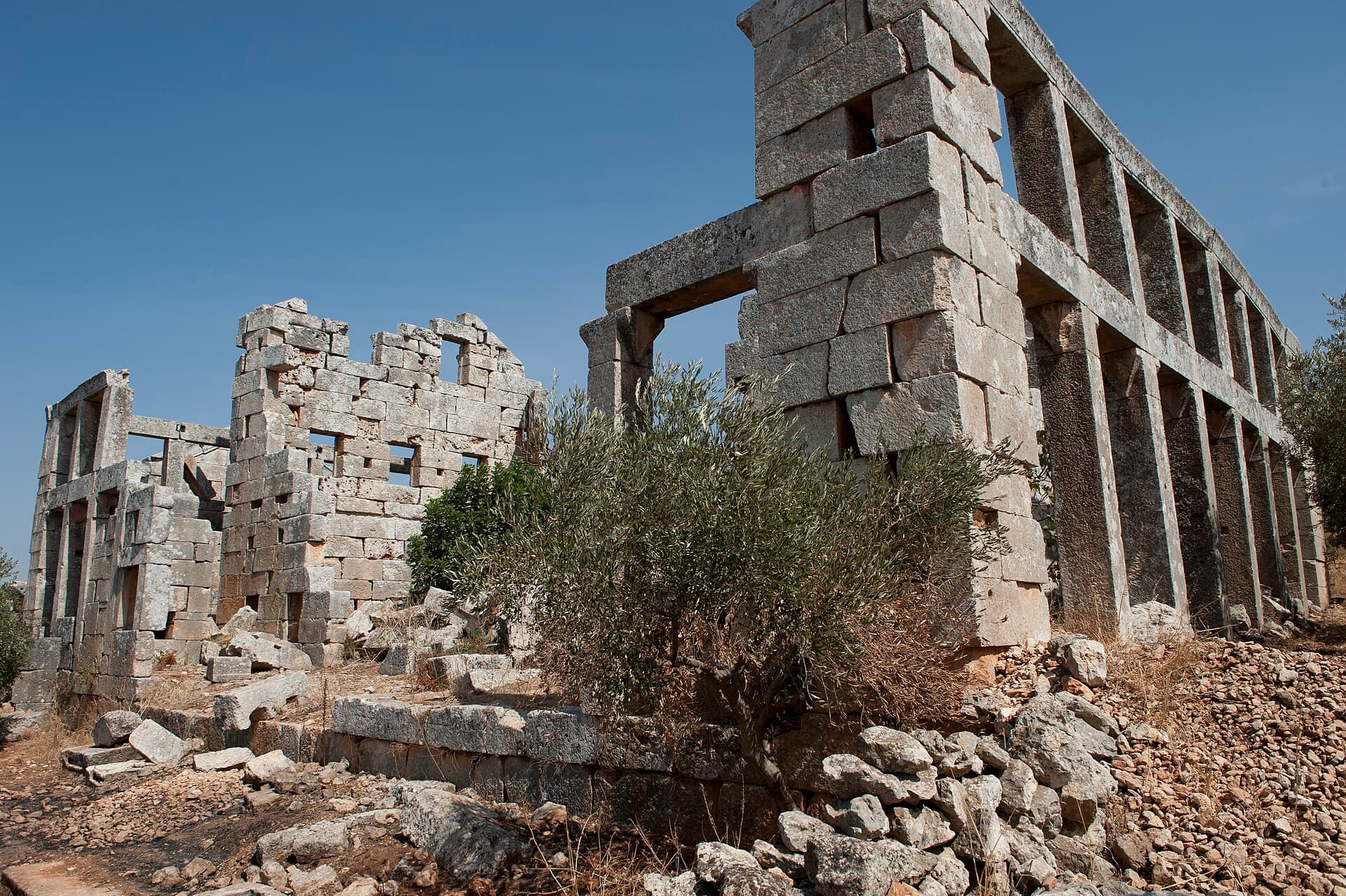
The pilgrim town below Saint Simeon’s monastery: two-storey hostels, the ruins of three monasteries, and the street where pilgrims once bought souvenirs.
- Opening hours
- Open site, daylight hours
- Entry
- Variable — confirm at the entrance
- Duration
- 90 minutes
- Best time
- Spring and autumn; there is no shade on the plateau in summer
- Period
- Late Roman — Byzantine
- Address
- Deir Semaan, Jebel Semaan, 40 km north-west of Aleppo
The monastery of Saint Simeon stands on the hill; the town that fed, lodged and sent off the pilgrims who came to it lies at the foot. Deir Semaan, ancient Telanissos, was the back yard of the busiest pilgrimage centre in northern Syria through the fifth and sixth centuries. Nowhere in the Dead Cities shows better what a Byzantine service town looked like.
Getting there
40 km north-west of Aleppo, beside the road that runs to Afrin through Daret Azza. The town spreads across the limestone flat directly below the hill where Saint Simeon’s church sits, and you can walk down the slope from the monastery to reach it. Do the two together, because either one is half a story on its own.
What to see
The buildings that set the town apart are the pilgrim hostels. Two large ones were put up towards the end of the fifth century, two storeys high, faced with porticoes and built of dressed stone. The walls and rows of windows still stand; the roofs are gone. At the north-west, south-west and south-east edges of the town stands a monastery complex, each of which had a basilica and a hostel of its own. The best preserved is the south-eastern one, where the two-storey communal buildings from the end of the sixth century and the porticoes in front of them can still be read.
What not to miss
The main street. Souvenirs were sold along it. Pilgrims bought small clay flasks filled with holy water or oil. The line of the street can still be followed from the courses of stone, and it changes how you see the place — this was not a monastery but a pilgrimage economy.
History
In the fourth century it was a village living on olives, on the Roman road running south from Cyrrhus. Simeon entered the monastery here in 412 and stayed three years. His asceticism was judged too severe and he was asked to leave; he climbed the nearest hill and spent the last 37 years of his life on a column. After 476 the great pilgrimage complex began to rise around that column, modelled on the church at Qalb Lozeh, which had just been finished. By the end of the century Deir Semaan was one of only three towns on the limestone plateau, alongside Brad and al-Bara. The Arab conquest did not destroy it; the inhabitants drifted away over the following centuries, and the site was resettled around 1900 by nomad families. It is part of the UNESCO listing of the Ancient Villages of Northern Syria.
Tips
- Pair it with Saint Simeon; the hill and the town are two halves of one story
- The south-eastern monastery is the best preserved; see all three before you leave
- Stones are loose and the ground uneven; wear shoes with a firm sole
- Some houses among the ruins shelter livestock; do not enter courtyards uninvited
Transparency
- How this was chosen
- Written by hand; opening hours, entry fee and coordinates are kept as data. A field that is not known for certain is marked as variable rather than guessed.
- Facts checked
- August 2026
- Last updated
- September 15, 2026