Aleppo’s consulate khans: from Khan al-Wazir to Khan al-Jumruk
A half-day walk in the Aleppo souq through six khans, tracing where Venetian, English and French consuls lived, from the treaty of 1207 to Khan al-Jumruk.
- Duration
- 3 hours
- Distance
- 0.8 km
- Difficulty
- Easy
- Best season
- March–June, September–November
- stops
- 6
- City
- Aleppo
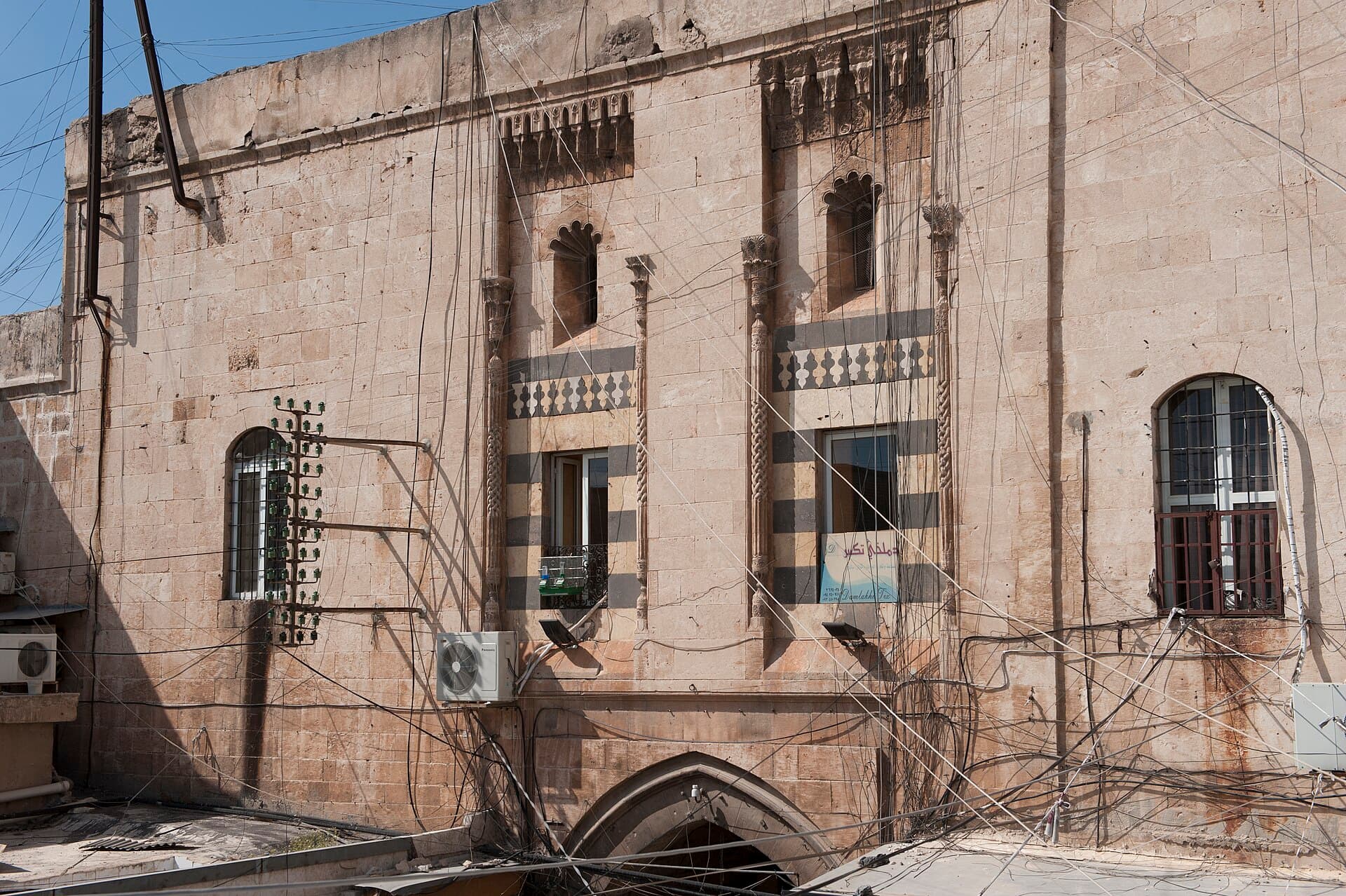
In Aleppo the European powers did not set their consulates outside the souq. They put them inside it, on the upper floors of the khans — merchants’ inns built around a courtyard. This walk follows that arrangement through six khans. It starts at Khan al-Wazir, passes the courtyards where Venetian, English and French consuls lived, and ends at Khan al-Jumruk. As the crow flies the stops lie along a line of 450 metres; with the bends of the souq lanes the walk comes to about 800 metres. Most of the half day goes not on walking but on finding doors that carry no sign.
Why a consul lived in a khan
A consul also represented his own merchants, and he had to be where the goods came in. The sequence starts with the Venetians: Khan al-Banadiqa simply means ‘khan of the Venetians’. In the middle of the 16th century the Venetian consulate moved to Khan al-Nahhasin. Khan al-Jumruk, built in 1574, took in French, English and Dutch merchants and their consuls, and the north part of Khan al-Burghul housed the British consulate general until the early 20th century. Within a few hundred metres there was a small Europe, and its addresses were the same doors the souq traders used.
The route
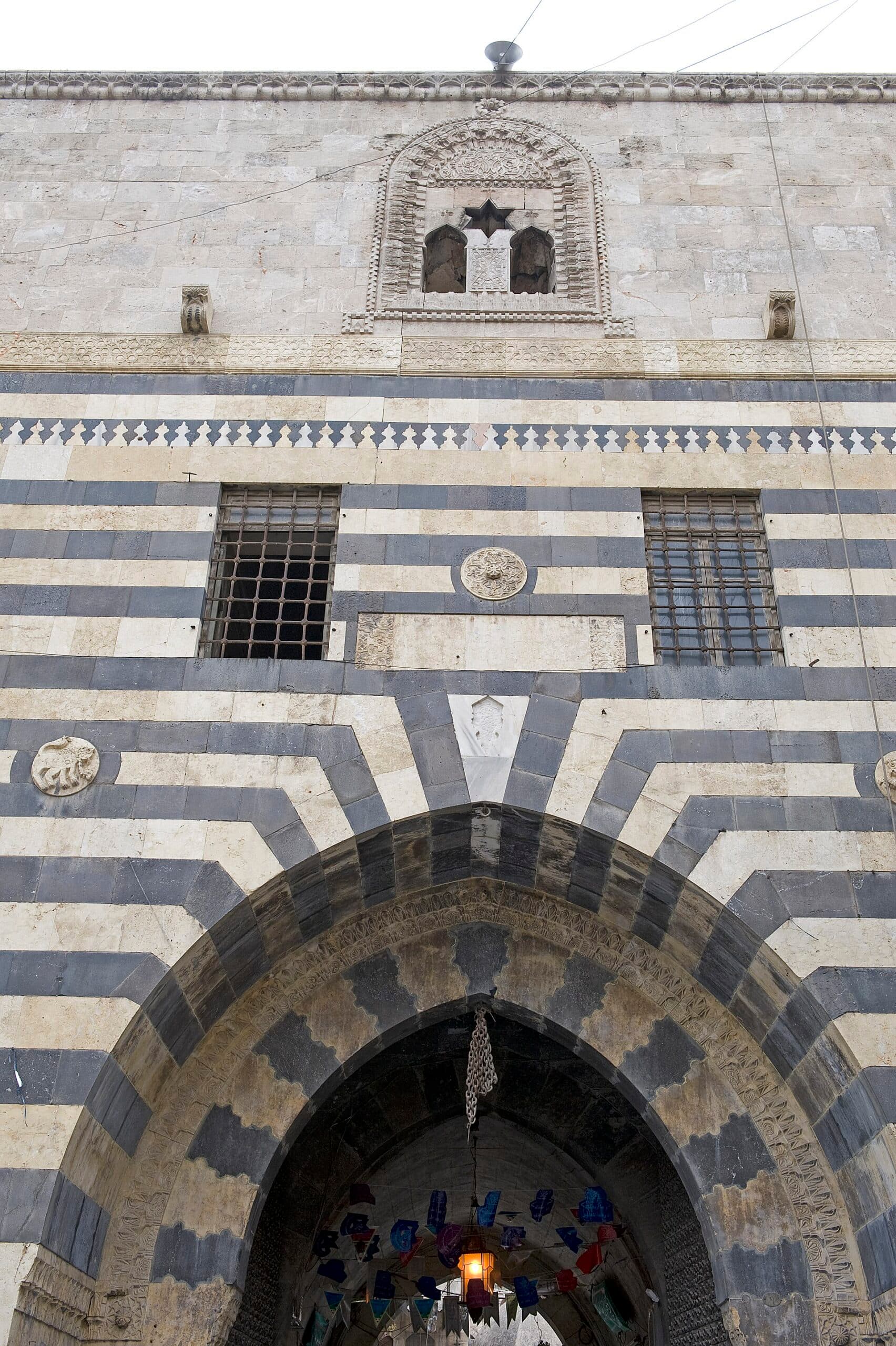
Begin at the portal of Khan al-Wazir. The interlocking courses of black basalt and white limestone, and the medallions on either side, read best from the opposite pavement. Built in 1682, this khan is not a consulate stop; it is the starting point that shows the scale of the souq on this side. Go south into the Souq al-Hibal branch, where the door of Khan al-Kattan opens onto the lane. Its older name is Khan al-Sayyida, after Sayyida bint Wassab, wife of the Mirdasid emir Nasr ibn Salih. The Belgian consulate is said to have been here, but the same claim is made for Khan al-Nahhasin.
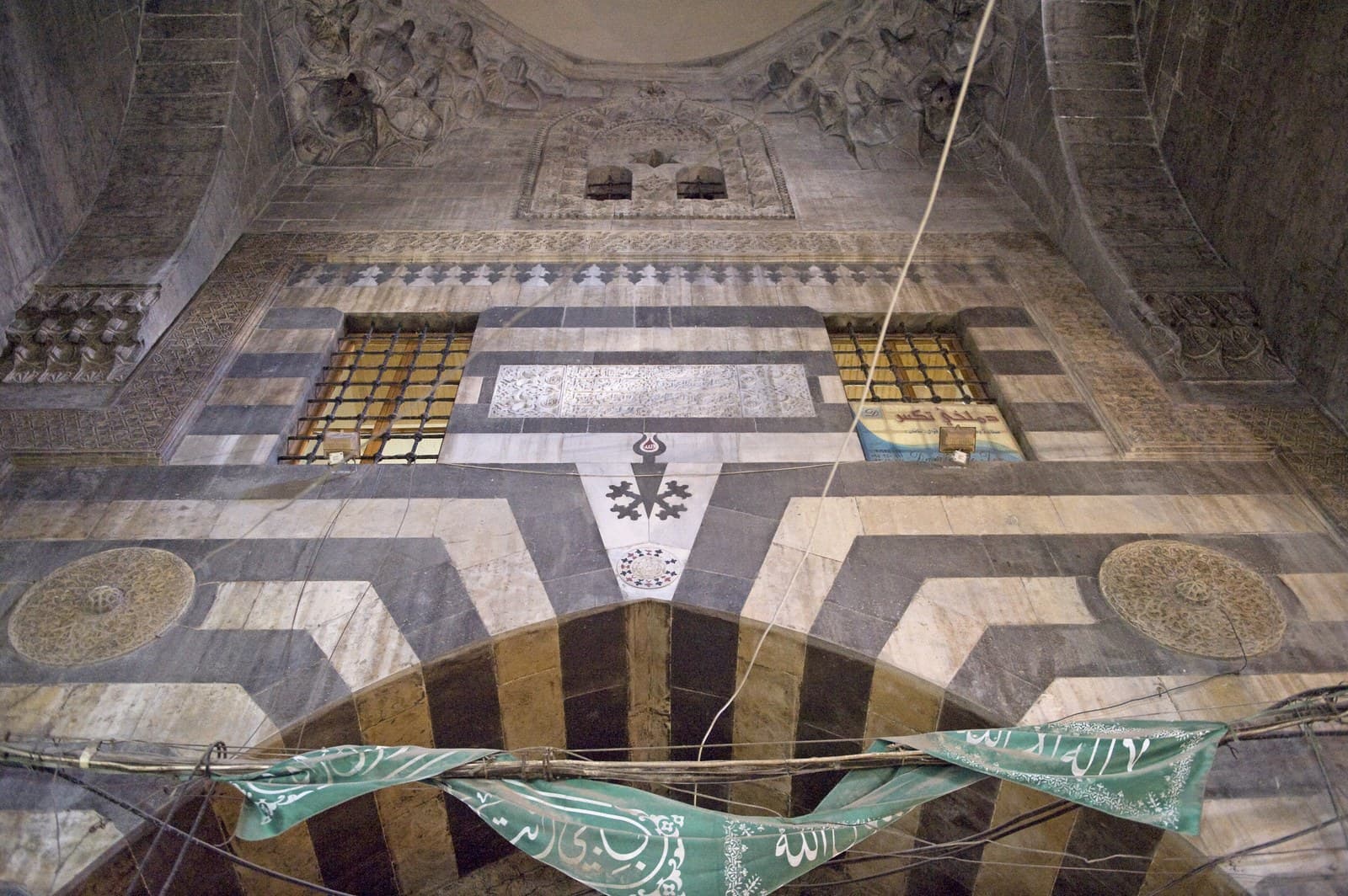
From there walk towards the Great Mosque, to the area around Souq al-Darb. Khan al-Banadiqa is close by and has no sign, so ask the traders for it by name. It has two courtyards, and the small square one is easy to miss. Then turn into the al-Muhammas branch from the south side of the Great Mosque. Once you find the door of Hammam al-Nahhasin, Khan al-Nahhasin is next to it and Khan al-Burghul right beside that, so the two khans work almost as one stop. The courtyard of Nahhasin, built in 1539, is now full of shoe shops. At Burghul, look at the wall where its two parts meet: the south half is Mamluk and is used as housing today. The last stop, Khan al-Jumruk, is a few minutes on, where the souq arms cross. Its gate is set back from the lane, and you know it by the muqarnas hood of the portal.
Timing
Be at Khan al-Wazir at 09:30; the portal looks best in the morning, before it drops into shade. Allow an hour for Kattan and Banadiqa together, because the time goes on asking directions, not on distance. Reach Nahhasin and Burghul in al-Muhammas around 11:00; 45 minutes covers both courtyards. Arrive at Khan al-Jumruk towards midday, when the cells of the muqarnas cut the shadow in layers. The walk ends at about 12:30.
Take care
The Al-Madina souq was badly damaged in the fire of 2012, and repair goes on branch by branch; which branch is open changes from week to week. Banadiqa and Nahhasin have no sign. Most of these khans are working premises: Jumruk is in the hands of cloth wholesalers, the upper floor of Nahhasin is mostly shut, and part of Burghul is lived in. So it is not certain that every courtyard can be entered; ask the traders or residents at the door. Opening hours had not been verified as of September 2026, so ask on the spot. Do not count on a consulate plaque either. The sources disagree between Kattan and Nahhasin, and where no plaque hangs on the door, the question stays open.
The route on a map
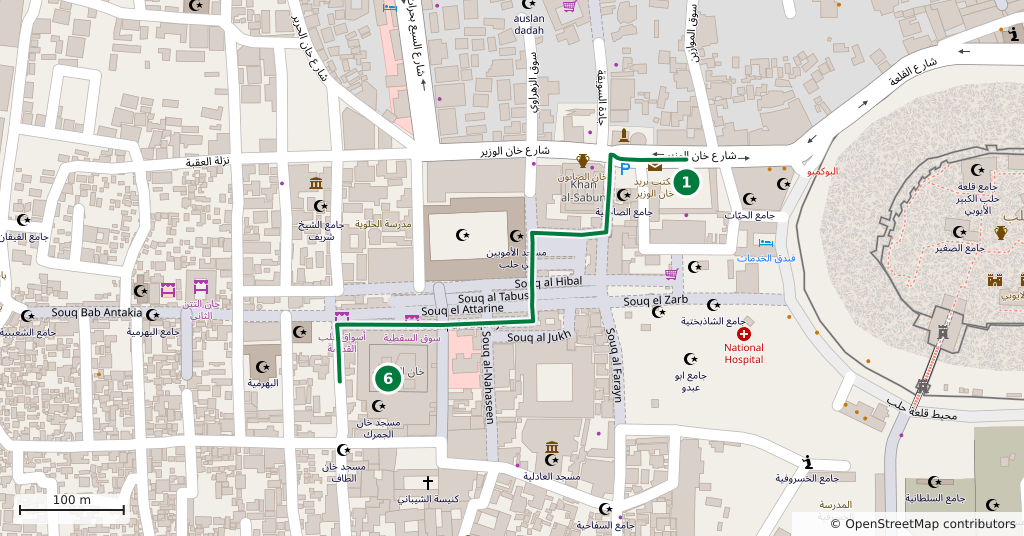
Stops along the route
- 01
- 02
- 03
- 04
- 05
- 06
Transparency
- How this was chosen
- The stops and their order were set by hand. The line on the map is real road geometry, not a straight hop between pins; distance and duration belong to that itinerary.
- Facts checked
- September 2026
- Last updated
- September 15, 2026