The Fir and Cedar Reserve above Slunfeh
A 1350-hectare reserve above Slunfeh, with Cilician fir on the western slope and Lebanon cedar on the eastern one. Declared in 1996; 142 plant species recorded.
- Opening hours
- Open forest; no posted visiting hours are known
- Entry
- Varies — confirm on site
- Duration
- 180 minutes
- Best time
- May to October; in winter snow can close the road
- Period
- Reserve, 1996
- Address
- Slunfeh subdistrict, Haffah district, Latakia
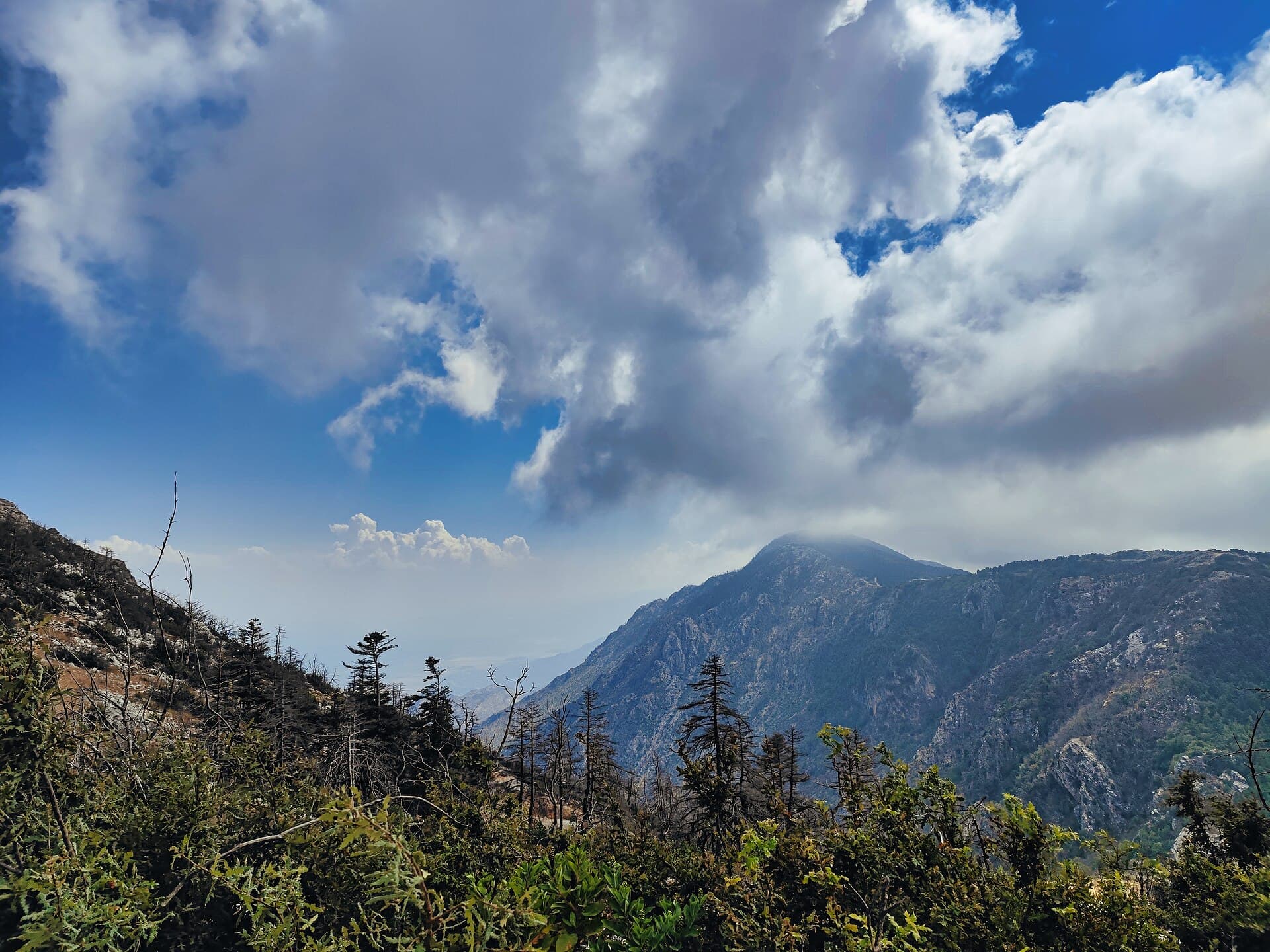
A 1350-hectare forest reserve on the ridges above Slunfeh, in the northern part of the coastal range. Its Arabic name, al-Shouh wal-Arz, means fir and cedar: Cilician fir grows on the western slope and Lebanon cedar on the eastern one. The reserve runs from 1100 to 1562 metres, and the cedar forest on the eastern side covers about 1000 hectares.
When and why it was protected
It was declared on 22 July 1996 by decision of the Syrian Minister of Agriculture and Agrarian Reform, as a forest reserve for science and training that is open to controlled ecotourism. Work on the ground began in 2002. There is a proposal to enlarge it to twenty thousand hectares.
Where it is and where it ends
The reserve lies in the Slunfeh subdistrict. To the north its edge is the road from Slunfeh past the transmitter station down to the Ghab; to the west, the road between Slunfeh and Jubbat Burghal. On the east the slope faces the Ghab, a rift-valley plain. OpenStreetMap marks a viewpoint named the fir forest overlooking the Ghab. Rooms, restaurants and picnic grounds are in the surrounding villages, above all in Slunfeh.
What grows at which height
The vegetation belts change with the slope. On the western side, semi-evergreen oak grows between 850 and 1250 metres and fir between 1250 and 1500. On the eastern side, oak runs from 850 to 1100 metres and cedar from 1100 to 1300. The two conifers share one mountain and take a face each. Arabic Wikipedia puts the cedar forest in the east at about 1000 hectares; for the fir, sources give different figures, and one says 500 hectares. Tree cover does not exceed 40 to 50 percent of the whole area. The reserve is divided into 13 uniform zones: nine fir, three cedar and one mixed.
Annual rainfall reaches 1500 millimetres. The bedrock is Jurassic limestone and dolomite, and the soil is 15 centimetres deep in places and a metre in others.
Which species are recorded
The 2006 inventory counted 142 plant species in 107 genera and 50 families; 53 are woody and 89 herbaceous. Rare ones include hop hornbeam (Ostrya carpinifolia), Syrian juniper (Juniperus drupacea), Lebanon oak (Quercus libani), Quercus cedrorum and the peony Paeonia mascula. More than 94 animal species are recorded, among them wolf, fox, hyena, hare, squirrel, roe deer, fallow deer and wild boar. Birds include blackbird, robin, jay, great tit, griffon vulture, partridge and little owl. The Syrian brown bear has disappeared from these forests, and the leopard once lived here too.
Walking it and how long it takes
The reserve is explored on foot, and you can climb to the top. From there you see summer villages such as Ayn al-Bayda, al-Barid, Bab Jannah, Jubb al-Ghar and Jubb al-Shouh. Three hours is realistic to walk the forest track from Slunfeh and climb one ridge. Summers are cool; in winter it snows and the road can close.
What most people miss
The eastern slope that looks over the Ghab: from the edge of the forest the plain opens up below in a single frame. The villages also tell a story that the firs were planted by the Romans 2000 years ago. It is not a documented fact, but you will still hear it around here.
Tips
- Cedar is on the eastern slope and fir on the western; cross the ridge to see both
- Go back to Slunfeh for rooms and meals; services are in the villages around
- In winter ask about snow before setting out; the road can close
- Do not pick flowers or touch rare plants; the reserve is protected for science
Transparency
- How this was chosen
- Written by hand; opening hours, entry fee and coordinates are kept as data. A field that is not known for certain is marked as variable rather than guessed.
- Facts checked
- September 2026
- Last updated
- September 15, 2026