The National Evangelical Presbyterian Church of Latakia
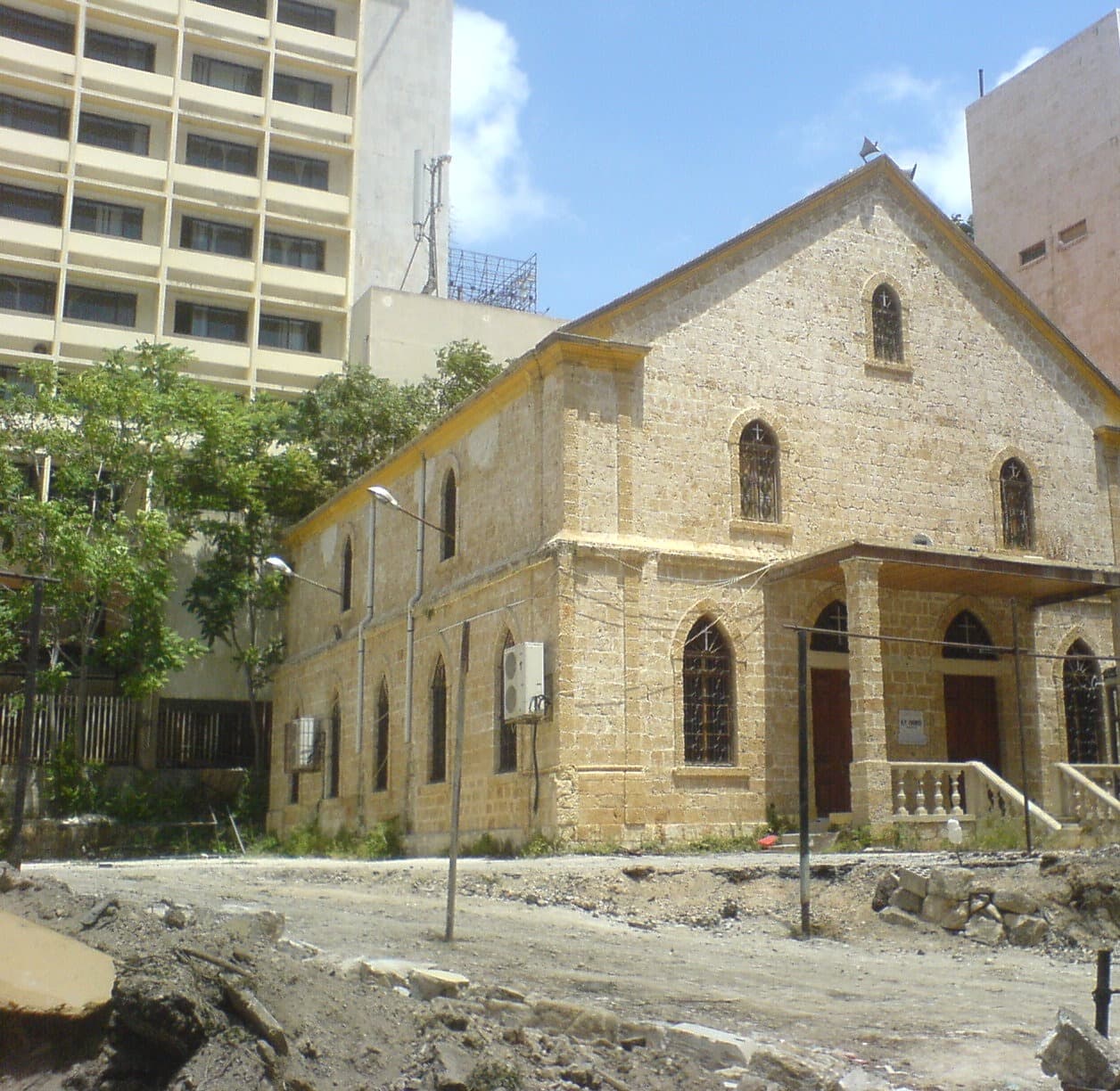
Home of Latakia’s Arabic-speaking Presbyterians, built in 1923-1924 as the marble plaque by its door says. The mission behind it reached the city in 1856.
- Opening hours
- Open for the Sunday service; otherwise varies, check at the door
- Entry
- Free
- Duration
- 20 minutes
- Best time
- Sunday morning, when the main service is held
- Period
- French Mandate (building 1923-1924)
- Address
- City centre, Latakia
The church of Latakia’s Arabic-speaking Presbyterian congregation, one of 20 churches in Syria that belong to the National Evangelical Synod of Syria and Lebanon. The stone building went up in 1923-1924, and the marble plaque beside the door says so in two languages. The hall holds around 400 people, which makes it one of the larger churches in the city, and the congregation has about 1000 members.
Getting there
The church is in the city centre, within walking distance of the Latin Church. It sits low among tall apartment blocks, so you see it only when you turn the corner, not from a distance.
How long it takes
Twenty minutes. The hall is a single plain nave; most of the time goes on the plaque by the door and the memorial stones in front.
What to see
A stone hall under a pitched roof with pointed-arch windows, entered through a porch on pillars with steps rising from both sides. Inside are wooden pews, chandeliers and pointed windows set in the stone walls. The marble plaque by the door reads ‘Evangelical Church, built 1923-1924’ in Arabic and ‘R.P. Church, Erected 1923-1924’ in English, and a lower panel records that the building went up under the pastor Khalil Awad. R.P. stands for Reformed Presbyterian, the mission that founded the church. Between the two languages runs a line from Psalm 46: ‘God is in the midst of her; she shall not be moved.’
From mission to church
In 1856 missionaries from the Reformed Presbyterian Church and the Free Church of Scotland arrived in Latakia; the cenotaph gravestones in front of the church commemorate them. The first service was held in 1859 in a rented house, and the first boys’ school opened in 1860. By 1876 the mission compound had a three-storey girls’ school, a chapel and a hospital. The congregation itself was formally established only in 1890. During the First World War, 100 of its 287 members went missing and most of the missionaries left the city. In 1921 the Synod installed Khalil Awad as the congregation’s first pastor of Syrian origin. The government of the new Syrian Republic closed the church’s schools in the years 1946-1963. After the 2023 earthquake the church sheltered people who had lost their homes and joined the relief work in the city.
Don’t miss
The memorial gravestones in front of the church. Nobody is buried beneath them; they were set up in the name of the first missionaries, who came in 1856. Read them together with the 1923-1924 plaque on the door and the timeline is plain: the congregation waited close to 70 years for a building of its own.
Tips
- Read the marble plaque by the door; the building date and the pastor's name are there
- The main service is on Sunday, the easiest day to see inside
- The gravestones in front are cenotaphs for the first missionaries
- The Latin Church fits into the same day; both are in the city centre
Transparency
- How this was chosen
- Written by hand; opening hours, entry fee and coordinates are kept as data. A field that is not known for certain is marked as variable rather than guessed.
- Facts checked
- September 2026
- Last updated
- September 15, 2026