Qasr al-Hayr al-Gharbi
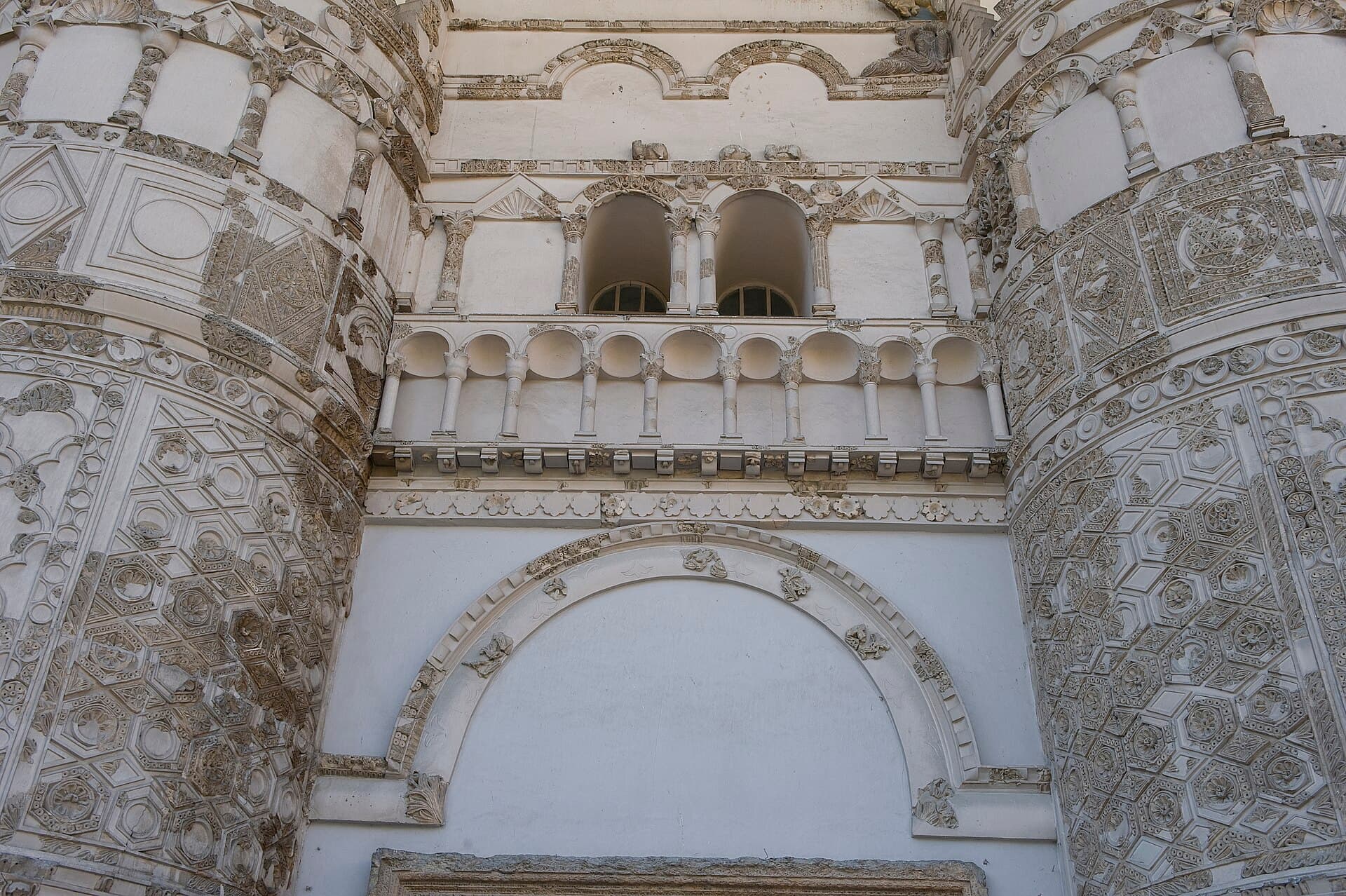
The Umayyad desert palace whose facade is now the entrance of the National Museum in Damascus. What is left on the site, and where the rest of it went.
- Opening hours
- Open site, daylight hours
- Entry
- Variable — confirm at the entrance
- Duration
- 60 minutes
- Best time
- Autumn and spring; there is no shade on the steppe in summer
- Period
- Umayyad
- Address
- Near al-Qaryatayn, 100 km east of Homs, Homs governorate
If you have walked into the National Museum of Damascus you have already seen this palace: the museum’s doorway is this building’s facade, dated 727. It was taken down stone by stone, carried to Damascus and rebuilt as the entrance. What is left of the palace stands out in the steppe between Homs and Palmyra. It was built for the Umayyad caliph Hisham ibn Abd al-Malik, and is the twin of Qasr al-Hayr al-Sharqi, which he built a year later.
Getting there
About 100 km east of Homs and 75 km south-west of Palmyra, near al-Qaryatayn on the steppe road. There is no settlement in between, so go with a driver who knows the route. The site is unmarked and there is next to nothing in the way of entrance control.
What to see
The palace is quadrangular, with sides of 70 metres. Its walls were mudbrick on a masonry base; the mudbrick has gone back into the sand, and the stone base now traces where the walls stood. Three corners keep the remains of round towers. On the fourth stands a tower taken over from an older monastery. The palace stood two storeys high. Around it a reservoir, a bath and a khan can still be made out; the water came from the Harbaqa dam.
What not to miss
The tower on the fourth corner. It is the oldest part of the site and older than the palace itself: the Umayyad builders simply folded a monastery tower that was already standing into their plan. One corner shows how comfortable Umayyad architecture was about borrowing what it inherited.
The other half is in Damascus
This page is incomplete on its own. The gate facade, fragments of stucco wall, floor frescoes and the reliefs found in the 1936 excavation are all in the National Museum of Damascus. One relief shows a man in Sasanian dress, thought possibly to be Hisham himself. To see the palace properly you need both stops: the foundations in the steppe and the facade in Damascus.
History
An inscription over the entrance records that Hisham had it built in 727. It was never the caliph’s main residence; the flat steppe around it was for hunting and racing, and visiting noblemen stayed in tents outside the walls. The Ayyubids and Mamluks used the building in later centuries, and it was abandoned for good after the Mongol invasions.
Tips
- To see the facade, go to the National Museum of Damascus; the gate is there
- The tower on the fourth corner is older than the palace; do not walk past it
- There is no settlement on the road; bring water and fuel and a driver who knows it
- The mudbrick has dissolved; read the building from the stone base that survives
Transparency
- How this was chosen
- Written by hand; opening hours, entry fee and coordinates are kept as data. A field that is not known for certain is marked as variable rather than guessed.
- Facts checked
- August 2026
- Last updated
- September 15, 2026