The Qubba Mosque (Al-Duha Mosque), Latakia
A tiny mosque in Latakia’s old Saliba quarter, beside the Colonnade of Bacchus: a Crusader chapel, a school from 1188, a mosque from 1710. Two cross windows remain.
- Opening hours
- Open around prayer times; hours in between vary, check at the door
- Entry
- Free
- Duration
- 15 minutes
- Best time
- Morning, on the same walk as the Colonnade of Bacchus, while the lanes are in shade
- Period
- Crusader — Ayyubid — Ottoman
- Address
- Saliba (Ashrafiyeh), west of the Colonnade of Bacchus, Latakia
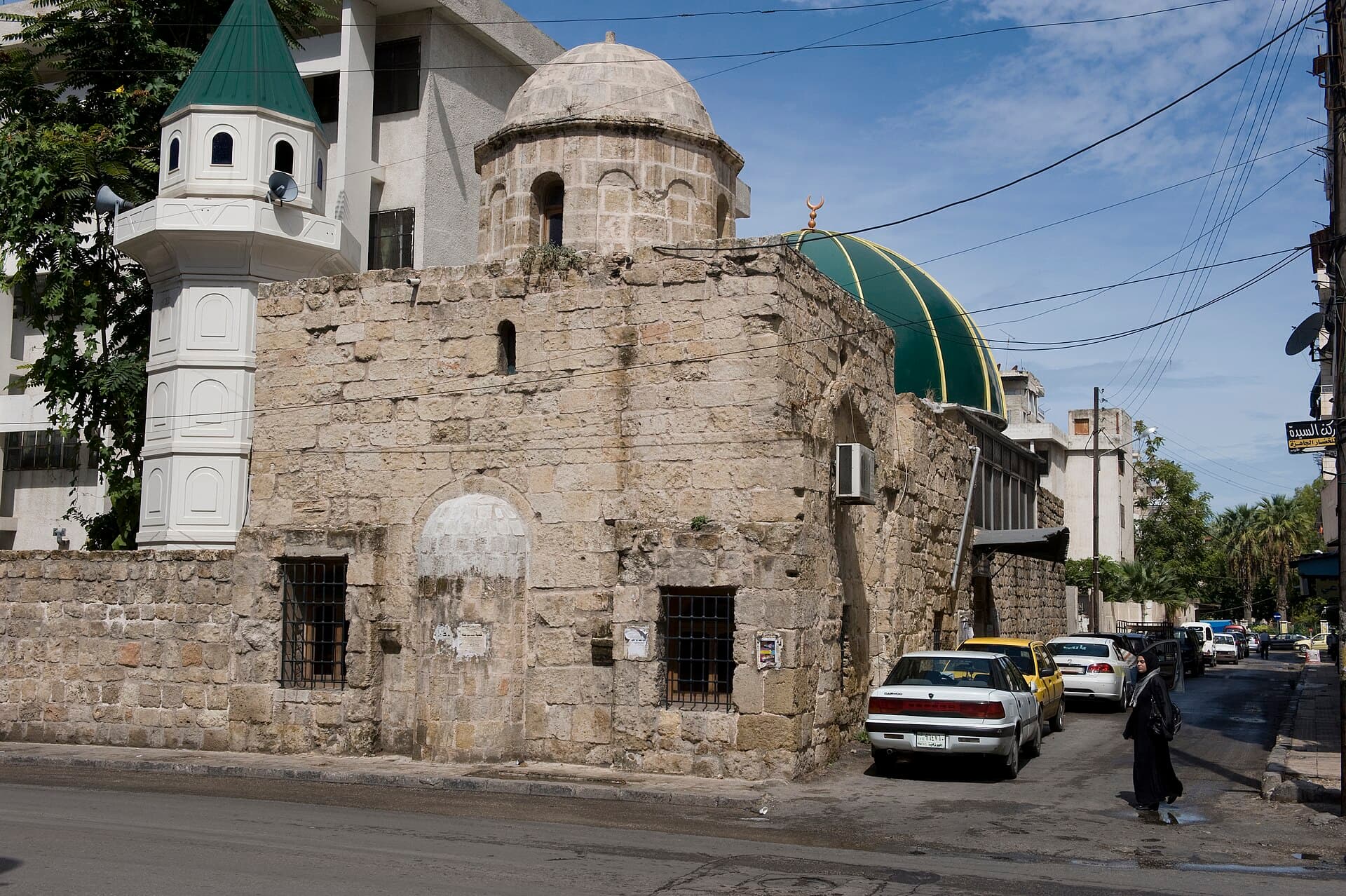
A small mosque in Saliba, the oldest quarter of Latakia, with a floor area of no more than 150 square metres. Three periods of the city sit inside one building: it was a chapel under the Crusaders, became a school after Saladin took the city, and was turned into a mosque at the start of the 18th century. The inscription over the door gives its official name, the Al-Duha Mosque; the neighbourhood still calls it the Qubba Mosque, or the Green Dome.
Getting there
The mosque is in the old part of Saliba, just west of the Colonnade of Bacchus and opposite the old Yasin Mosque, restored in 2011. Abu Tammam Park is close by. If you find the columns, you have found the mosque. Around it are narrow stone-walled lanes and small craft workshops.
How it reached today
In the Crusader period the building was the chapel of Latakia’s Latin bishop and of the Knights Templar. After Saladin captured the city in 1188, he turned it into an Islamic school. In 1710 Hajj Ali bin Abd al-Rahman, known as Ibn al-Ajjan al-Akkari, converted it into a mosque. The physician Ibn Butlan, writing about Latakia in the 11th century, mentions a building that had first belonged to idols, was a mosque in the early years of Islam and was a church in his day. This mosque is thought to be that building, though it is not certain.
In 2004 it was enlarged with a donation from a woman named Duha Qannish. The open courtyard in front was covered with a large dome made in Aleppo, and the mosque reopened on 19 August 2004; the restoration was completed in 2005. The big green dome you see from the street is that addition.
What to see
A door from the side lane on the east leads into the courtyard and from there into the prayer hall. The hall is rectangular, with a stone dome at its centre. The minaret has twelve sides and is of medium height. The wall stones vary in size and shape from place to place; the building has been reworked many times.
How long it takes
Fifteen minutes. Walking round the outside and looking in is enough. Visitors do not go in during prayers.
What most people miss
The two cross-shaped windows and the traces of two arches on the east and west faces. The Latakia antiquities directorate reads them as proof that the building was once a church. Look too at the point where the old wall meets the new green-domed section: stone from two centuries sits side by side.
Tips
- The cross-shaped windows are on the outside; walk the east and west faces before going in
- This is a small neighbourhood mosque: do not stay inside as a visitor during prayers
- The Colonnade of Bacchus is a few steps east; see both in one stop
Transparency
- How this was chosen
- Written by hand; opening hours, entry fee and coordinates are kept as data. A field that is not known for certain is marked as variable rather than guessed.
- Facts checked
- September 2026
- Last updated
- September 15, 2026