The Sheikh al-Maghribi Mosque and Citadel Gate, Latakia
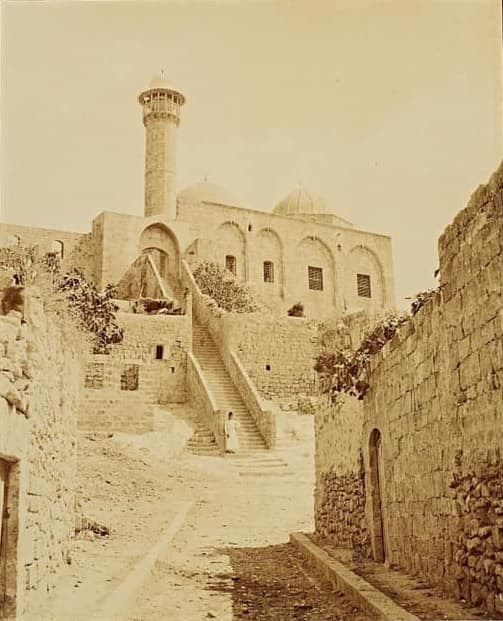
A 19th-century shrine mosque on the southern tip of Latakia’s Citadel hill, reached by 82 steps. The gate beside it is all that stands of the city’s castles.
- Opening hours
- Daylight hours; the prayer hall closes at prayer times. Exact hours vary, check at the door
- Entry
- Free
- Duration
- 45 minutes
- Best time
- Morning, while the west stairway is in shade and the courtyard is quiet
- Period
- Ottoman
- Address
- Qala'a quarter, southern end of the Citadel hill, Latakia
A shrine mosque on the southern tip of the Citadel hill in Latakia, looking down over the city. Work began in 1827 over the grave of a Moroccan scholar, and the building keeps most of its original form. Right beside it stands the Citadel Gate (Bab al-Qala’a), the one surviving piece of the three castles Latakia once had; its steps climb up to the mosque.
Who was Sheikh al-Maghribi
Muhammad al-Maghribi was born in 1764 in the Draa valley in Morocco. He went on the hajj in 1802, spent time in Medina, Jerusalem and Damascus, where he stayed three years, then settled in Latakia and taught there. He died of plague in Ramadan 1242, which is 1827. The townspeople decided to build a mosque in his name. The foundations went in that same year. On the marble inscription, the letters of the second half of the last verse add up to 1242 in abjad numerals, the old system of giving each Arabic letter a number. The portico and the iwan, a vaulted hall open on one side, were finished three years later, and the minaret came last. The builder is thought to have been the sheikh’s student, Ahmad al-Halabi.
Getting there
The mosque is in the Qala’a quarter of the old city, on the south-facing end of the hill. There are two entrances. The main one, on the west, is reached by a stairway of 82 steps with three landings; the same stairway appears in a photograph from 1875. The east entrance is reached from the south by 17 steps, a much shorter climb. The steps from the Citadel Gate lead to the same place.
What to see
The east door opens onto a rectangular courtyard with a shallow rectangular pool in the middle. Next to the pool sits a hollowed-out Roman Corinthian capital: it is the mouth of the water cistern below. The minaret has twelve sides. Its wooden balcony rests on carved stone muqarnas and a small stone dome caps it. Lightning struck the minaret in 1909; it fell and was rebuilt.
The prayer hall has a wooden door about two and a half metres wide. Above it is a wooden gallery once used for the Friday sermon, painted in the colourful style known as ajami. The tomb chamber is square, and its dome sits on an octagonal drum with a wooden window on each side. The sheikh lies in the centre, with his student Ahmad al-Halabi beside him.
How long it takes
Forty-five minutes covers the stairs, the courtyard, the prayer hall and the tomb chamber. The prayer hall closes to visitors at prayer times; you can wait in the courtyard.
What most people miss
The wooden wall clock in the tomb chamber. It is said to have been a gift from an Ottoman sultan, and it still keeps time. A glass case in the same room holds three hairs attributed to the Prophet; their origin is not documented. They are shown once a year, on the last Friday of Ramadan, from dawn prayer until the night prayer, and the courtyard is packed that day.
Tips
- The 82 steps on the west side are steep; the east entrance has only 17
- This is a working mosque: cover arms and legs, and women need a headscarf
- Look for the hollow Corinthian capital beside the pool; it is the cistern opening
- The last Friday of Ramadan is very crowded because the relics are shown; pick another day for a quiet visit
Transparency
- How this was chosen
- Written by hand; opening hours, entry fee and coordinates are kept as data. A field that is not known for certain is marked as variable rather than guessed.
- Facts checked
- September 2026
- Last updated
- September 15, 2026