Sura, a Roman Legionary City near Raqqa
Sura, 25 km west of Raqqa on the Euphrates, was a Late Roman legionary city: a 1700-metre wall, a Persian siege, a bishopric, and what is unknown about it today.
- Opening hours
- Open ground; current access unconfirmed
- Entry
- Varies — check on arrival
- Duration
- 60 minutes
- Best time
- A spring morning; there is no shade on the site
- Period
- Roman — Byzantine (walls of Justinian's reign)
- Address
- Near al-Mansura on the Aleppo-Raqqa road; 25 km west of Raqqa
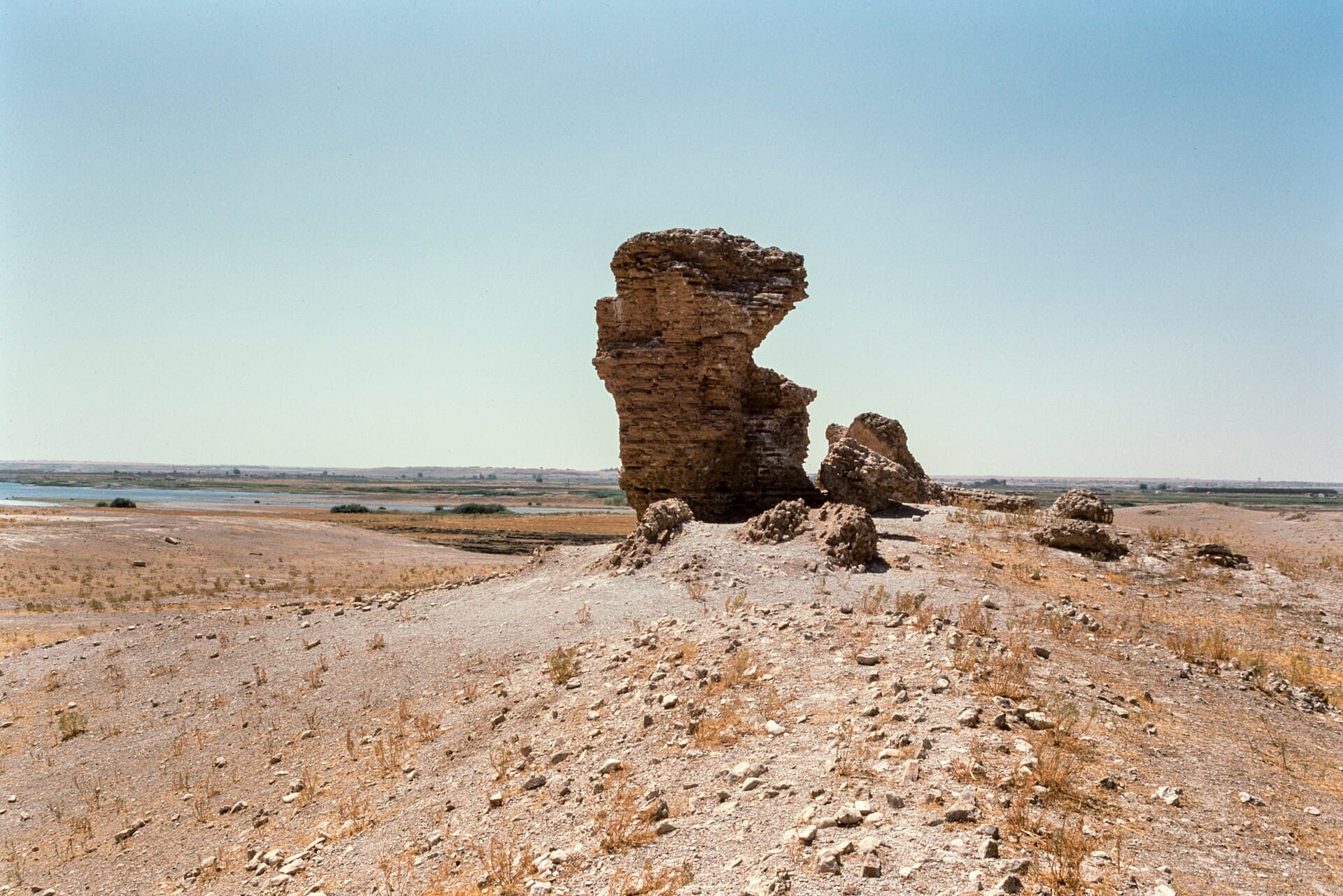
Sura is a Late Roman legionary city on the Euphrates. It lies 25 kilometres west of Raqqa and 35 kilometres north of Resafa, next to the village of al-Mansura. A wall of roughly 1700 by 450 metres enclosed it, and the commander of Legio XVI Flavia Firma, which held the Euphrates frontier, was based here. In photographs taken in 1996 the site is a wide, low field of ruins, with free-standing masses of mortar and rubble from the wall rising above it.
Where it is
On the Aleppo-Raqqa road, at a place now called al-Suriyya, in the al-Mansura subdistrict of Tabqa district. Its position makes sense alongside the Euphrates frontier sites on this website: Halabiye and Circesium downstream, Resafa in the desert to the south, and Sura in between.
Why the Romans held it
It may have been one of the Roman posts set up along the Euphrates in the 1st century AD. An inscription from the governorship of Marcus Ulpius Traianus (73/74-77/78) was found at Sura. The city grew in importance in the Late Roman period: according to the Notitia Dignitatum, the commander of Legio XVI Flavia Firma was based at Sura, and the legionary camp lay inside the city. The wall was renewed in the 6th century under the emperor Justinian.
The historian Procopius gives Sura plenty of space in his account of the campaign of Khosrow I, the Persian king. Khosrow marched along the river from Circesium to Zenobia — today’s Halabiye — and from there to Sura. The walls did not hold out even half an hour; Khosrow took the city and burned it. Justinian later had it fortified again.
The bishopric
Sura was a bishopric under Hierapolis (today’s Manbij). At the Council of Chalcedon in 451, the metropolitan Stephanos signed on behalf of Uranios, bishop of Sura. Bishop Marios was removed from office in 518 for siding with the anti-Chalcedonian Jacobites. Sura survives today as a titular see of the Catholic Church.
The link with Tetrapyrgium
About 12500 metres south of Sura, on the road to Resafa, stood the small fort of Tetrapyrgium. The two forts could see each other and were linked by a signalling connection. Its plan and measurements are covered in its own entry.
The illegal digging of 2013-2015
The site was illegally dug in 2013-2015, under ISIS, and photographs of the finds removed from it circulated publicly. The archaeologist Ali Othman claimed to see Old Turkic runic script on these finds and linked them to the Hun raid of 395/396. This is one researcher’s claim and it is disputed, not established fact.
Can you visit today
This could not be confirmed. No current source was found on the state of the surface, whether there is a guard, or access by road. Because of looters’ pits and the risk of unexploded ordnance in the area, the site should not be entered without a local guide. Ask in Raqqa before you go.
What not to miss
From the foot of the wall remains, look north towards the river. In the 1996 photographs the water of the Euphrates shows right behind the standing mass of mortar. That one view explains why the legion held exactly this bank: the river road and the crossing.
Tips
- Ask in Raqqa about the site and the road before you go; current access could not be confirmed
- Keep away from the edges of looters' pits; they are undercut and deep
- Do not climb the standing masses of the wall; the mortar is loose and pieces fall
- Bring water and a hat; nothing on the site gives shade
Transparency
- How this was chosen
- Written by hand; opening hours, entry fee and coordinates are kept as data. A field that is not known for certain is marked as variable rather than guessed.
- Facts checked
- September 2026
- Last updated
- September 15, 2026