The Walls of al-Rafiqa, Raqqa
Of the horseshoe wall al-Mansur built for al-Rafiqa in 772, 2660 metres still stand: brick-faced mudbrick, towers, the north gate, and where to start walking it.
- Opening hours
- Open ground, daylight hours
- Entry
- Free
- Duration
- 60 minutes
- Best time
- Morning; the brick facing reads best in raking light, and at noon the line has no shade
- Period
- Abbasid (772; brick facing under Harun al-Rashid)
- Address
- Al-Rafiqa wall line, Raqqa; Bab Baghdad at its south-eastern end
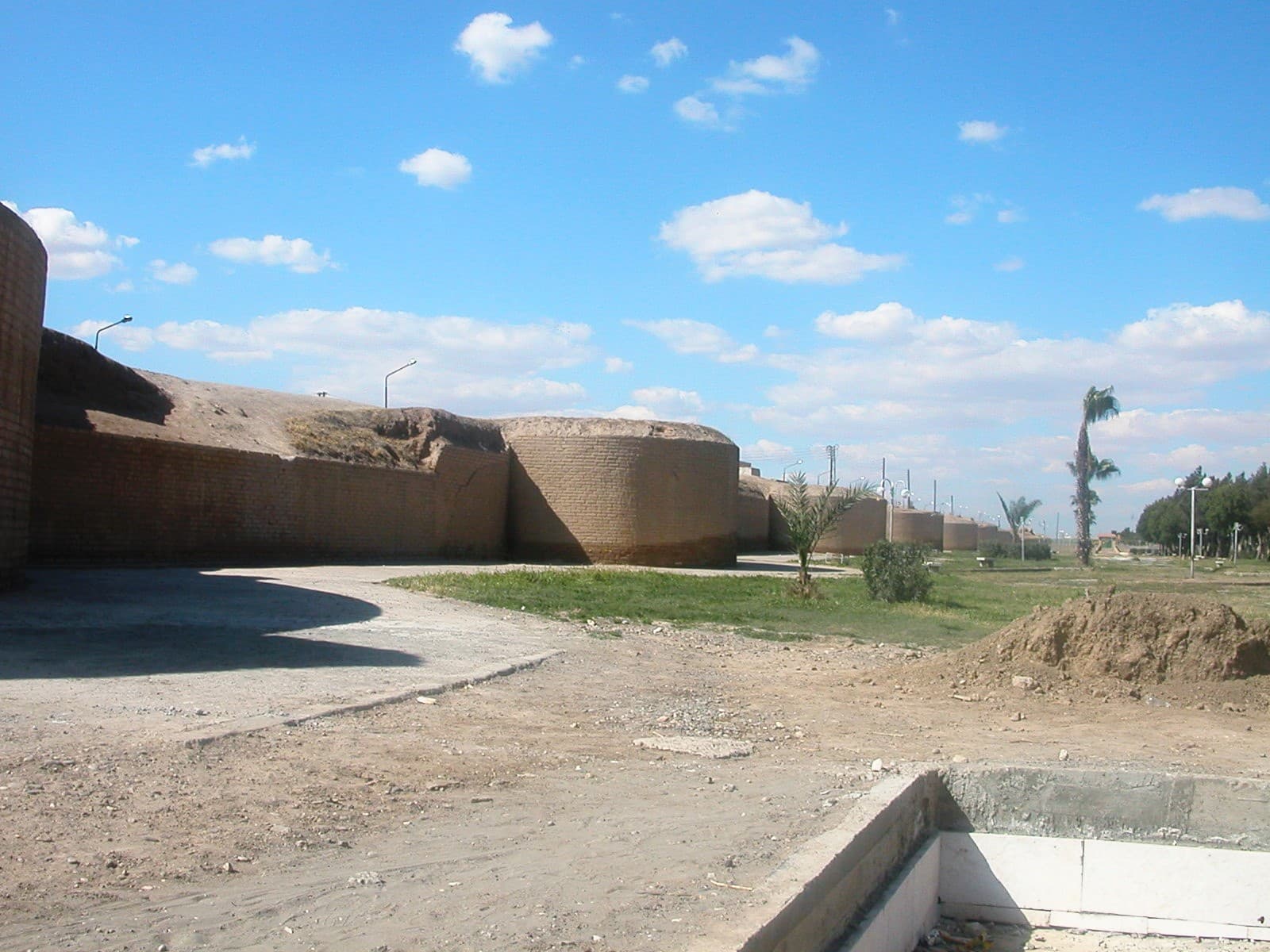
The longest structure still standing in Raqqa is a wall. Al-Mansur, the Abbasid caliph, founded the garrison city of al-Rafiqa in 772, and 2660 metres of its 4580-metre wall survive: a mudbrick core on stone foundations, faced with kiln-fired brick, with semicircular towers set along its front. Walking the line lets you read the plan of Abbasid Raqqa on the ground rather than in a book.
Why the plan is a horseshoe
Al-Mansur had al-Rafiqa designed in 155 AH as a twin of the round city of Baghdad. Its southern side runs straight and parallel to the Euphrates, which turns the circle into a horseshoe. The walls of al-Rafiqa were a metre thicker than Baghdad’s, and its towers were both more numerous and larger; 132 are counted in all. Outside the main wall stood a second wall, four and a half metres thick, and a moat fed from the Euphrates. On the river side there was no double line and no moat.
What survives and what was lost
The outer wall and the moat were bulldozed in the 1970s and 1980s to make room for new building, so the line you see today is the main wall alone. Decay is nothing new: al-Sarakhsi, writing in 884-885, noted that parts of the walls were in ruins. In the 1980s the Abbasid walls were taken into protection together with Bab Baghdad.
Which gates it had
Arabic sources give three gate names: Bab al-Sibal on the east, Bab al-Jinan on the west and Bab Harran on the north. When Harun al-Rashid had the wall faced in brick in 180 AH, he put his name on the east gate. The north gate was excavated in the 1990s and partly rebuilt, and it is regarded as the oldest Abbasid city gate to survive. Its plan is a tower gate with rectangular rooms and a deep entrance recess.
Is Bab Baghdad a gate in the wall
Probably not. An aerial photograph that the British scholar Creswell had taken by the French 39th air squadron shows the moat breaking off at that tower. The brick structure at the south-eastern end of the wall is therefore a separate building, not a gate in the line. Its own story, including why its name may be wrong, has a separate entry.
How to walk it
The wall line lies inside the modern city, and roads cut across it in places. The easiest start is Bab Baghdad at the south-eastern corner: from there the line runs north with its towers in a row. Inside the wall stand the brick minaret of the Great Mosque and the vaulted halls of Qasr al-Banat, both within walking distance. Walking the surviving stretch at an easy pace, stopping at the towers, takes about an hour.
Safety
Rubble and unexploded ordnance remain a reported risk in Raqqa. On the empty plots and dug ground at the foot of the wall, keep to marked paths. Do not climb onto the wall: the mudbrick core cannot carry weight, and the brick facing is crumbling in places.
What not to miss
The north gate. Most visitors stop at Bab Baghdad and turn back. The real Abbasid city gate, documented by excavation, stands at the north of the line, where the sources place Bab Harran.
Tips
- Start at Bab Baghdad and follow the line north
- Do not climb the mudbrick core; the facing is crumbling and the top will not take weight
- Do not skip the north gate; it is the Abbasid city gate documented by excavation
- Keep to marked paths on empty plots and dug ground; unexploded ordnance is a reported risk
Transparency
- How this was chosen
- Written by hand; opening hours, entry fee and coordinates are kept as data. A field that is not known for certain is marked as variable rather than guessed.
- Facts checked
- September 2026
- Last updated
- September 15, 2026