Knafeh
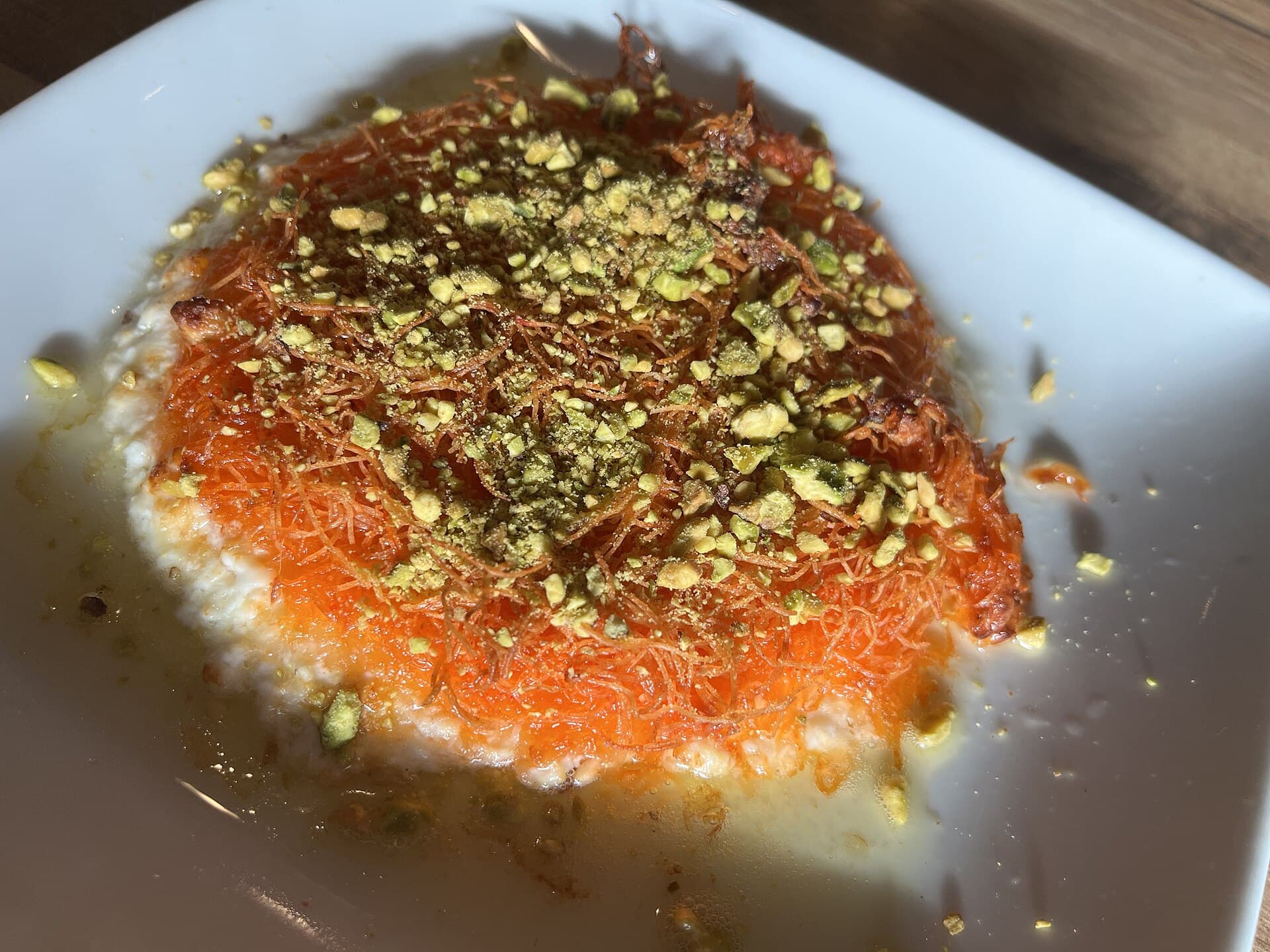
Shredded pastry or semolina dough around desalted cheese, drenched in syrup while hot and topped with crushed pistachio. Cold, it is a different dish.
- Where to eat it
- At the sweet shops of Aleppo, once the morning tray is on the fire. Freshest before midday; the evening comes off what is left of the tray.
- Price
- Variable — a plate and a weighed portion are priced apart, ask at the counter
- When it is eaten
- Between breakfast and midday, while the tray is fresh
Desalted white cheese goes between two layers of pastry, the tray is cooked from underneath over the fire, then flipped and left until the cheese has melted through. Syrup is poured on last and crushed pistachio scattered over it. It is eaten while the cheese still pulls; once cold it stiffens, and there is no way back.
How many doughs there are
You will hear four names. Khishnah is the coarse shredded pastry, na’imah is the semolina dough, muhayara is the two mixed, and mabruma is the twined version. In Aleppo all of them are sold separately, and asking for knafeh can prompt a question about which dough you want.
Why Aleppo
The encyclopedia of Aleppo written by Khayr al-Din al-Asadi, completed in 1971 and published in 1981, describes ten distinct kinds of knafeh, the Nabulsi version among them. The global centre of knafeh today is Nablus in Palestine, but Aleppo’s confectionery tradition has split the dish into branches of its own. There is a Syrian and Lebanese cousin as well: osmalieh, clotted cream between two layers of shredded pastry.
How old it is
Ibn al-Jazari describes a market inspector riding through Mamluk Damascus at night in the 13th century, checking the quality of knafeh and qatayif. The cheese-filled version is much younger. It does not appear in records before the 19th century, and 18th-century Damascene recipes used nuts instead. The earliest known written recipe for the cheese version is in a cookbook printed in Beirut in 1885.
When it is eaten
Not as an after-dinner sweet. The trays go on the fire in the morning and knafeh belongs to the first half of the day; between breakfast and midday is the right hour. In Nablus it is eaten in pita and in Lebanon inside a sesame ka’ak ring, sandwich style — that habit belongs to those places. In Aleppo it arrives on a plate.
Tips
- Ask for it hot; cold knafeh stiffens and reheating does not bring it back
- You can ask which dough: khishnah shredded, na'imah semolina, muhayara mixed
- It is cheese-filled — not a plate for anyone avoiding dairy
- Take plain coffee with it; the syrup is heavy enough on its own
Transparency
- How this was chosen
- Two kinds of record live here: the dish itself, and the place that serves it. Both are chosen and written by hand; ranking is not for sale and there are no sponsored entries. If a price range is not known for certain, it says so. Venues that serve alcohol are not listed on this site at all.
- Facts checked
- August 2026
- Last updated
- September 15, 2026